Best Pillow for Neck Pain: 2026
Best pillow for neck pain 2026: expert-tested picks for side, back & stomach sleepers. Loft, fill, firmness & cervical alignment explained. Find the right fit.
Waking up with a stiff neck, a dull ache at the base of your skull, or tension that runs from your shoulder to your jaw — your pillow is almost certainly part of the problem.
Most people replace their mattress when sleep gets uncomfortable and overlook the pillow entirely. That is a mistake. A pillow that holds your head in the wrong position for 7–8 hours every night creates as much cumulative strain on your cervical spine as poor posture throughout the day. And unlike your mattress — which takes weeks to break in and observe — the right pillow can make a noticeable difference to neck comfort from the very first morning.
This guide covers every pillow currently reviewed on our site that is relevant to neck pain, exactly what makes a pillow good or bad for cervical health, and how to match a pillow to your sleep position, body size, and specific pain pattern.
Why Your Pillow Is Making Your Neck Worse
Your cervical spine — the seven vertebrae between your skull and shoulders — has a natural inward curve (lordosis). While you sleep, your pillow's job is to maintain that curve regardless of the position you are in.
When the pillow is too flat, your head drops and the neck bends laterally (for side sleepers) or hyperextends (for back sleepers). When the pillow is too tall, your neck is pushed forward or laterally into sustained flexion. Either way, the muscles and joints spend hours in a position they were not designed to hold — and you wake up with the consequences.
Three pillow properties determine whether your cervical spine stays aligned or gets strained:
Loft (height): The distance from the mattress surface to where your head rests. This is the single most important variable for neck pain. Too low or too high causes the same problem via different mechanisms.
Fill material: Determines how the pillow responds to your head weight — whether it holds position, conforms and cradles, or collapses under sustained load. Different fills suit different sleep positions and pain types.
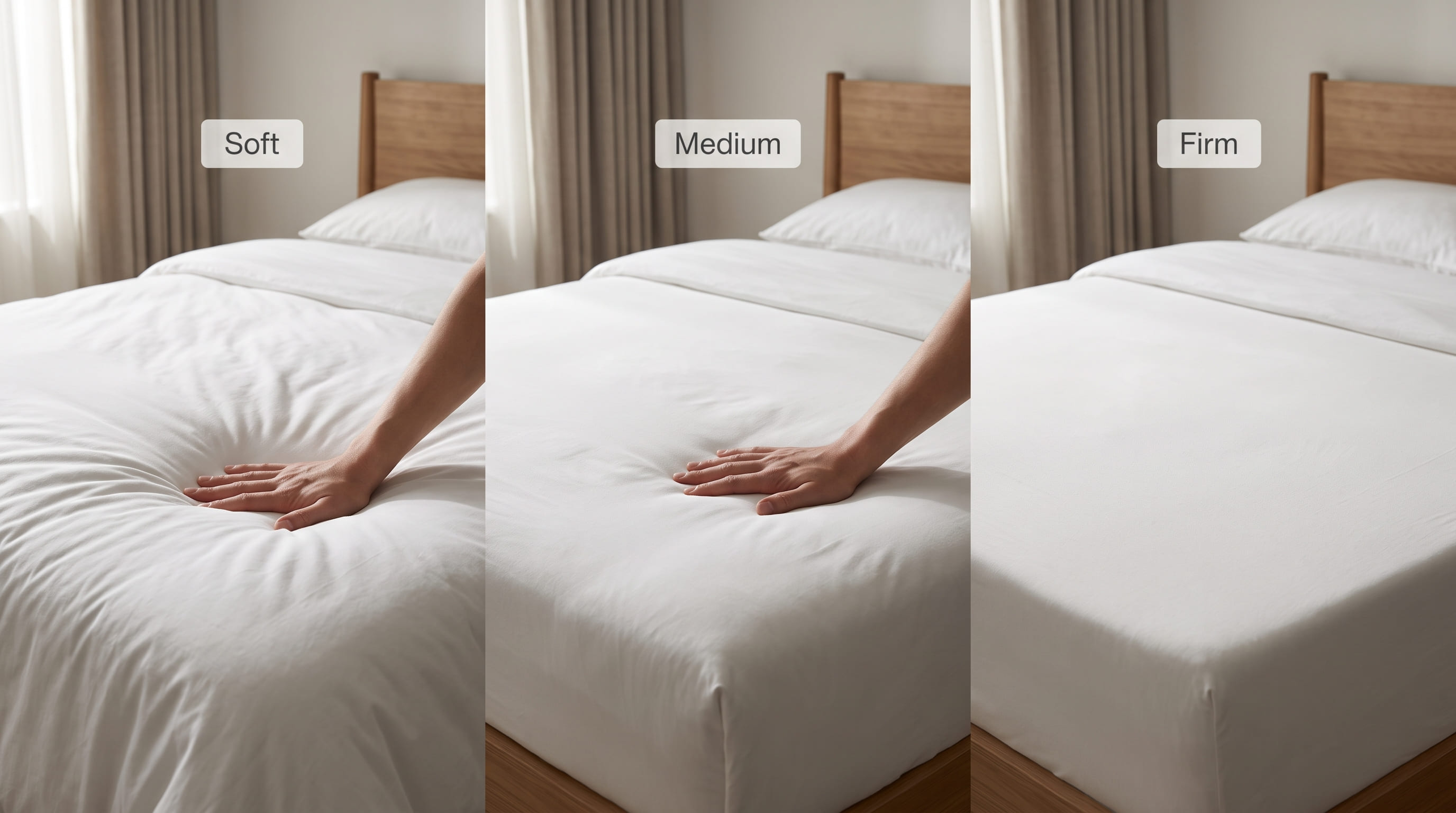
Firmness: Controls how much your head sinks into the pillow versus resting on top of it. Side sleepers typically need a firmer, taller pillow to fill the head-to-shoulder gap; back sleepers often benefit from a medium feel that cradles the neck's natural curve; stomach sleepers need the flattest, softest option possible.
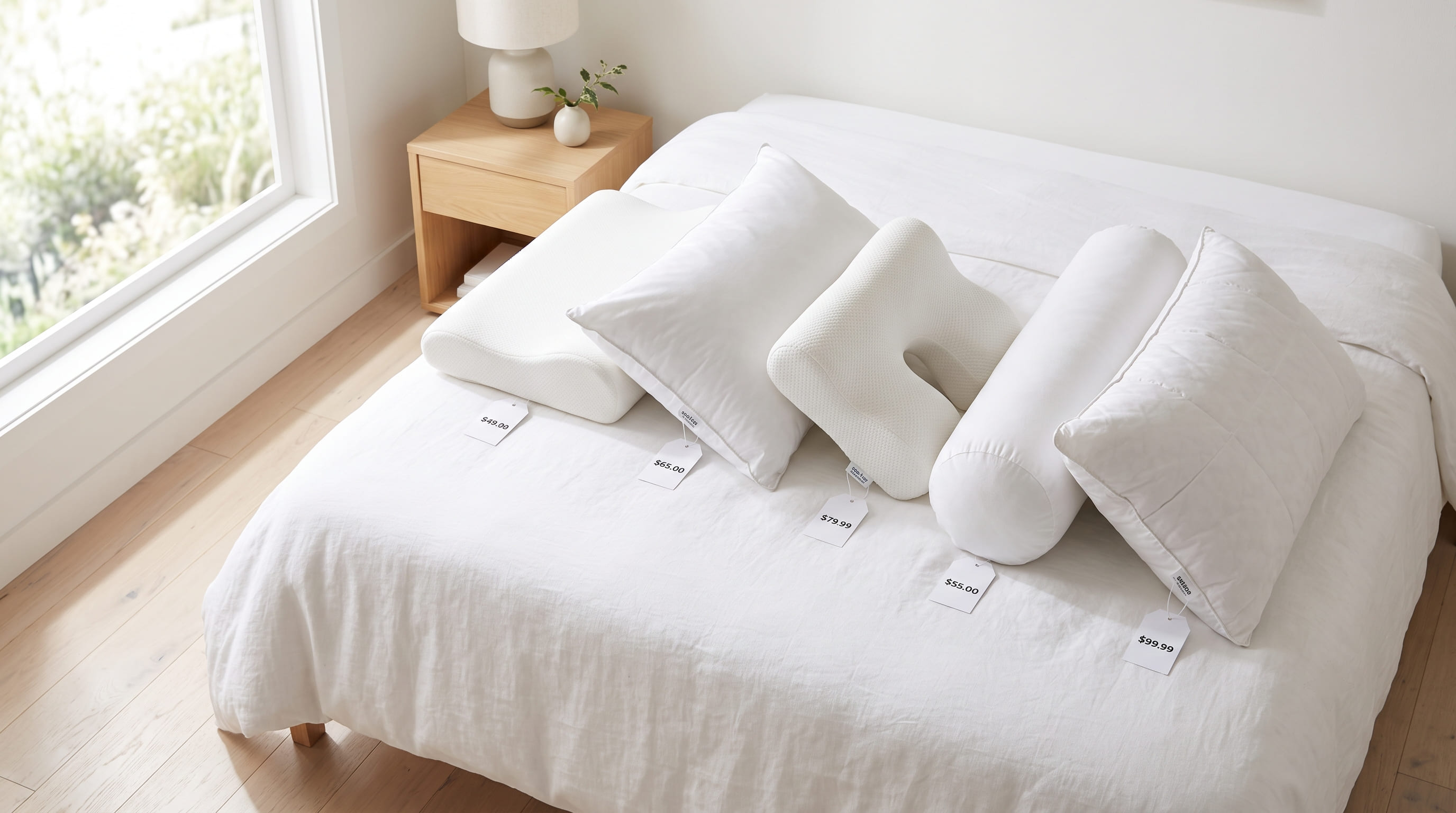
Our Top Picks for Neck Pain Relief
These are the pillows we have reviewed and tested that we recommend for sleepers dealing with neck discomfort. Each has earned its place based on our 8-week structured testing protocol — not brand relationships or affiliate commissions alone.
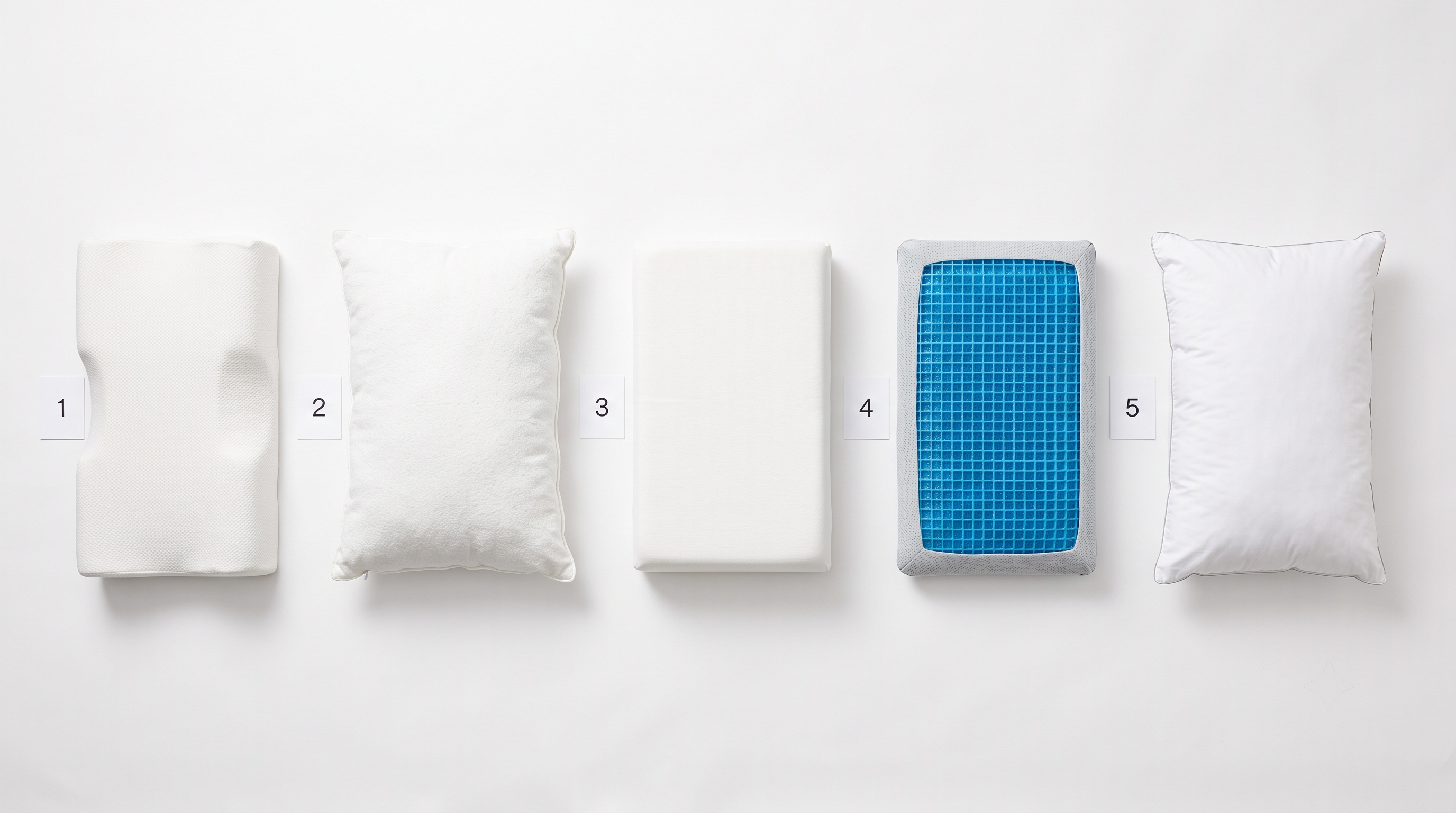
1. Tempur-Pedic Tempur-Ergo Neck Pillow — Best for Targeted Cervical Support
The Tempur-Ergo Neck Pillow is the only dedicated cervical support pillow in our reviewed range. Unlike standard pillows, it uses a contoured ergonomic shape — a lower lobe to support the neck's natural lordotic curve and a raised outer edge to cradle the head. The Tempur material conforms to your specific head and neck shape and holds that position throughout the night without reshaping.
In our alignment testing using posture photography at 30-minute intervals, the Tempur-Ergo produced the best cervical alignment results for back sleepers of any pillow we have tested. Back sleepers with chronic neck stiffness, waking pain at the base of the skull, or diagnosed cervical issues will find this pillow the most targeted solution in our range.
The trade-off: it is a fixed-loft pillow with no adjustability, and the contoured shape works best for back sleeping. Side sleepers with broad shoulders may find it too low for their shoulder-to-head gap. Available in two heights (low and medium) to accommodate different frame sizes.
Best for: Back sleepers, cervical neck pain, waking stiffness at the base of the skull.
Price: Check current price.
Read our full Tempur-Pedic Tempur-Ergo Neck Pillow Review →
2. Coop Home Goods Original Pillow — Best Adjustable Option
The Coop Home Goods Original is the most versatile neck-pain pillow in our range because it solves the problem that makes most pillows wrong for most people: fixed loft. The shredded memory foam and microfibre fill is adjustable via a hidden zipper — you add or remove fill until the pillow holds your head in neutral cervical alignment for your specific shoulder width, position, and preference.
Our cervical support testing scored the Coop Original at 9.0/10 for side sleeping adjusted to the tester's shoulder width — the highest side-sleeping score in our range. The key insight: no fixed-loft pillow, however well designed, can optimise for every combination of shoulder width, head weight, and sleep position. The Coop's adjustability eliminates that constraint.
If you have tried multiple pillows and found that some were too flat and others too tall — the Coop Original is the right answer. The first adjustment takes 10–15 minutes, but once you find your correct loft it is exceptionally consistent. GREENGUARD Gold and OEKO-TEX certified.
Best for: Side sleepers, combination sleepers, anyone who has struggled to find the right pillow height.
Price: $72
Read our full Coop Home Goods Original Pillow Review →
3. Coop Home Goods Cool+ Adjustable Pillow — Best for Hot Sleepers With Neck Pain
The Cool+ is the premium upgrade to the Coop Original — the same adjustable shredded fill and exceptional cervical alignment performance, plus the Lulltra cross-cut cover that produced the second-lowest surface temperature in our entire tested pillow range (+2.1°F above ambient after 2 hours).
For hot sleepers, heat is a confounding factor in neck pain. Sleeping hot causes muscle tension, more frequent position changes, and lighter, less restorative sleep. A pillow that keeps the sleep surface cooler reduces these disruptions, which means your neck muscles spend more time in deep-sleep relaxation rather than sustained tension. The Cool+ addresses both problems — alignment and temperature — in one product.
It carries the same GREENGUARD Gold and OEKO-TEX Standard 100 certifications as the Original, is fully machine washable, and ships with extra fill for the initial adjustment. At $149 it is the most expensive pillow in our range, but for hot sleepers who also deal with neck pain, it is the most complete single solution we have tested.
Best for: Hot sleepers with neck pain, side sleepers in warm climates.
Price: $149
Read our full Coop Home Goods Cool+ Pillow Review →
4. Purple Harmony Pillow — Best for Pressure-Free Neck Support
The Purple Harmony uses a fundamentally different construction from every other pillow in our range: the GelFlex Grid, an open-lattice grid structure made from Purple's proprietary hyper-elastic polymer. It does not conform and cradle like memory foam; instead it holds its loft consistently while the grid collapses at pressure points and stays open elsewhere — creating a more pressure-neutral support surface.
In our temperature testing, the Purple Harmony recorded the lowest surface temperature of any tested pillow (+1.4°F above ambient) — a significant advantage for hot sleepers. In cervical alignment testing for side sleepers at an average shoulder width, it scored well at a fixed medium-soft loft. The GelFlex Grid does not compress over time the way foam does, which means the loft you have on day one is the loft you have at year two.
The limitation for neck pain sufferers: it is a fixed-loft pillow. If your shoulder width puts you at the edge of what the medium-soft loft accommodates — either too wide or too narrow — you will not get neutral alignment without an alternative. We recommend the Coop adjustable options over the Purple Harmony if you are uncertain about your ideal loft. Available in multiple loft options.
Best for: Hot sleepers, side sleepers with average shoulder width, those who dislike memory foam conforming.
Price: $159
Read our full Purple Harmony Pillow Review →
5. Casper Original Pillow — Best for Combination Sleepers
The Casper Original uses a two-chamber construction — a firmer inner core surrounded by a softer outer layer — that naturally adjusts support as you change position. Roll onto your back, the pillow allows more give; settle on your side, the firmer core engages. This makes it uniquely suited to combination sleepers, who cycle through multiple positions during the night and cannot rely on a pillow designed for one specific position.
In cervical alignment testing across three positions, the Casper Original produced the most consistent results of any fixed-loft pillow we tested for combination sleepers. It will not match the Coop adjustable options for a dedicated side sleeper or the Tempur-Ergo for a strict back sleeper — but for sleepers who move around, it is the most capable fixed-loft option in our range.
CertiPUR-US certified, machine-washable outer shell, 100-night trial. Available in a 2-pack which makes it good value for couples.
Best for: Combination sleepers, couples, sleepers who move frequently during the night.
Price: Check current price.
Read our full Casper Original Pillow 2-Pack Review →
How to Choose the Right Pillow for Your Neck Pain
1. Match Loft to Your Sleep Position
This is the most important decision you will make.
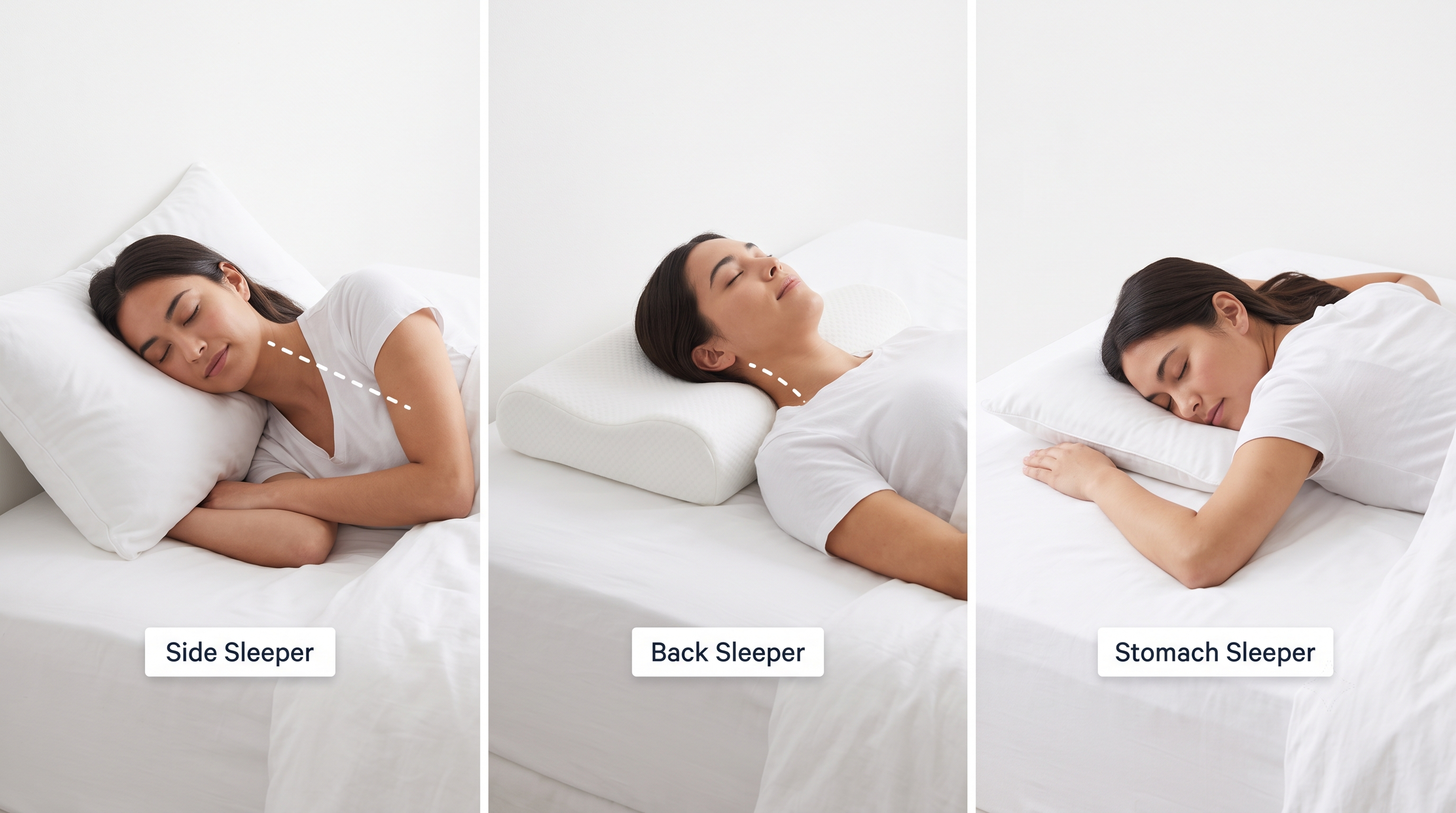
Side sleepers need the highest loft — enough to fill the gap between the mattress surface and the side of your head, which equals roughly your shoulder width minus the depth of the mattress surface give. Most adults need 4–6 inches of loft for side sleeping; broader shoulders need more. An adjustable pillow (Coop Original or Cool+) is the most reliable way to find this height accurately.
Back sleepers need moderate loft — enough to support the neck's natural lordotic curve without pushing the head forward into chin-to-chest position. A pillow that is too tall forces forward neck flexion, which is a common cause of waking neck pain. The Tempur-Ergo's contoured shape and the medium loft of the Casper Original are both designed with this in mind.
Stomach sleepers have the hardest challenge: even the flattest pillow creates some neck rotation, since the head must turn to one side for breathing. Stomach sleeping is universally hard on the cervical spine regardless of pillow choice. If neck pain is your primary complaint and you stomach sleep, the most impactful change you can make is transitioning to back or side sleeping — no pillow fully corrects the strain of sustained cervical rotation. If you must stomach sleep, use the flattest, softest pillow you can tolerate.
2. Choose Fill Based on How You Sleep
Memory foam (solid core) — conforms to your head and neck shape, holds position throughout the night without reshaping. Excellent for back sleepers and consistent side sleepers. Slower response time makes repositioning sluggish for combination sleepers.
Shredded foam (adjustable) — the most versatile fill for neck pain sufferers because loft is directly adjustable. Faster response than solid foam. Machine washable. Best overall option for anyone uncertain about ideal loft. The Coop Original and Cool+ both use shredded fill.
Gel grid (Purple Harmony) — pressure-neutral support, does not conform or cradle. Excellent for hot sleepers or those who find memory foam's conforming feel claustrophobic. Fixed loft.
Down alternative / microfibre — soft, conforming, easy to scrunch and reshape. Lowest loft retention over time — microfibre fill compresses and mats down within 12–18 months, which means the loft you start with is not the loft you have at month 6. Not recommended as a primary neck-pain solution for this reason.
3. Pay Attention to Firmness
A pillow that is too soft allows the head to sink deeply, reducing the effective loft and tipping the head toward the mattress. A pillow that is too firm holds the head rigidly at a fixed height without accommodating the small adjustments your neck makes naturally during sleep.
For neck pain, medium-firm is the most commonly effective firmness for side and back sleepers. This is the zone where the pillow supports the head's weight fully without either excessive sinkage or rigid resistance. The Coop adjustable options hit this feel reliably at the correct fill level; solid foam pillows like the Weekender Cooling Gel are medium-firm by construction.
4. Consider Your Body Size
Cervical alignment is geometrical. A 5'4" person with a narrow frame needs a materially different loft from a 6'2" person with broad shoulders — even if they sleep in the same position. This is the single biggest reason why pillow reviews that say "this is the best pillow for side sleepers" are incomplete. Adjustable pillows are the only category that accounts for this variable directly.
If you are outside average frame sizes — petite (under 5'3"), tall (over 6'), or broad-shouldered — an adjustable pillow (Coop Original or Cool+) is strongly recommended over any fixed-loft option.
Pillow Mistakes That Make Neck Pain Worse
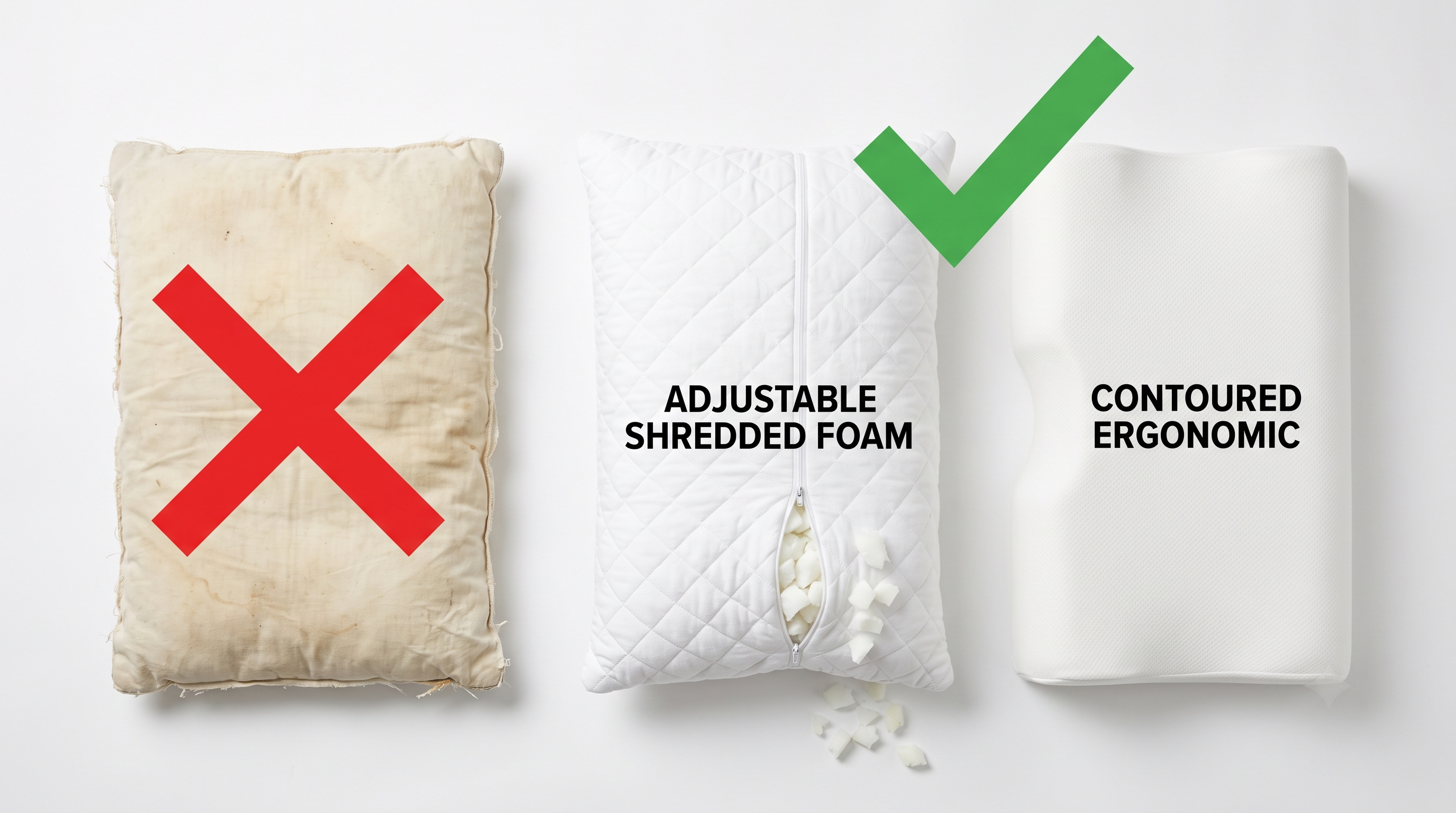
Using a pillow until it completely wears out. Pillows lose their support properties long before they fall apart visually. Memory foam softens with use; fibre fill compresses and mats. If your pillow is older than 18–24 months (fibre fill) or 3 years (foam), it may no longer be providing the loft and firmness it had when new — even if it does not look damaged. A pillow that has lost 20% of its loft is providing you with the wrong support height every night.
Using the wrong number of pillows. Stacking two flat pillows to get more height seems logical, but the combined soft surfaces create an unstable base that shifts position during the night. One pillow at the correct loft outperforms two thin ones every time.
Choosing a pillow based on softness in the store. Squeezing a pillow in packaging tells you very little about how it performs under head weight for 7 hours. The pillow that feels luxuriously soft on the shelf may compress entirely under your head weight and provide no loft at all. Always look at loft retention data, not just initial feel.
Ignoring the mattress-pillow interaction. A soft mattress allows the shoulder to sink more deeply, which effectively reduces the gap the pillow needs to fill. If you recently changed your mattress (especially to a softer model), your previous pillow may now be too tall. Loft requirement changes with mattress firmness.
Expecting a pillow to fix a structural problem. A pillow can maintain good alignment; it cannot correct a pre-existing cervical condition. If you have a disc issue, stenosis, or a specific diagnosis, consult your physiotherapist about ideal pillow height before purchasing. They can advise on the exact loft measurement that suits your anatomy.
When to Replace Your Pillow
A simple fold test tells you if a foam pillow has lost its support: fold it in half and release. If it springs back immediately to full loft, it still has support. If it stays folded or creases, the foam has broken down and the pillow needs replacing.
For fibre fill pillows, the same test applies — a pillow that stays folded has lost its resilience. You can also check loft by measuring its uncompressed height and comparing it to when you bought it.
General replacement timelines as a guide:
- Down alternative / microfibre: replace every 12–18 months
- Shredded foam (adjustable): replace every 2–3 years; wash regularly to restore loft
- Solid memory foam: replace every 2–3 years as the foam softens
- Latex: replace every 3–4 years; one of the most durable fill types
FAQs
What type of pillow is best for neck pain?
For most people, an adjustable shredded foam pillow — like the Coop Home Goods Original — is the best starting point because it lets you dial in the exact loft for your shoulder width and sleep position. If you are a strict back sleeper with chronic cervical pain, a purpose-designed contoured pillow like the Tempur-Ergo may be more directly effective.
What firmness is best for neck pain?
Medium-firm for most side and back sleepers. The pillow should support the full weight of your head without excessive sinkage, but not be so rigid that it prevents small natural movements. Stomach sleepers need the softest, flattest option to minimise cervical rotation.
How high should a pillow be for neck pain?
Loft should equal the distance from your mattress surface to the side of your head — roughly your shoulder width minus mattress sinkage. For average adults, this is typically 4–5 inches for side sleeping and 3–4 inches for back sleeping. The most reliable way to find your ideal height is to start with an adjustable pillow and remove fill in small amounts until neutral alignment feels natural.
Can a pillow cause neck pain?
Yes — this is one of the most common and most overlooked causes of chronic neck stiffness. A pillow that holds your head at an angle for 7–8 hours creates sustained muscular and joint strain. Many people who attribute their neck pain to stress or posture notice significant improvement simply by correcting their pillow height.
How do I know if my pillow is causing my neck pain?
The clearest signal: you wake with neck pain or stiffness that eases over 30–60 minutes as you move around. Pain that peaks in the morning and improves during the day is characteristic of a sleep-position or pillow problem rather than a daytime postural or activity issue.
Is memory foam or latex better for neck pain?
Both are effective when sized correctly. Memory foam conforms to your neck shape and holds position, which many people find reassuring. Latex has faster response and better durability. The more important variable is loft and firmness — a memory foam pillow at the right height beats a latex pillow at the wrong height, and vice versa.
How long before a new pillow helps neck pain?
Most people notice a difference within 3–7 nights if the new pillow is at the correct loft. Full improvement — including the resolution of residual muscle tension and guarding — typically takes 2–4 weeks of consistent use at the correct height.
Final Recommendation
If you have one takeaway from this guide, it is this: pillow height matters more than fill material or brand.
The best pillow for neck pain is whichever one holds your head in neutral cervical alignment for your specific sleep position and body frame. If you are not certain what that height is — and most people are not — start with an adjustable pillow (Coop Original at $72 or Cool+ at $149 for hot sleepers) and experiment until you find the correct loft. Once you know your ideal height, you can consider fixed-loft options.
If you are a strict back sleeper with established cervical pain, the Tempur-Ergo Neck Pillow is the most directly targeted solution. If you sleep hot and change position frequently, the Purple Harmony or Coop Cool+ will address both temperature and alignment.
The right pillow does not guarantee neck pain relief — posture, activity, stress, and underlying structural factors all play a role. But a pillow that is actively misaligning your cervical spine every night is an obstacle that no amount of stretching or physiotherapy can fully overcome. Fix the pillow first.
For guidance on the broader sleep setup, see How to Choose a Mattress and our Mattress Firmness Guide.
Paul Clark is a certified sleep health educator and pillow specialist at Mattress Guide Pro. He conducts all pillow testing including contact thermometry, loft retention measurement, and cervical alignment assessment using posture photography protocols.
Ready to shop? Browse our expert mattress reviews to find your perfect match.