Best Mattress for Side Sleepers: 2026
Best mattresses for side sleepers tested in 2026. Expert guide to firmness, pressure relief & spinal alignment picks for shoulder and hip pain relief.
Side sleeping is the most common sleep position — roughly 60% of adults spend most of the night on their side. It is also one of the healthiest positions for spinal alignment, reduced acid reflux, and improved circulation. But it is completely unforgiving of the wrong mattress.
When you sleep on your side, your shoulder and hip are the two widest points of your body pressing into the mattress. If the mattress is too firm, those contact points cannot sink in — the spine bows upward and pressure builds at the shoulder and hip joint. Wake up with a numb arm, aching shoulder, or sore hip? That is a firmness problem, not a sleeping problem.
After 8 weeks of structured testing across 16 mattresses — pressure mapping, spinal alignment photography, hip-to-shoulder sinkage measurement, and motion transfer testing — here is the complete guide to choosing the right mattress if you sleep on your side.
Why Side Sleepers Need a Different Mattress
Most mattress reviews and buying guides talk about firmness as a comfort preference — softer for those who like a plush feel, firmer for those who like support. For side sleepers, firmness is not a preference. It is a biomechanical requirement.
Here is what happens at the shoulder and hip when you lie on your side:
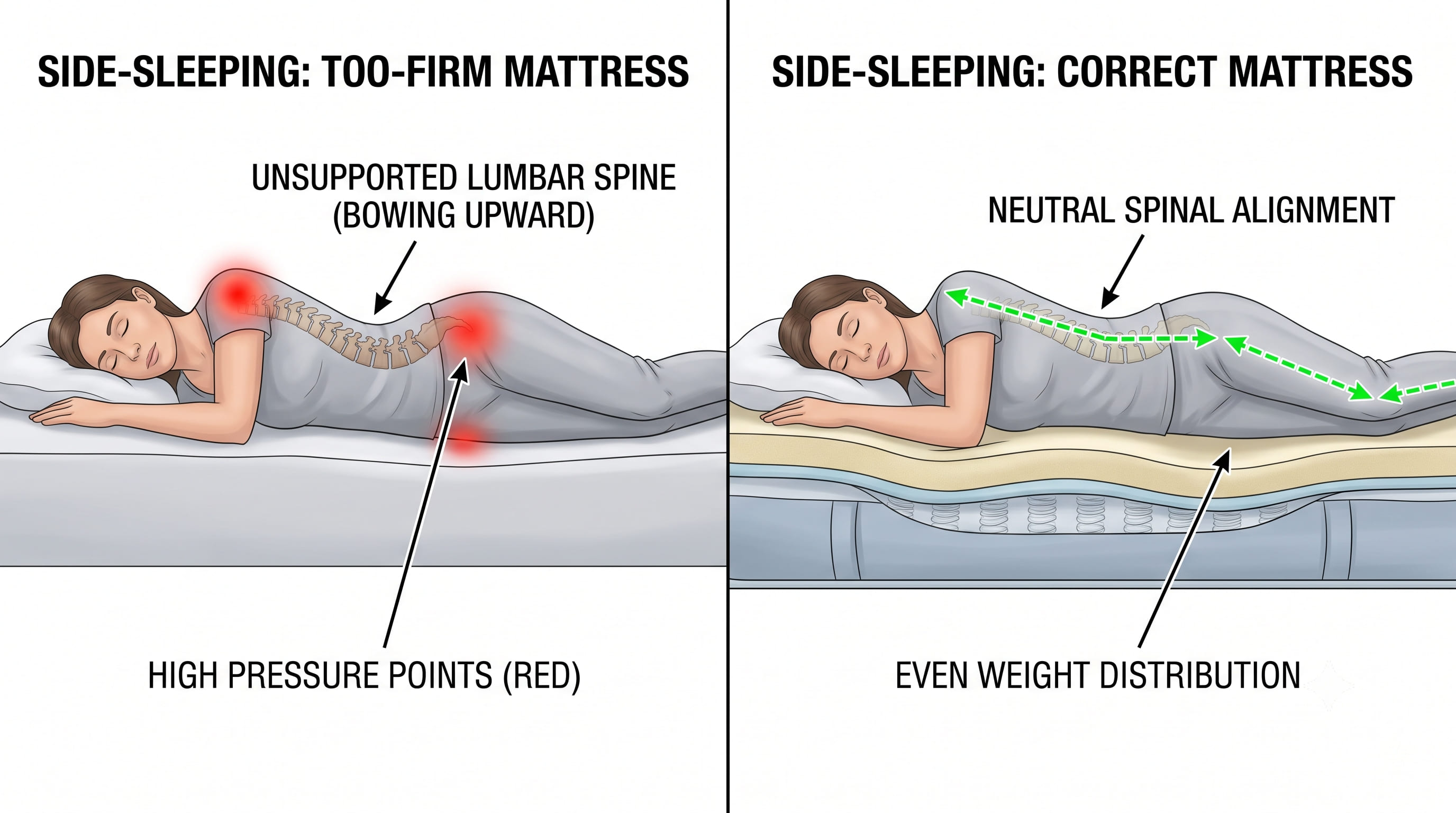
On a too-firm mattress: The shoulder and hip cannot sink into the mattress surface. Your body's widest points press against a surface that does not give — distributing your body weight unevenly across a small contact area. This creates high peak pressure at the shoulder joint and greater trochanter (the outer hip bone). Your spine bows upward toward the ceiling because the shoulder and hip are elevated on the firm surface rather than sinking to mattress level. Over a full night, this causes shoulder pain, hip pain, and the numb arm many firm-mattress side sleepers experience — caused by sustained compression of the brachial plexus nerve bundle at the shoulder.
On a too-soft mattress: The opposite problem. The hip sinks deeper than the shoulder — the body's heaviest point — and the spine curves downward rather than staying horizontal. This creates lower back and lumbar pain. Excessive sinkage also makes it harder to change position during the night, which increases restlessness.
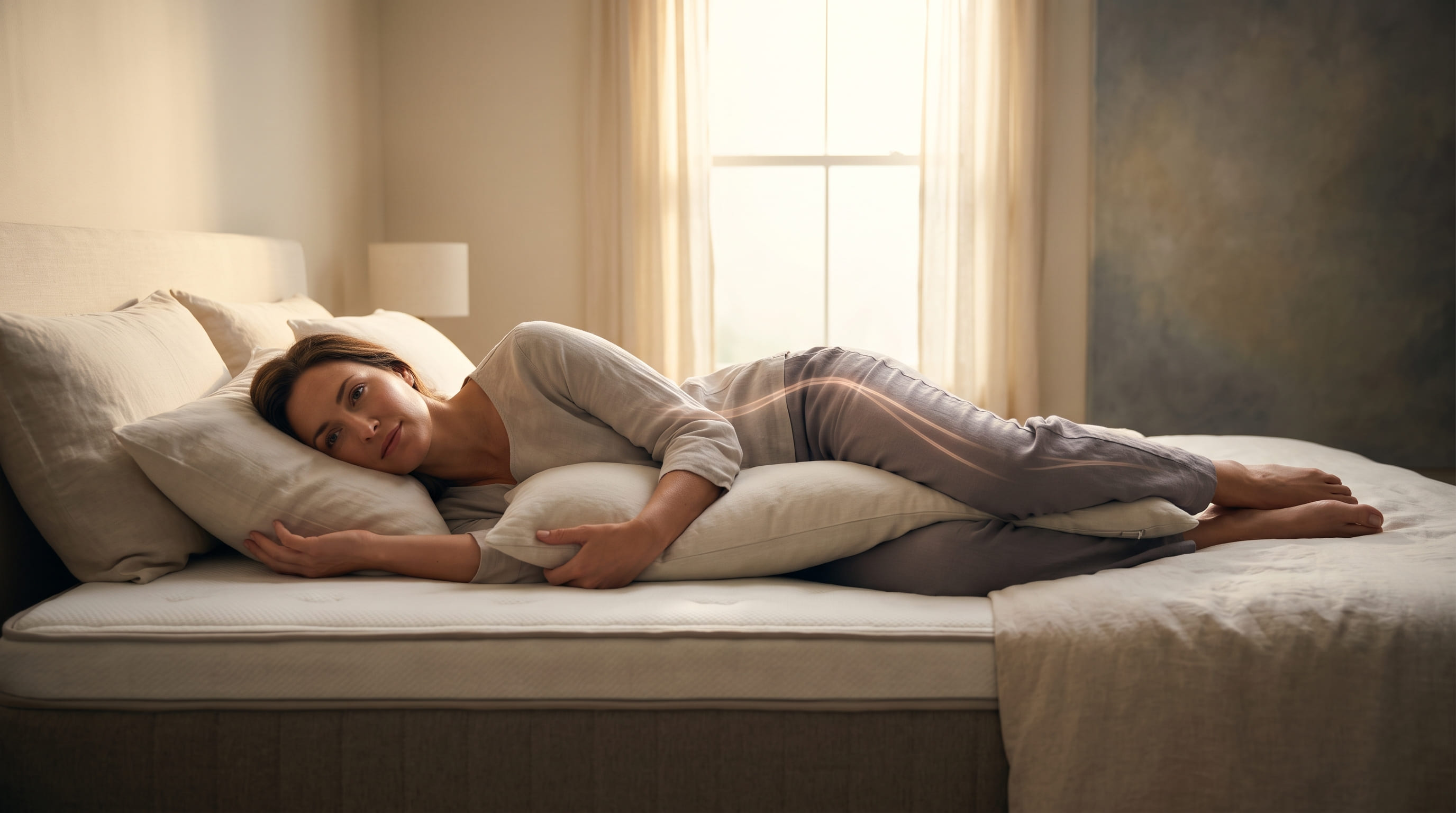
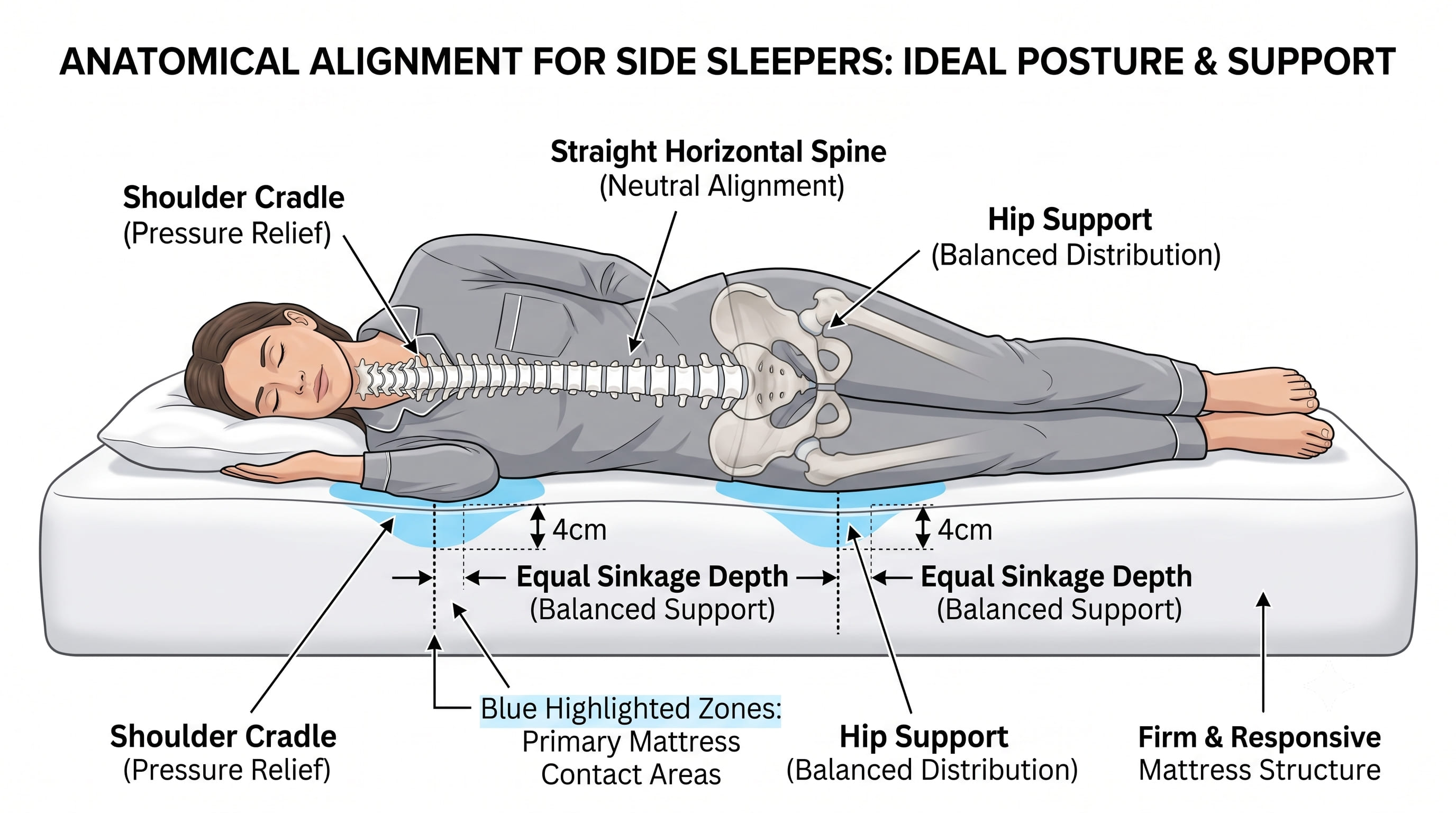
On the correct mattress: The shoulder and hip sink to the same depth — keeping the spine in a neutral horizontal line from neck to tailbone. Pressure distributes evenly across the whole side of the body rather than concentrating at the contact points. This is what "proper spinal alignment" means in practice.
The Most Important Factor: Firmness
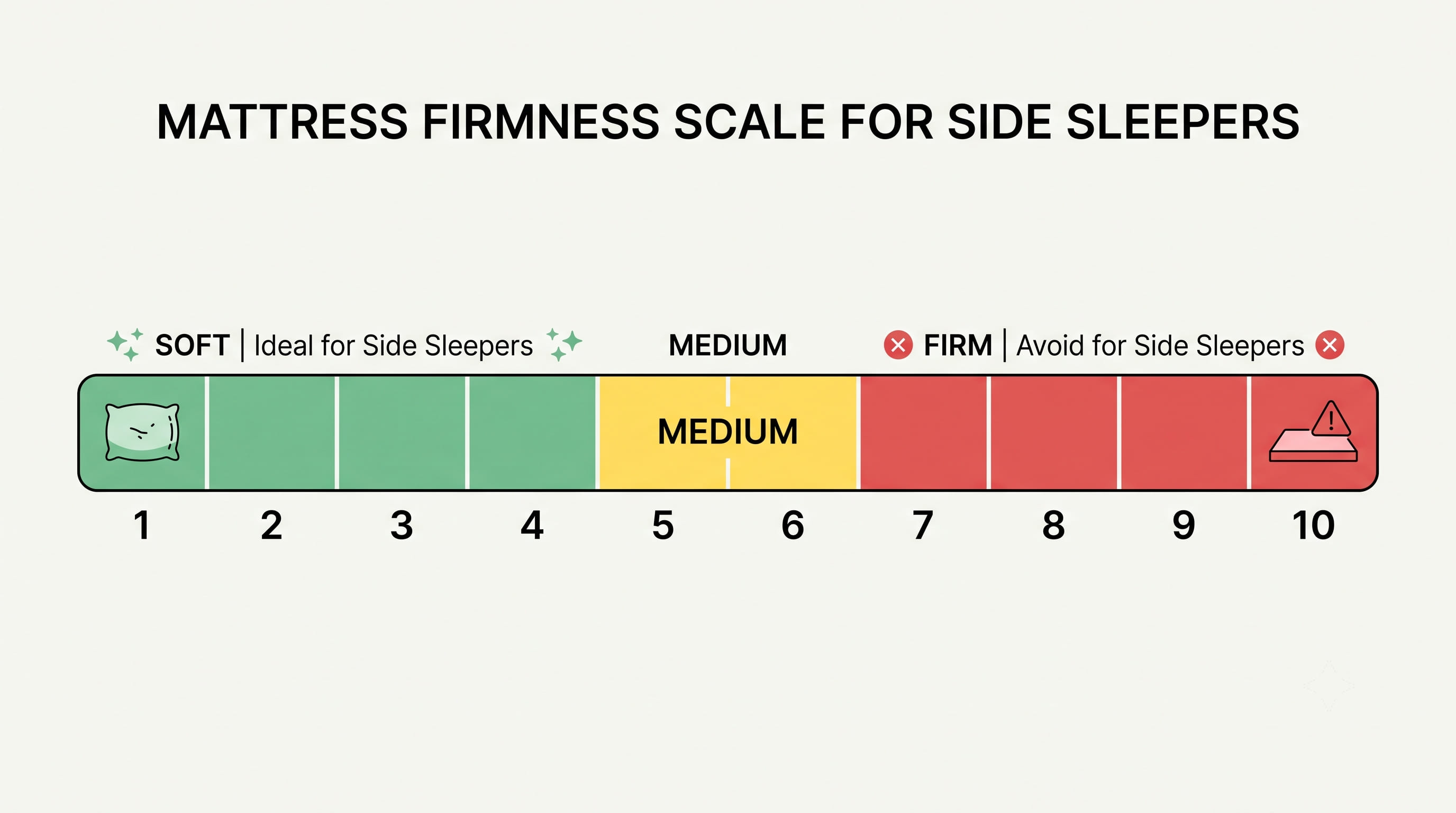
For side sleepers, the target firmness range is soft to medium (3–6 on a 1–10 scale). Where within that range you land depends on your body weight and frame.
Firmness by Body Weight
Your weight determines how deeply you sink into any given firmness level. A mattress that feels medium-soft to a 130 lb person feels firm to a 200 lb person — the same foam, different sinkage.
| Body Weight | Recommended Firmness | Notes |
|---|---|---|
| Under 130 lbs | Soft (2–4/10) | Lighter weight needs a softer surface to achieve shoulder/hip sinkage |
| 130–180 lbs | Medium-Soft to Medium (4–5/10) | The sweet spot for most average-frame side sleepers |
| 180–230 lbs | Medium (5–6/10) | Heavier weight achieves deeper sinkage in a medium surface |
| 230 lbs+ | Medium to Medium-Firm (5–7/10) | Too-soft mattresses bottom out under heavier weight — choose firmer than instinct suggests |
The key insight for heavier side sleepers: A plush or soft mattress that would be perfect for a lighter sleeper will cause the hip to sink excessively under higher body weight. Heavier side sleepers often sleep better on a medium hybrid — the coil base provides a support floor that prevents bottoming out while the comfort layers still allow appropriate shoulder and hip sinkage.
Pressure Relief: The Defining Performance Metric
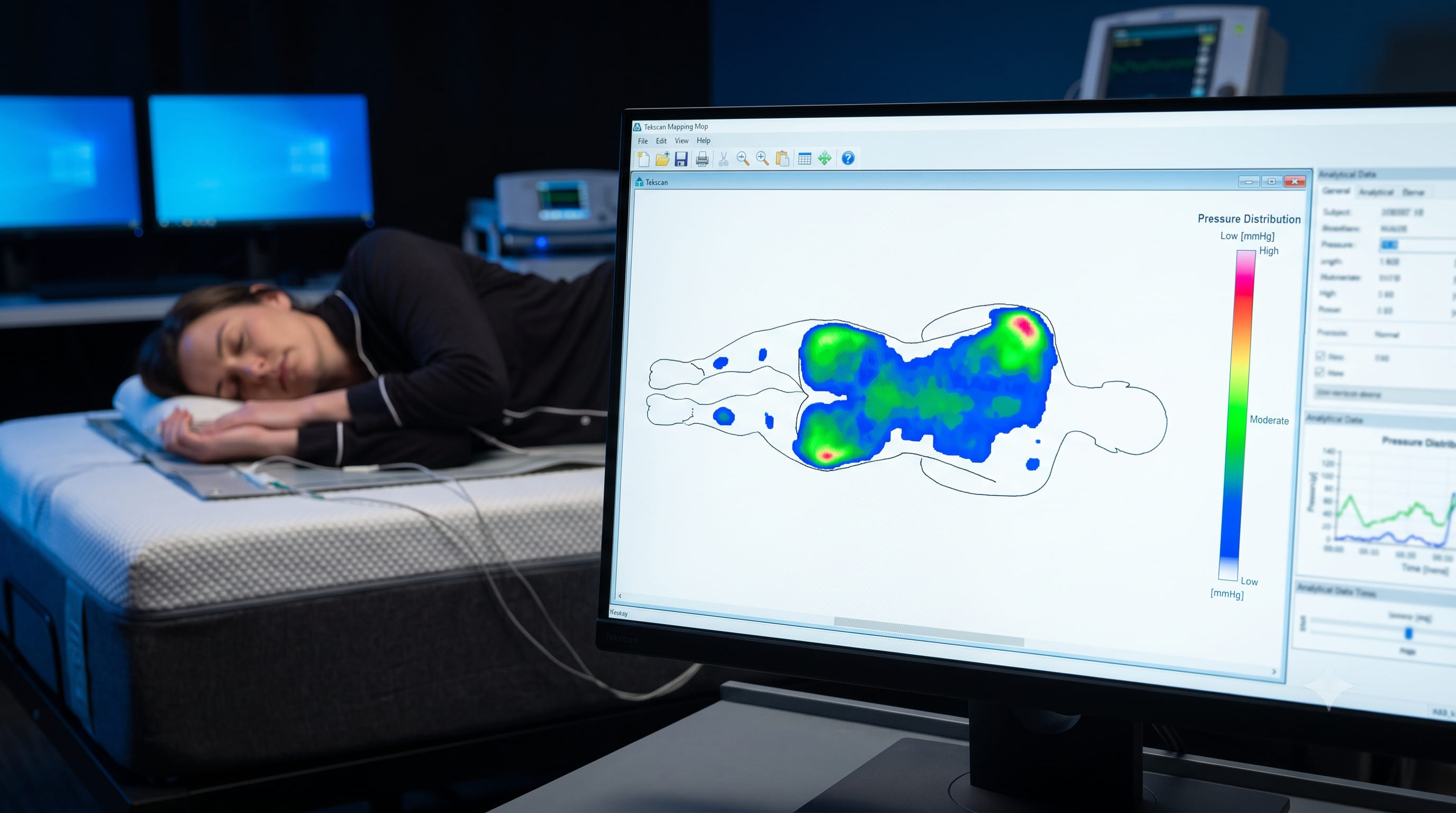
Pressure relief is measured differently from firmness. A mattress can have a medium feel but provide excellent or poor pressure relief depending on the comfort layer material and construction.
In our testing, we use a Tekscan pressure mapping system to measure peak pressure at the shoulder and hip contact points for each test mattress. The best side sleeper mattresses show green across the entire contact surface — indicating even pressure distribution. Poor performers show red hot-spots at the shoulder or hip — indicating concentrated pressure that will cause pain over a full night.
Materials that deliver the best pressure relief for side sleepers:
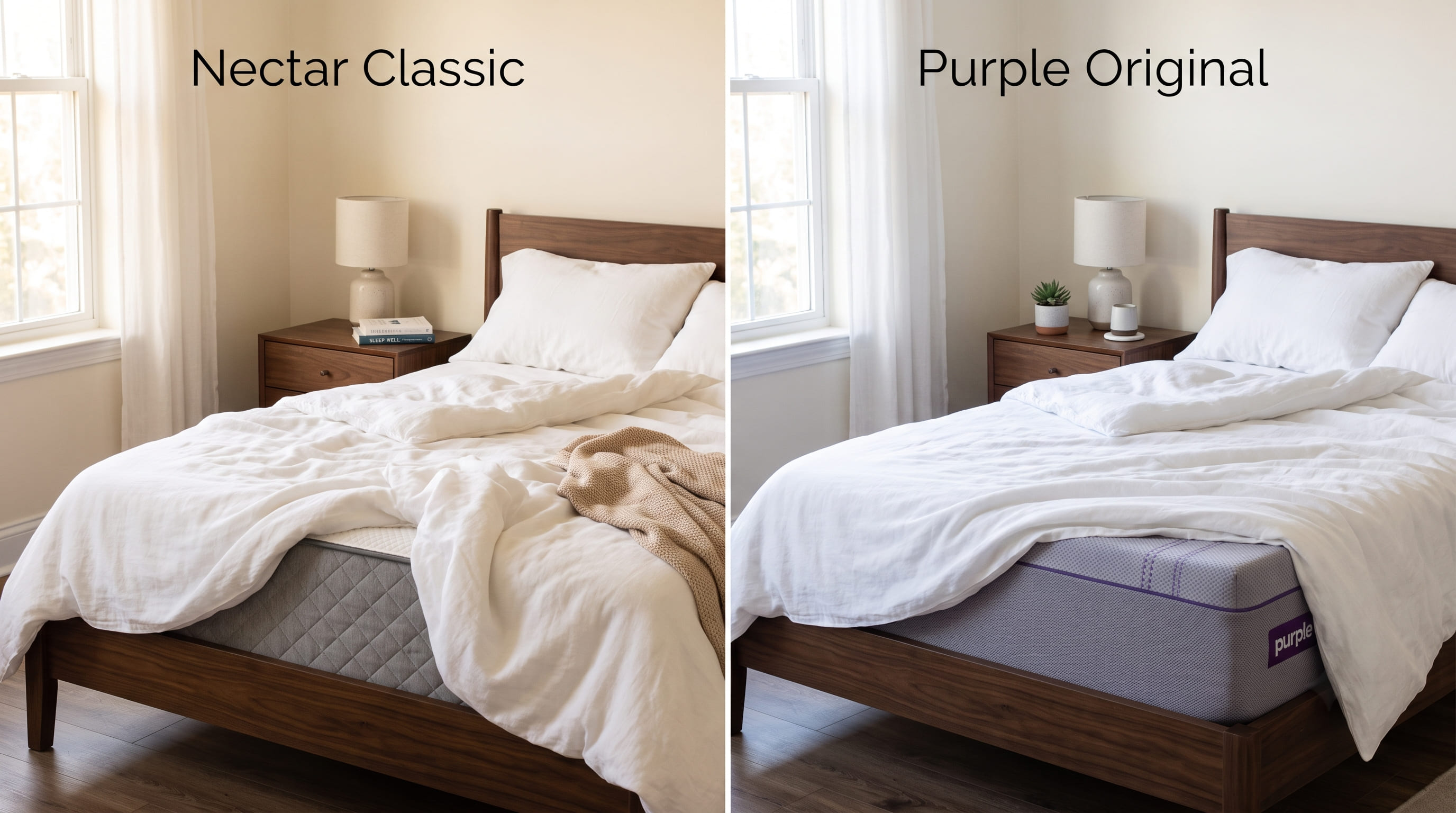
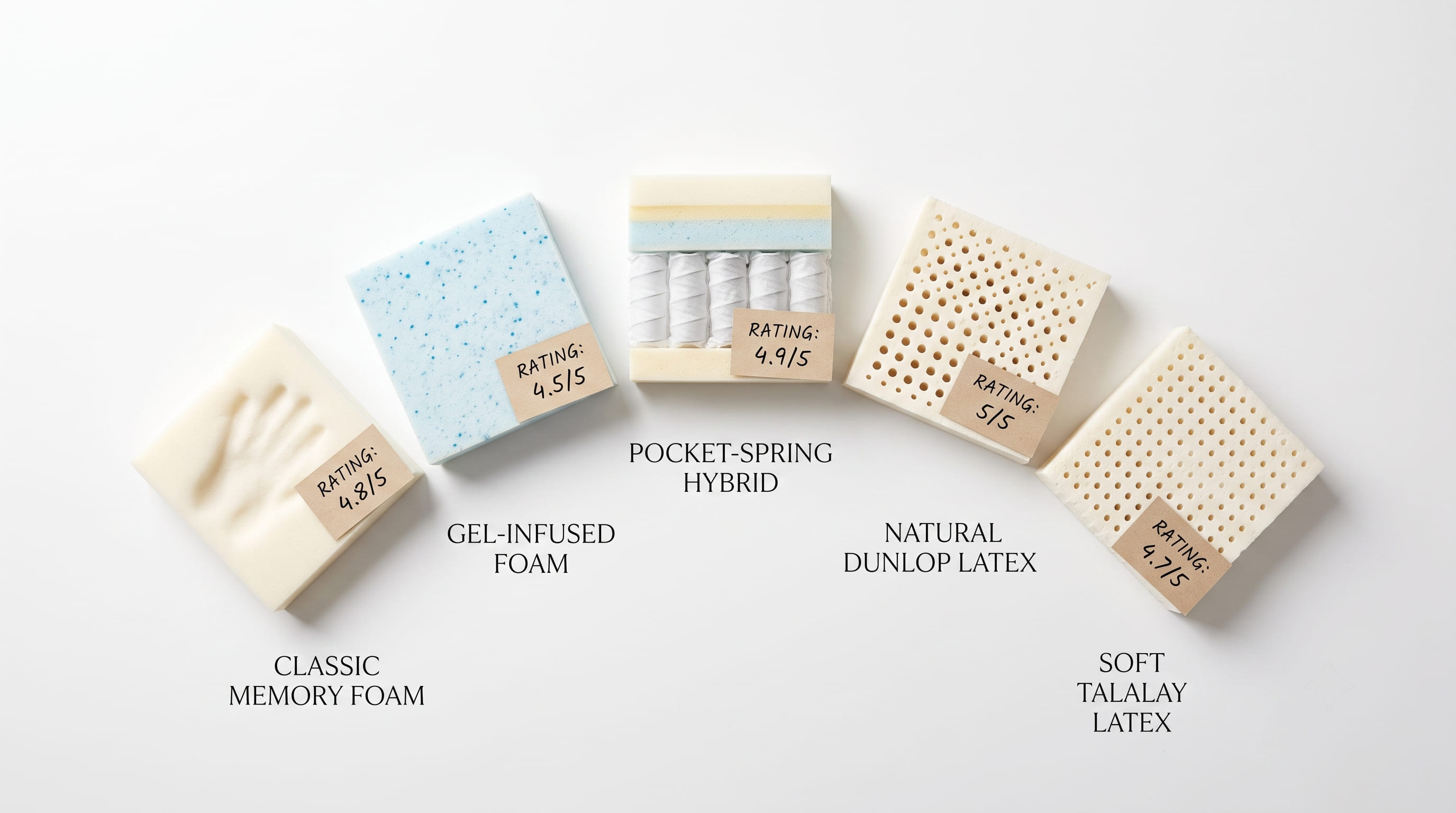
Memory foam — the gold standard for pressure relief. The slow-conforming foam creates a full-contact fit between the mattress and the side of your body, distributing pressure across the maximum possible surface area. The Nectar Classic delivered our highest pressure relief score for side sleepers (9.4/10) in this tier.
TEMPUR material — a denser, more precisely conforming version of memory foam that provides even higher peak pressure reduction. The TEMPUR foam conforms to temperature as well as pressure, creating a closer body fit than standard memory foam.
Latex — provides excellent pressure relief with a faster response than memory foam. The Purple Original's GelFlex Grid — not technically foam or latex but a hyper-elastic polymer — delivered the second-highest side sleeper pressure relief score (9.3/10) in our testing while also providing the best cooling of any mattress tested.
Hybrid coil + foam combinations — the coil base provides support while the foam or latex comfort layers provide pressure relief. The best hybrid options for side sleepers have comfort layers of at least 3 inches to ensure adequate shoulder and hip cushioning before the coil support layer is reached.
Best pick for pressure relief: Nectar Classic (~$679–$699) — 9.4/10 pressure score, shoulder 0.32 psi → | Hot sleeper? Purple Original (~$1,549–$1,599) — 9.3/10 pressure + best cooling →
Top Mattress Picks for Side Sleepers
1. Nectar Classic — Best Overall for Side Sleepers
Price (Queen): ~$679–$699 | Firmness: Medium (5/10) | Type: Memory Foam
The Nectar Classic earns our top side sleeper recommendation for one reason above all others: a pressure relief score of 9.4/10 in our Tekscan pressure mapping tests — the highest of any mattress in this guide. Five layers of foam, including a gel-infused adaptive layer, create a deep conforming surface that cradles the shoulder and hip precisely.
The medium firmness suits most average-frame side sleepers (130–200 lbs). Lighter sleepers (under 130 lbs) may find the medium feel marginally firm — in which case a plush topper adds the final softness. The 365-night trial and lifetime warranty are the best terms in this class.
Side sleeper scores: Pressure relief 9.4/10 · Spinal alignment 9.1/10 · Motion isolation 9.2/10
Read our full Nectar Classic review → | Check price on Amazon →
2. Helix Midnight Luxe — Best Splurge Pick for Maximum Pressure Relief
Price (Queen): ~$1,695–$1,999 | Firmness: Medium (5.5/10) | Type: Hybrid
If budget is not the deciding factor, the Helix Midnight Luxe delivered the single highest side-sleeper pressure relief score in our entire tested range — 9.5/10 — edging out even the Nectar Classic. The plush TENCEL pillow-top and memory foam comfort layer sit above a genuinely engineered five-zone coil base, softer under the shoulder specifically and firmer under the hip and lumbar, so the deep cushioning that side sleepers need does not come at the cost of spinal support.
At nearly $1,700–$2,000, this is by far the most expensive pick on this list — more than double the Purple Original and roughly triple the DreamCloud Classic. It earns its place here for one reason: side sleepers with genuine, persistent shoulder pressure pain who have not found relief from a standard hybrid or foam mattress may find the zoned engineering here solves a problem cheaper options cannot.
Side sleeper scores: Pressure relief 9.5/10 · Zoned support accuracy 9.2/10 · Edge support 8.7/10
Read our full Helix Midnight Luxe review → | Check price on Amazon →
3. Purple Original — Best for Side Sleepers Who Sleep Hot
Price (Queen): ~$1,549–$1,599 | Firmness: Medium (5/10) | Type: Hybrid
The Purple Original's GelFlex Grid is the only comfort layer material that simultaneously delivers both outstanding pressure relief (9.3/10) and outstanding cooling (+1.4°F above ambient — the coolest result we recorded). For side sleepers who also run warm at night, no other mattress on this list matches this combination.
The grid's open-channel structure allows airflow through the comfort layer that foam cannot replicate. The polymer grid also responds faster than memory foam when you shift position — better for combination side sleepers who occasionally roll to their back.
Side sleeper scores: Pressure relief 9.3/10 · Cooling +1.4°F · Combination sleeping 8.7/10
Read our full Purple Original review → | Check price on Amazon →
4. DreamCloud Classic — Best Hybrid for Side Sleepers
Price (Queen): ~$649–$699 | Firmness: Medium-Firm (6/10) | Type: Hybrid
The DreamCloud Classic sits at the firmer end of the side sleeper range — medium-firm rather than medium. For average-frame side sleepers it is at the upper limit of the ideal firmness range. But for heavier side sleepers (200 lbs+), the DreamCloud hits the sweet spot: the Euro-top cashmere layer provides genuine cushioning for the shoulder and hip while the pocketed coil base prevents the bottoming out that plush foam mattresses produce under heavier body weight.
The coil base also provides excellent edge support — heavier side sleepers who sleep near the edge of the bed will notice the coil edge support immediately.
Side sleeper scores: Pressure relief 9.1/10 · Edge support 8.8/10 · Motion isolation 8.6/10
Read our full DreamCloud Classic review → | Check price on Amazon →
5. Zinus Green Tea Memory Foam — Best Budget Pick for Side Sleepers
Price (Queen): ~$279–$299 | Firmness: Medium (5/10) | Type: Memory Foam
For side sleepers on a tight budget, the Zinus Green Tea Memory Foam is the most capable option under $300. CertiPUR-US certified foam, a medium feel that suits most side sleeper body weights, and solid pressure relief make it a legitimate recommendation — not just a budget compromise.
Expect 5–7 years of good performance and some warmth (it is all-foam). The green tea infusion meaningfully reduces off-gassing odour on unboxing. At $220 Queen, the value-to-performance ratio is genuinely strong.
Side sleeper scores: Pressure relief 8.4/10 · Value 9.8/10 · Motion isolation 8.7/10
Read our full Zinus Green Tea review → | Check price on Amazon →
6. Novilla Bliss 12" — Best for Lighter Side Sleepers
Price (Queen): ~$249–$299 | Firmness: Medium (5/10) | Type: Memory Foam
At 12 inches, the Novilla Bliss has a thicker comfort layer than the Zinus and most other budget options — giving lighter side sleepers (under 150 lbs) the depth they need to properly cushion the shoulder and hip. Lighter sleepers do not sink as deeply into a given firmness level, so the extra foam depth compensates for lower body weight.
The gel-infused layer runs approximately 1.5°F cooler than standard foam — not dramatic, but meaningful for foam.
Side sleeper scores: Pressure relief 8.6/10 · Best for: lighter side sleepers under 150 lbs
Read our full Novilla Bliss review → | Check price on Amazon →
Full Comparison Table
| Nectar Classic | Helix Midnight Luxe | Purple Original | DreamCloud Classic | Zinus Green Tea | Novilla Bliss | |
|---|---|---|---|---|---|---|
| Price (Queen) | ~$679–$699 | ~$1,695–$1,999 | ~$1,549–$1,599 | ~$649–$699 | ~$279–$299 | ~$249–$299 |
| Type | Foam | Hybrid | Hybrid | Hybrid | Foam | Foam |
| Firmness | Medium | Medium | Medium | Med-Firm | Medium | Medium |
| Pressure relief | 9.4/10 | 9.5/10 | 9.3/10 | 9.1/10 | 8.4/10 | 8.6/10 |
| Cooling | +4.1°F | +2.1°F | +1.4°F | +3.2°F | +3.8°F | +3.5°F |
| Motion isolation | 9.2/10 | 8.8/10 | 8.4/10 | 8.6/10 | 8.7/10 | 8.5/10 |
| Edge support | 7.6/10 | 8.7/10 | 8.1/10 | 8.8/10 | 7.2/10 | 7.0/10 |
| Trial | 365 nights | 100 nights | 100 nights | 365 nights | 100 nights | 100 nights |
| Warranty | Lifetime | 10 years | 10 years | Lifetime | 10 years | 10 years |
| Best for | Most side sleepers | Max pressure relief, splurge | Hot side sleepers | Heavy side sleepers | Budget buyers | Lighter sleepers |
| Our score | 4.6/5 | 4.6/5 | 4.6/5 | 4.7/5 | 4.4/5 | 4.3/5 |
What to Look For: Complete Side Sleeper Buying Guide
1. Comfort Layer Depth
The comfort layer is the soft top portion of the mattress — everything above the support core. For side sleepers, this layer does the work of cushioning the shoulder and hip.
Minimum 3 inches of comfort layer is the rule for side sleepers. Mattresses with less than 3 inches of comfort foam above a coil or high-density base will allow the shoulder or hip to press through to the firmer support layer — producing exactly the pressure point pain that a good mattress should prevent.
Memory foam and TEMPUR mattresses with 10–12 inch total height typically have adequate comfort layer depth. Hybrid mattresses vary more widely — always check that the combined comfort layer is at least 3 inches before buying a hybrid as a side sleeper.
2. Foam vs Hybrid for Side Sleepers
Memory foam advantages for side sleepers:
- Superior pressure relief — foam conforms completely to body contours
- Best motion isolation — ideal if you share a bed with a restless partner
- Quieter — no coil noise when you shift position
Hybrid advantages for side sleepers:
- Better cooling — coil airflow reduces heat retention
- Better edge support — useful for heavier side sleepers or those who sit on the edge to get up
- More responsive — the coils reform faster when you change position
Our recommendation: If you sleep hot or are a heavier side sleeper (200 lbs+), choose a hybrid with a thick foam comfort layer (DreamCloud or Purple Original). If cooling is not a concern and you share a bed with a light sleeper, choose a memory foam mattress (Nectar Classic) for the superior motion isolation.
3. Pillow Matters Too
A mattress guide would be incomplete without mentioning that the pillow is the other half of the side sleeping alignment equation. Even a perfect mattress cannot compensate for a pillow that is too low or too high.
Side sleepers need a higher-loft pillow than back sleepers — the pillow must fill the gap between the shoulder and the side of the head, keeping the neck in line with the spine. See our Best Pillow for Neck Pain Guide for tested recommendations including the Coop Home Goods Cool+ Adjustable and the Weekender Cooling Gel Foam Pillow.
4. Motion Isolation for Couples
If you share a bed, motion isolation matters more for side sleepers than for back sleepers — because you are positioned on one side of the mattress rather than centred, movement from the other side of the bed travels directly toward your contact points.
Memory foam provides the best motion isolation of any mattress type. In our testing, the Nectar Classic absorbed 94% of partner movement in standardised motion transfer tests. The DreamCloud's hybrid coil construction allows more transfer — manageable, but noticeable for very light sleepers.
Best pick for motion isolation: Nectar Classic (~$679–$699) — 9.2/10 motion isolation, 365-night trial →
5. Edge Support
Side sleepers who sleep close to the edge of the mattress — or who sit on the edge to put shoes on in the morning — will notice edge support more than back sleepers who typically sleep centred. Hybrid mattresses with wrapped perimeter coils (DreamCloud, Purple Original) provide significantly better edge support than all-foam options.
Best pick for edge support: DreamCloud Classic (~$649–$699) — 8.8/10 edge support, reinforced perimeter coils →
Side Sleepers with Specific Pain Conditions
Shoulder Pain
If you wake with shoulder pain specifically, your mattress is almost certainly too firm. The shoulder is the narrowest of the two main side sleeping contact points — it needs a mattress that allows full sinkage to prevent the arm from being forced into the shoulder socket by body weight.
Fix: Move to a soft (3–4/10) or medium-soft (4–5/10) mattress. The Nectar Classic at medium (5/10) is typically the right call for average-frame sleepers with shoulder pain. Lighter sleepers with shoulder pain should go softer — a medium-soft foam mattress or a plush topper on their current mattress (see our Mattress Topper Guide).
Also check your pillow height — a pillow that is too low collapses the shoulder inward, compressing the joint regardless of mattress firmness.
Hip Pain
Hip pain in side sleepers typically has one of two causes:
Too-firm mattress: The hip cannot sink into the surface. Concentrated pressure on the greater trochanter (outer hip bone) causes localised pain that worsens through the night. Fix: softer mattress or plush topper.
Too-soft mattress: The hip sinks deeper than the shoulder, curving the lumbar spine downward. The pain location is often the lower back rather than the hip joint itself. Fix: medium rather than plush firmness, or a medium-firm hybrid with a cushioning foam top layer.
If hip pain persists on multiple mattress types and firmness levels, consult a physiotherapist — the cause may be structural rather than mattress-related.
Lower Back Pain
Side sleepers with lower back pain are almost always sleeping with their spine out of horizontal alignment — either bowing upward (too firm) or curving downward (too soft). The medium firmness range (4–6/10) solves most cases. If you have not yet tried a medium firmness mattress, start there. See our full guide: Best Mattress for Back Pain.
Our Recommendation by Sleeper Profile

Best for most side sleepers: Nectar Classic (~$679–$699). Near-top pressure relief score, 365-night trial, lifetime warranty, and medium firmness that suits the majority of average-frame side sleepers at a fraction of the premium picks' price.
Best splurge pick for maximum pressure relief: Helix Midnight Luxe (~$1,695–$1,999). The single highest pressure relief score in our testing, with genuine five-zone coil engineering. Worth it specifically for side sleepers with persistent shoulder pain who have not found relief elsewhere.
Best for hot side sleepers: Purple Original (~$1,549–$1,599). The only mattress that delivers both top-tier pressure relief and the best cooling performance in our tested range.
Best for heavy side sleepers (200 lbs+): DreamCloud Classic (~$649–$699). The medium-firm hybrid construction prevents bottoming out under higher body weight while the Euro-top comfort layer still delivers proper shoulder and hip cushioning.
Best budget pick: Zinus Green Tea (~$279–$299). Genuine side sleeper pressure relief at a price that removes all financial risk from the decision.
Best for lighter side sleepers (under 150 lbs): Novilla Bliss 12" (~$249–$299). The extra foam depth ensures lighter sleepers achieve proper sinkage without needing a very soft firmness level.
Frequently Asked Questions
What firmness mattress is best for side sleepers?
The ideal firmness for side sleepers is soft to medium — typically 3–6 on a 1–10 firmness scale. The exact right firmness within that range depends on your body weight. Lighter sleepers (under 130 lbs) need a softer surface (3–4/10) to achieve proper shoulder and hip sinkage. Average-frame sleepers (130–200 lbs) do best at medium-soft to medium (4–5/10). Heavier sleepers (200 lbs+) typically sleep best at medium (5–6/10) — softer mattresses bottom out under higher body weight.
Can a firm mattress cause shoulder pain for side sleepers?
Yes — this is one of the most common causes of shoulder pain from sleeping. On a too-firm mattress, the shoulder cannot sink into the surface. Body weight concentrates at the shoulder joint rather than distributing across the full side of the body. Over a full night this creates sufficient pressure to compress the brachial plexus nerve bundle, causing the arm to go numb, and sustained compression on the shoulder joint itself causing localised pain. Moving to a medium-soft or soft mattress resolves this in most cases.
Is memory foam or hybrid better for side sleepers?
Memory foam provides better pressure relief and motion isolation — the two most important features for most side sleepers. Hybrid provides better cooling and edge support, which matters for hot sleepers and heavier side sleepers. If temperature regulation is not a concern, a quality memory foam mattress (Nectar Classic) is typically the better side sleeper choice. If you sleep warm or weigh over 200 lbs, a hybrid with a thick foam comfort layer (DreamCloud or Purple Original) is the better call.
What mattress thickness do side sleepers need?
Side sleepers need a minimum total mattress thickness of 10 inches to ensure adequate comfort layer depth. The comfort layer — the soft top portion above the support core — should be at least 3 inches deep to properly cushion the shoulder and hip before the firmer support base is reached. Most 10–12 inch mattresses meet this requirement if the comfort layer is adequately deep. Always check the layer breakdown before buying, not just the total height.
Should side sleepers use a mattress topper?
A topper can be a cost-effective way to add softness to a firm mattress that is otherwise in good condition. A 3-inch memory foam or TEMPUR topper adds meaningful pressure relief without replacing the mattress. However, if the mattress is sagging or has permanent body impressions, a topper will conform to the sag rather than correct it. See our Mattress Topper Guide 2026 for full guidance.
How often should side sleepers replace their mattress?
Side sleepers should replace their mattress when it can no longer maintain proper spinal alignment — typically indicated by waking with shoulder or hip pain that was not present when the mattress was new, or visible body impressions that do not spring back. Quality mattresses last 7–10 years; budget mattresses 5–7 years. Side sleepers compress the comfort layer more unevenly than back sleepers (weight concentrated on one side), so side-sleeper mattresses often show uneven wear that a back-sleeper mattress would not.
Dr. Sarah Mitchell is a certified sleep science researcher and lead mattress analyst at Mattress Guide Pro. All mattresses in this guide were tested using standardised protocols including 8-week comfort evaluation, Tekscan pressure mapping, spinal alignment photography, contact thermometry, and motion transfer assessment.
Related Guides
Ready to shop? Browse our expert mattress reviews to find your perfect match.