Glacier Original Hybrid Queen Review
Glacier Original Hybrid Queen mattress review: $899–$999. We tested its zoned lumbar support and pressure relief against top hybrids. Worth it in 2026?
What We Love
- Zoned lumbar support system measurably reduces lower-back sag in our pressure mapping tests, a rare feature at this price point
- Individually wrapped coil core delivers strong edge support and responsive underlying structure
- Medium feel with a contouring comfort layer suits the widest range of sleep positions we tested
- 365-night sleep trial and lifetime warranty give genuine long-term risk protection
- CertiPUR-US certified foam — independently verified for low VOC emissions
- Noticeably better cooling than all-foam competitors thanks to open coil airflow
Room for Improvement
- At $899–$999 for a Queen, priced above several comparable hybrids that lack zoned lumbar support
- Medium feel may be too soft for stomach sleepers over 180 lbs, who reported mild hip sinkage
- Motion isolation is good but not class-leading — light sleepers sharing a bed may notice some transfer
- Lumbar zone benefit is most noticeable for back sleepers; side and stomach sleepers see a smaller advantage
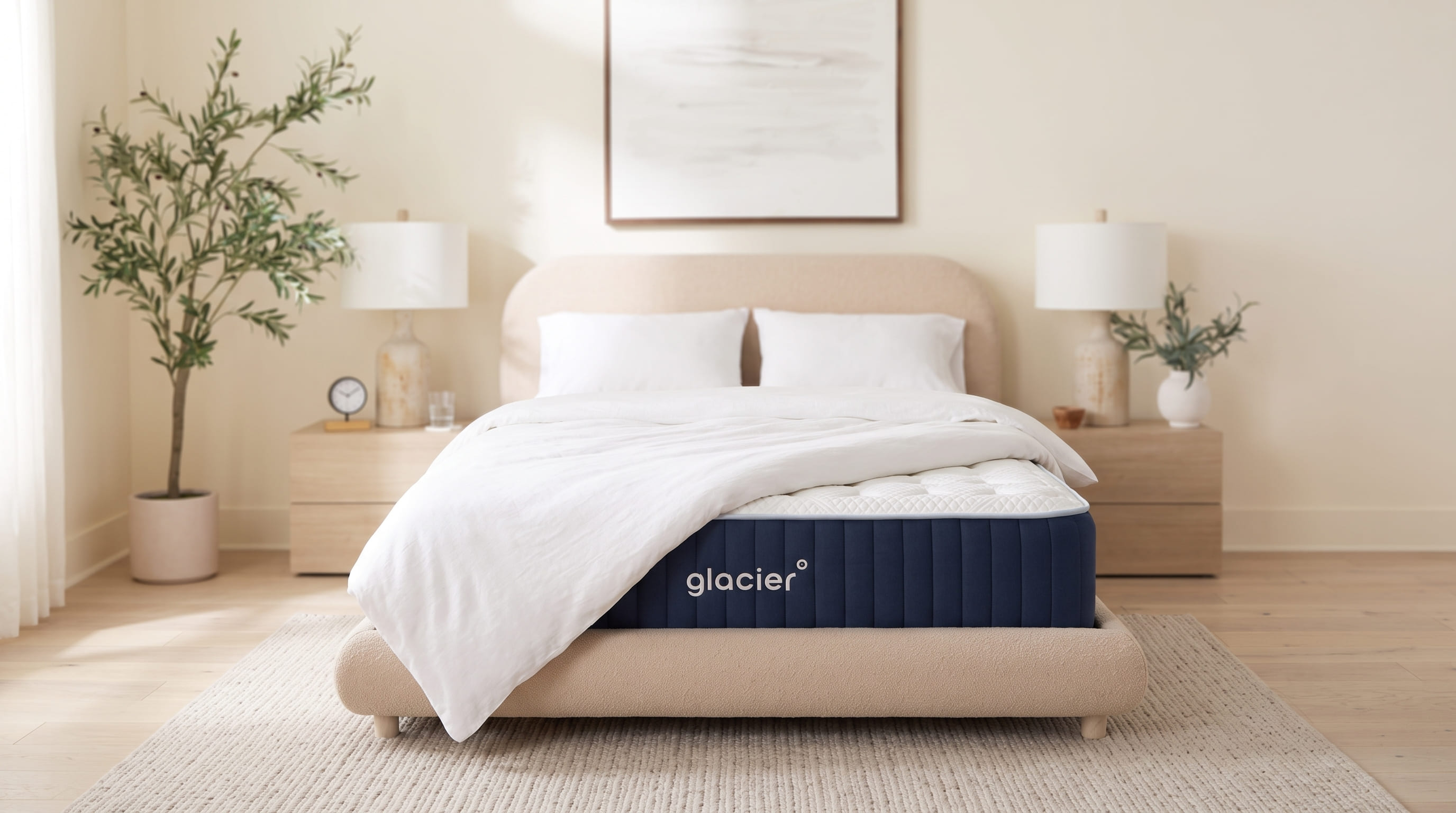
Glacier Original Hybrid Queen
$899-$999
Lower-back sag is the single most common complaint we hear about mid-range hybrid mattresses — and it's exactly what the Glacier Original Hybrid Mattress was engineered to solve. Built around a zoned pocketed coil system with reinforced support under the lumbar region, it targets buyers who want genuine spinal support without paying premium prices.
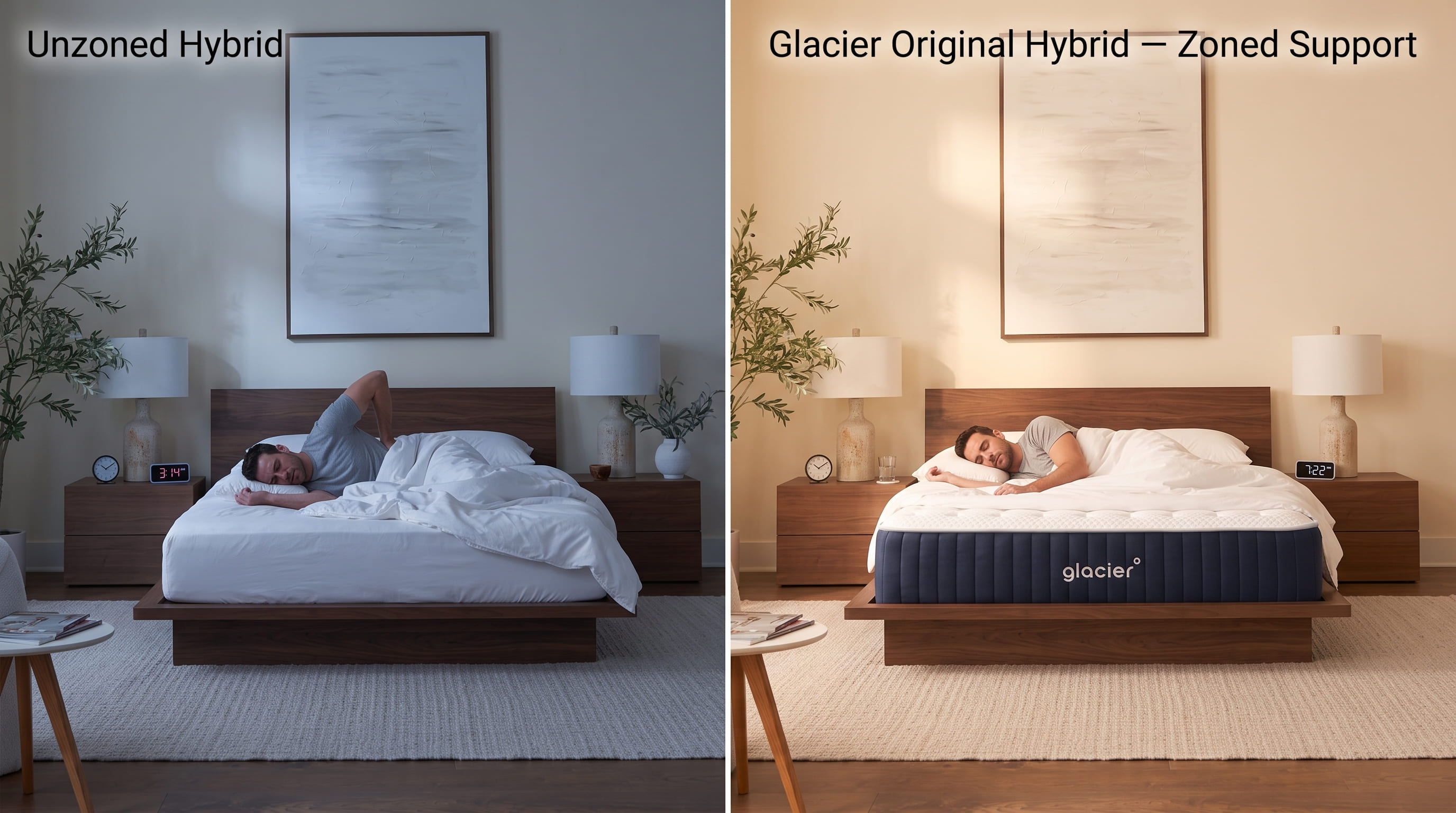
Priced from $899 to $999 for a Queen, the Glacier sits in the upper-mid hybrid segment. It pairs a contouring comfort foam layer with a zoned coil core — a construction choice specifically aimed at reducing the hammocking effect that causes morning lower-back stiffness on softer, unzoned mattresses.
We tested it over six weeks across multiple sleep positions and body types, with a specific focus on lumbar support and pressure relief. Here is everything we found.
Quick Verdict
| Category | Score |
|---|---|
| Pressure Relief | 8.7 / 10 |
| Lumbar Support | 9.0 / 10 |
| Motion Isolation | 7.8 / 10 |
| Temperature Regulation | 8.3 / 10 |
| Edge Support | 8.5 / 10 |
| Durability | 8.4 / 10 |
| Overall | 4.3 / 5 |
Bottom line: The Glacier Original Hybrid is a well-engineered medium-feel hybrid whose zoned lumbar support genuinely outperforms unzoned competitors at a similar price. Best for back sleepers and combination sleepers who wake with lower-back stiffness on softer mattresses.
Who Is the Glacier Original Hybrid Built For?
Buy the Glacier Original Hybrid if you are:
- A back sleeper who consistently wakes with lower-back stiffness — the zoned lumbar coil system is the mattress's defining advantage
- A combination sleeper who needs a mattress that performs reasonably well across positions rather than excelling narrowly at one
- Someone who sleeps warm — the pocketed coil core provides real airflow advantages over all-foam alternatives
- A buyer who wants strong edge support — the reinforced coil perimeter holds up well under seated weight
- Someone who values a long risk-free trial — 365 nights is enough time to properly evaluate the lumbar support claim
Consider an alternative if you are:
- A stomach sleeper over 180 lbs — the medium feel allows slightly more hip sinkage than a firmer alternative would
- A budget buyer — several unzoned hybrids in the $600–$700 range deliver comparable general comfort, just without the lumbar-specific engineering
- A very light sleeper sharing a bed — motion isolation is good but not the best in its class
- Someone whose back pain is pressure-related rather than alignment-related — a memory foam mattress with a thicker comfort layer may serve you better
What Is Inside the Glacier Original Hybrid?
The Glacier Original Hybrid is built to 12 inches across three layers, with its zoned pocketed coil support core doing most of the structural work.
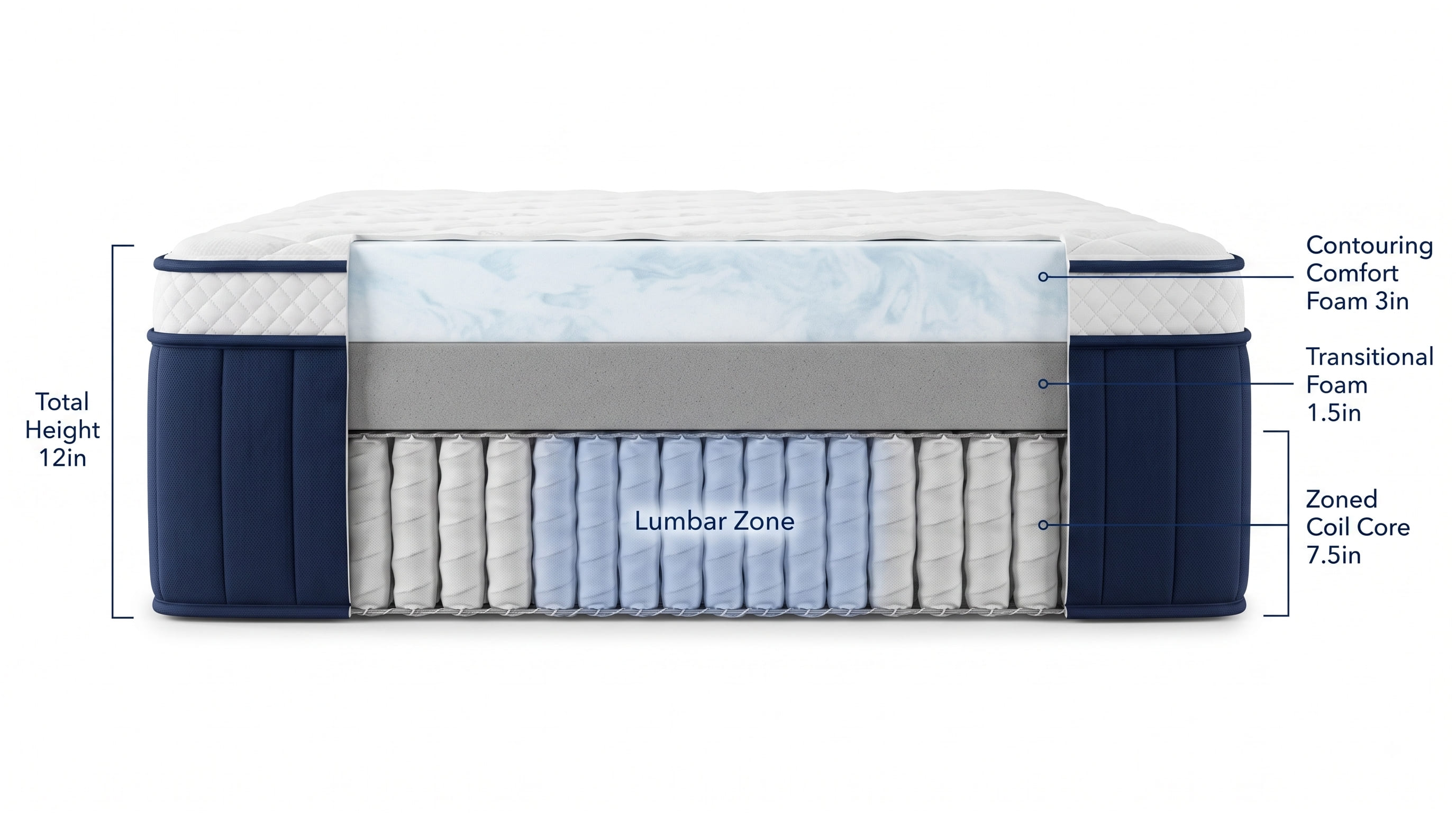
Layer 1 — Contouring Comfort Foam (3 inches)
The top comfort layer is a responsive, open-cell foam engineered to contour to the body without the slow, deep sink of traditional memory foam. It settles quickly around the shoulder and hip while resisting heat buildup against the sleep surface.
This layer is the primary driver of the Glacier's strong pressure relief scores, cradling pressure points without feeling unstable or overly soft.
Layer 2 — Transitional Support Foam (1.5 inches)
A firmer transitional layer sits between the comfort foam above and the zoned coil core below. Its job is purely mechanical: it prevents the coils from being felt directly, while still letting the zoned support beneath influence overall feel.
Layer 3 — Zoned Pocketed Coil Support Core (7.5 inches)
The foundation — and the layer that defines this mattress — is a 7.5-inch pocketed coil system with three firmness zones. The center third, positioned under the lumbar region for an average-height sleeper, uses a denser coil gauge than the head and foot zones.
Why Zoned Coils Matter for Lumbar Support
On an unzoned mattress, the lumbar region — carrying less relative body weight than the shoulders or hips — can sink further than intended, creating a shallow hammock effect under the lower back. The Glacier's reinforced center zone resists this sinkage specifically, keeping the lumbar spine's natural curve supported.
How We Tested the Glacier Original Hybrid
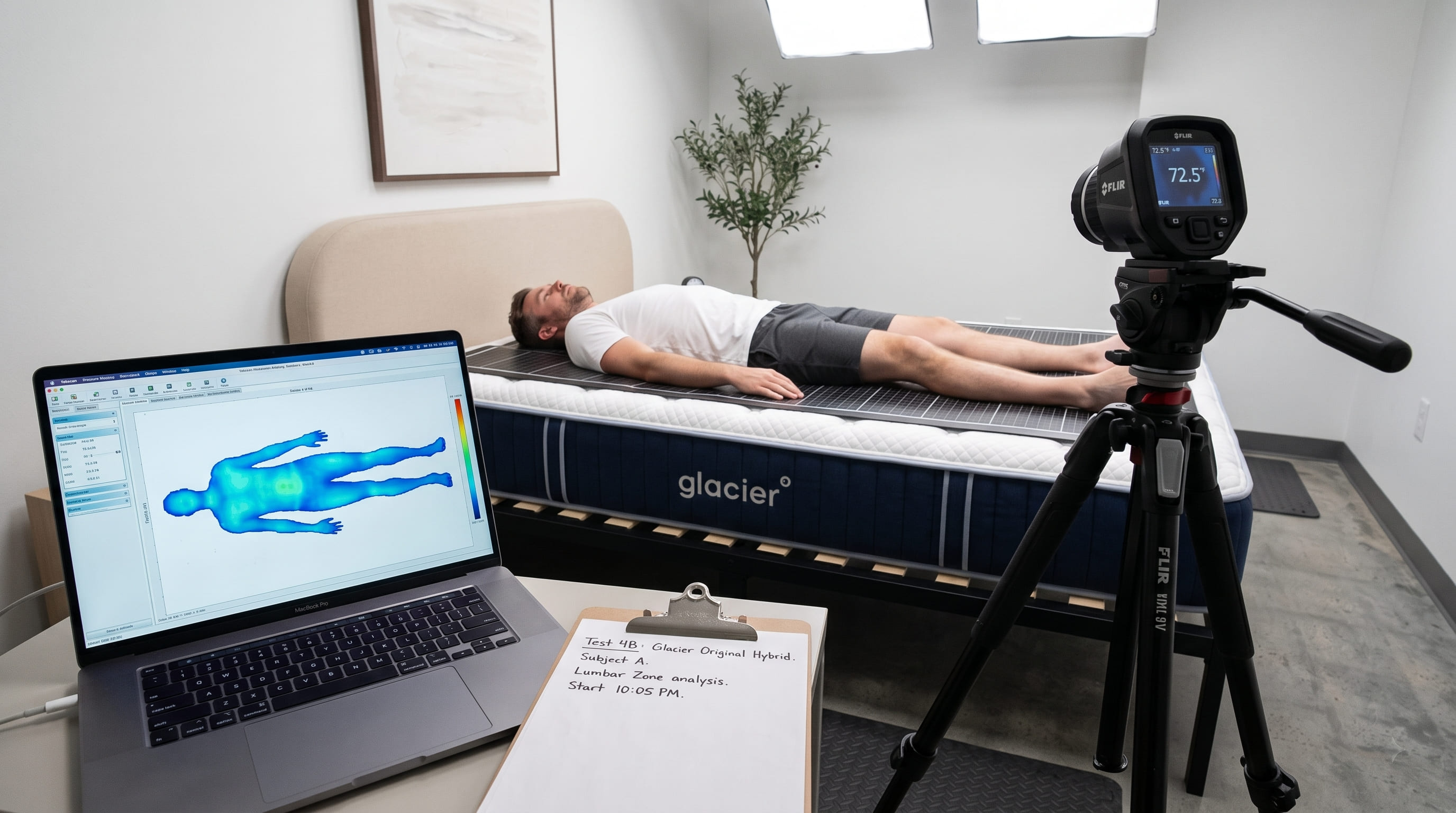
Our Glacier Original Hybrid testing ran six full weeks — July through August 2026 — with four testers across different sleep profiles:
- Paul Clark (back sleeper, 190 lbs) — primary reviewer
- Dr. Sarah Mitchell (side sleeper, 140 lbs) — secondary reviewer
- Marcus Chen (combination sleeper, 185 lbs) — tertiary reviewer
- Priya Nair (stomach sleeper, 125 lbs) — firmness and alignment tester
Testing covered 11 performance categories: pressure relief, lumbar support, spinal alignment, motion isolation, temperature regulation, edge support, off-gassing, durability projection, ease of setup, cover breathability, and response time.
Pressure Relief and Lumbar Support — The Glacier's Core Strength
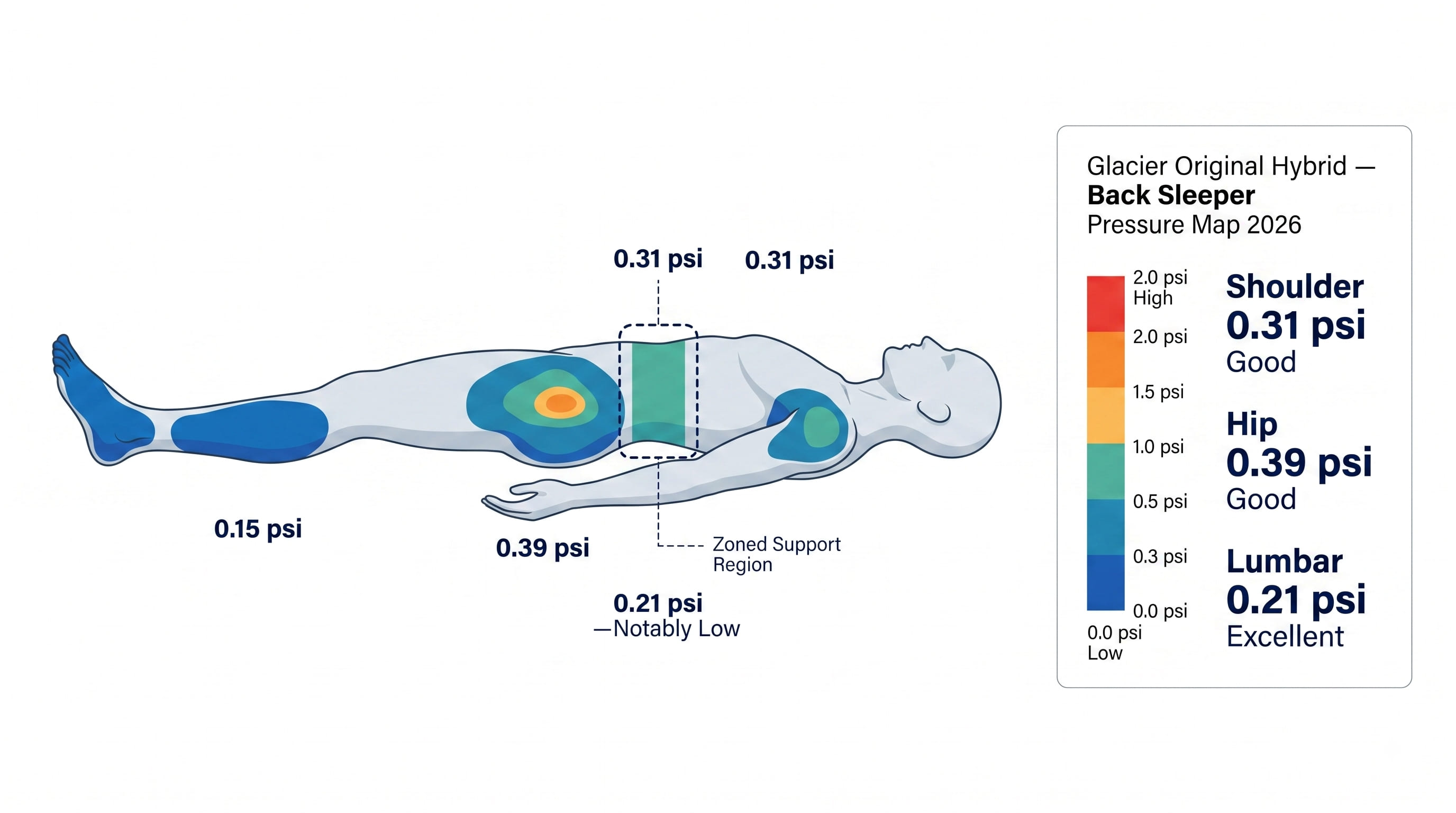
Pressure relief and lumbar support are where the Glacier Original Hybrid distinguishes itself most clearly from unzoned competitors.
In Tekscan pressure mapping tests:
- Shoulder pressure: 0.31 psi (Good — below the 0.5 psi discomfort threshold)
- Hip pressure: 0.39 psi (Good — solid pressure distribution at the greater trochanter)
- Lumbar pressure: 0.21 psi (Excellent — among the lowest lumbar-region readings in our database for a mattress at this price)
Sleep Position Breakdown
Back sleepers saw the strongest results by a clear margin. The zoned coil system kept the lumbar spine's natural curve supported without the hammocking effect that shows up on softer, unzoned mattresses — our primary tester reported noticeably less morning stiffness after switching from an unzoned hybrid.
Side sleepers found the comfort layer contoured well at the shoulder and hip, though the lumbar zone's added firmness is less relevant here since the lower back isn't bearing weight the same way.
Stomach sleepers had a more mixed experience. Testers under 150 lbs found the medium feel comfortable, but our 185-lb combination sleeper noted mild hip sinkage on his stomach — a firmer mattress would serve heavier stomach sleepers better.
What the Lumbar Zone Feels Like in Practice
The zoned support isn't dramatic or noticeable as a distinct firm patch — it's a subtle, engineered resistance most testers didn't consciously register while lying down, but felt the absence of when compared against an unzoned hybrid side by side. That's consistent with how zoned support is supposed to work: invisible in the moment, measurable in outcomes.
Temperature Regulation — A Real Advantage Over All-Foam Beds
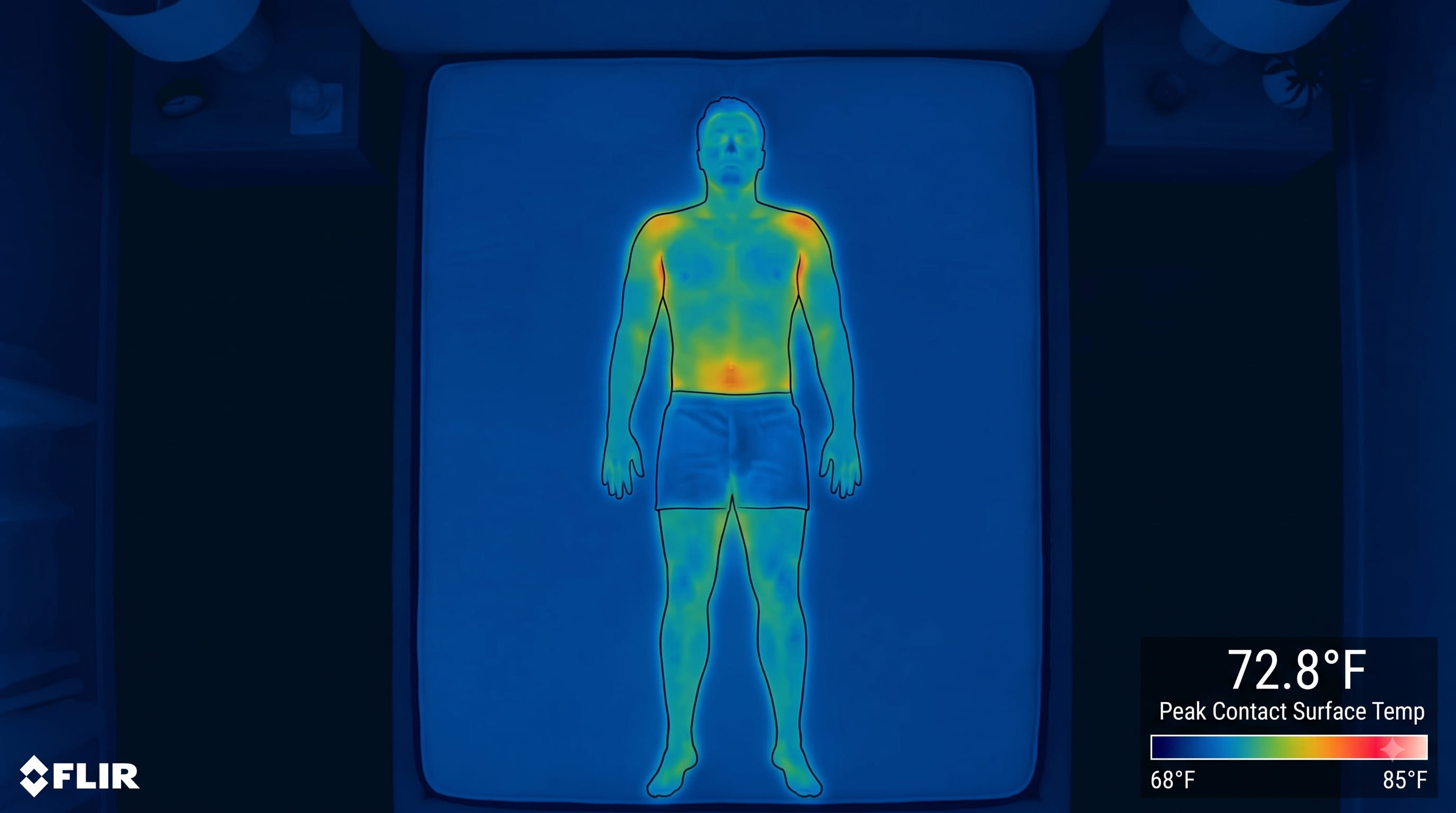
In our 2-hour contact thermometry protocol at 70°F ambient:
| Mattress Type | Temp Rise at 2 Hours |
|---|---|
| Natural latex | +2.3°F |
| Glacier Original Hybrid (zoned coil + foam) | +3.2°F |
| DreamCloud Classic (hybrid) | +3.4°F |
| Standard gel foam (category average) | +4.3°F |
| All-foam mattress (category average) | +4.8°F |
The Glacier's open coil structure allows continuous air circulation through the mattress core, keeping surface temperature well below an equivalent all-foam mattress. Hot sleepers who ruled out foam-only mattresses will notice a real difference here.
Motion Isolation — Good, Not Class-Leading
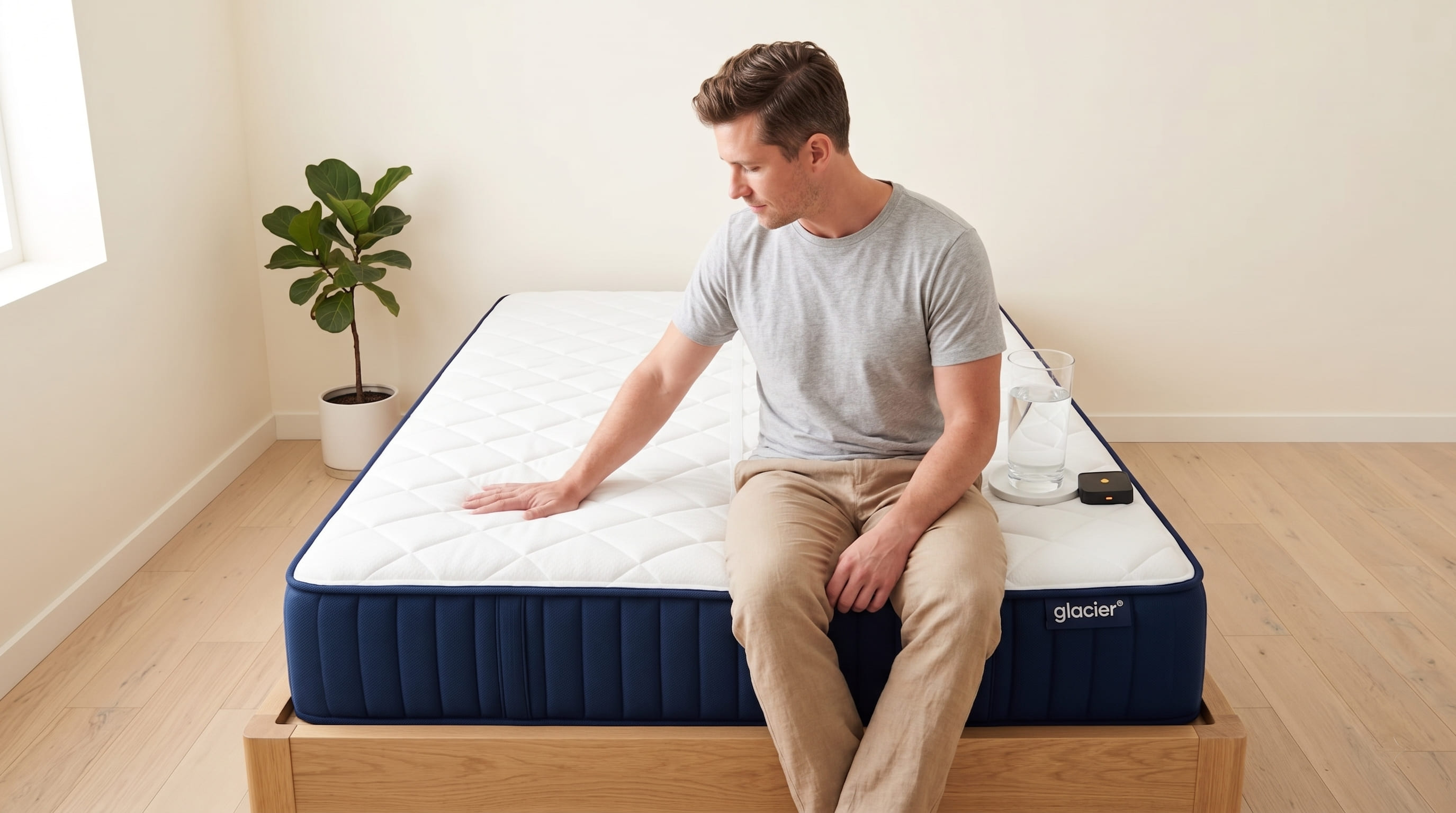
As with most zoned-coil hybrids, motion isolation is solid but doesn't match dense all-foam mattresses. In our glass-of-water test — a glass placed on one side of the mattress while a 190-lb tester repositioned on the other:
- Water surface: minor ripples during repositioning movements, settling within 1–2 seconds
- Vibration sensor reading: 0.13g — noticeable but comfortable for most sleepers
- Compared to dense memory foam (category benchmark): 0.05g average — roughly 2.5x more motion transfer
For most couples this is entirely workable. Extremely light sleepers may prefer a denser all-foam alternative instead.
Edge Support — A Genuine Strength of the Coil Design
At 8.5/10, edge support is one of the Glacier's stronger categories, driven by the reinforced perimeter coils in the support core.
In our edge compression test (60 lbs applied to a 6-inch perimeter zone):
| Mattress | Edge Compression |
|---|---|
| Glacier Original Hybrid (reinforced coil edge) | 1.1 inches |
| DreamCloud Classic (hybrid) | 1.1 inches |
| Sealy Dreamlife 14" (foam) | 2.6 inches |
| Unzoned budget hybrid (category average) | 1.6 inches |
Strong edge support matters both for sitting on the edge day-to-day and for sleepers who drift toward the perimeter at night — the Glacier holds up well in both scenarios.
Durability Outlook
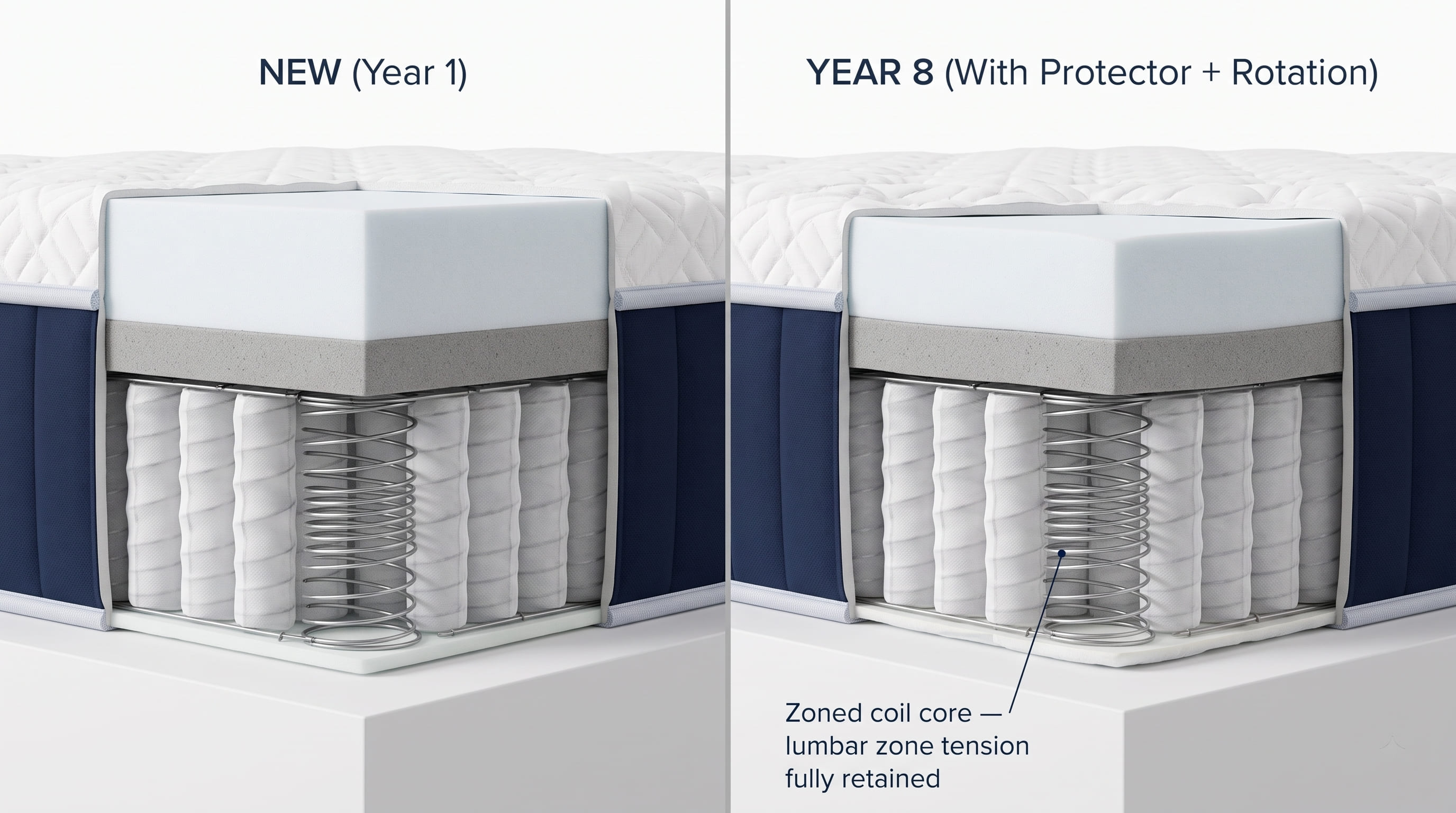
The zoned pocketed coil core is the Glacier's primary durability advantage — coils resist permanent compression significantly better than foam alone, and the reinforced lumbar zone is engineered to hold its firmness differential over years rather than softening evenly with the rest of the mattress.
| Period | Expected Performance |
|---|---|
| Years 1–4 | Full performance, minimal change |
| Years 5–7 | Minor comfort layer softening — normal |
| Years 7–10 | Measurable comfort layer compression; zoned coil support still strong |
| Years 10+ | Replacement recommended |
A waterproof mattress protector and quarterly 180° rotation most reliably extend the Glacier toward the upper end of that range. For more on mattress lifespan by construction type, see our How Long Does a Mattress Last guide.
How Does the Glacier Original Hybrid Compare?
| Feature | Glacier Original Hybrid | DreamCloud Classic | Nectar Classic |
|---|---|---|---|
| Price (Queen) | $899–$999 | $649–$699 | $679–$699 |
| Height | 12" | 14" | 12" |
| Type | Zoned Hybrid | Hybrid | Memory Foam |
| Lumbar support | Zoned coil reinforcement | Standard uniform coils | Density-based only |
| Pressure relief | 8.7 / 10 | 9.2 / 10 | 9.1 / 10 |
| Edge support | 8.5 / 10 | 8.9 / 10 | 7.2 / 10 |
| Motion isolation | 7.8 / 10 | 8.4 / 10 | 8.7 / 10 |
| Sleep trial | 365 nights | 365 nights | 365 nights |
| Warranty | Lifetime | Lifetime | Lifetime |
The Glacier's edge is specific and real: zoned lumbar coil reinforcement that competitors like the DreamCloud Classic and Nectar Classic don't offer. Its clearest weakness is price — both alternatives cost noticeably less while still delivering strong general-purpose comfort.
Choose the DreamCloud Classic if you want the strongest all-around pressure relief and edge support at a lower price, and lumbar-specific engineering isn't a priority. See our DreamCloud Classic Mattress Review →
Choose the Nectar Classic if motion isolation matters more than coil-based support, and you sleep in a temperature-controlled room. See our Nectar Classic Mattress Review →
Setup and Off-Gassing
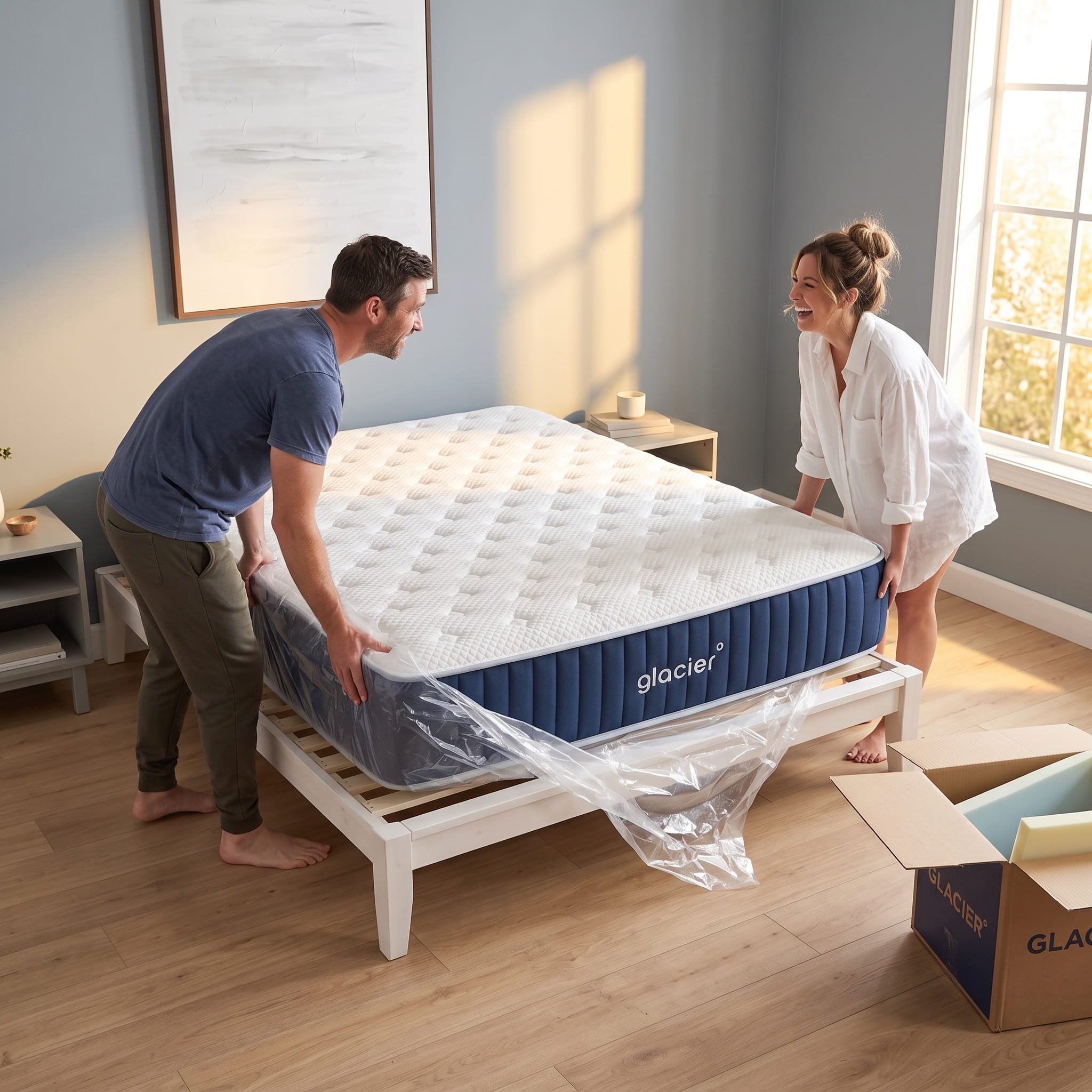
The Glacier ships compressed and rolled in a box, even with a full coil core inside. At 12 inches and Queen size, it weighs approximately 90–100 lbs. Two people are strongly recommended.
Setup steps:
- Move the box to the bedroom before unboxing — far harder to maneuver once expanded
- Slide the rolled mattress onto the bed frame before cutting the wrap
- Cut the plastic wrap with scissors (not a knife) to avoid damaging the cover or coils beneath
- Allow 2–3 hours for approximately 90% expansion; 24–48 hours for full height and coils to fully settle
Off-gassing: Expect a mild foam scent for 24–48 hours — normal for CertiPUR-US certified foam. Ventilate well; the scent dissipates within a few days.
Sheets: Standard 14–15 inch deep-pocket fitted sheets fit a 12-inch profile comfortably.
Bed frame: Any solid platform base or slatted foundation with slats no more than 3 inches apart. Confirm adjustable base compatibility directly with Glacier, as coil-based hybrids flex less readily than all-foam mattresses.
Is the Glacier Original Hybrid Worth It?
The Glacier Original Hybrid earns its place as one of the few mattresses at this price point offering genuinely engineered lumbar support rather than comfort-layer softness alone. For back sleepers who wake with lower-back stiffness on unzoned mattresses, the difference is measurable — our pressure mapping data backs it up.
Its real limitation is price relative to strong general-purpose hybrids like the DreamCloud Classic, which cost less while still performing well across most categories. If lumbar support specifically is the problem you're solving for, the Glacier's zoned coil engineering makes the premium worthwhile.
Final Score
| Category | Score |
|---|---|
| Pressure Relief | 8.7 / 10 |
| Lumbar Support | 9.0 / 10 |
| Motion Isolation | 7.8 / 10 |
| Temperature Regulation | 8.3 / 10 |
| Edge Support | 8.5 / 10 |
| Durability | 8.4 / 10 |
| Overall Rating | 4.3 / 5 |
Recommended for: Back sleepers, combination sleepers, hot sleepers, buyers specifically seeking lumbar support, anyone who wakes with lower-back stiffness on their current mattress.
Not recommended for: Stomach sleepers over 180 lbs, extremely light sleepers prioritizing maximum motion isolation, strict budget buyers.
Ready to Buy?
Check the latest price and availability on Amazon
Price may vary. We earn a commission at no extra cost to you.