How Long Does a Mattress Last: 2026
How long does a mattress last? Most last 7–10 years. Learn lifespan by type, 7 warning signs it's time to replace, and tips to make yours last longer.
Here is a number worth sitting with: the average person spends around 26 years of their life in bed. That is a long time to be lying on something that may be slowly breaking down beneath you.
Most people replace their mattress far later than they should — not because they enjoy sleeping on a worn-out surface, but because it is easy to adapt gradually to a degrading mattress without noticing the decline. The back pain, the restless nights, the morning stiffness — these creep in slowly enough that the mattress rarely gets the blame.
So how long does a mattress actually last? The honest answer: it depends on the type, the materials, how it is used, and how well it is maintained. This guide gives you the full picture — average lifespans by mattress type, the signs that tell you it is time to replace, and practical steps to extend the life of what you already own.
The Short Answer: How Long Does a Mattress Last?
Most mattresses last 7 to 10 years under normal use conditions. But that range is wide for a reason — a low-density foam mattress used daily by two adults may need replacing at 5 years, while a high-density latex mattress with proper care can comfortably reach 15 years.
The 7–10 year figure is the most commonly cited guideline, and it has a practical basis: most mattress warranties run 10 years, and most foam materials show measurable performance decline within that window. But warranty length is not the same as useful lifespan — more on that distinction below.
Mattress Lifespan by Type
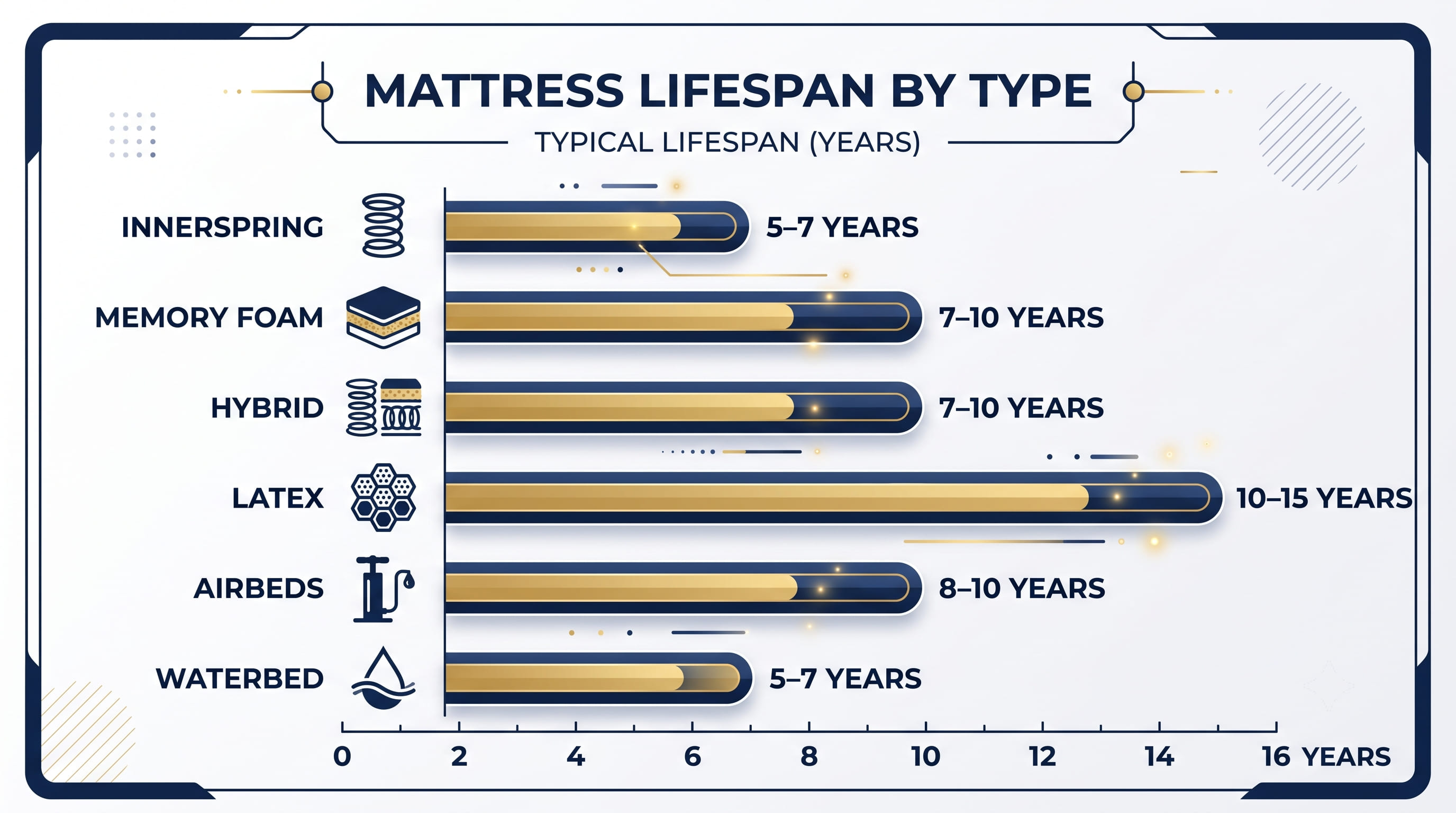
Memory Foam: 7–10 Years
Memory foam is the most popular mattress material sold today, and its lifespan depends almost entirely on foam density. Foam density is measured in pounds per cubic foot (lbs/ft³):
- Low-density foam (2.0–3.0 lbs/ft³): Found in budget mattresses under $500. Breaks down fastest — expect 5–7 years before noticeable sagging and body impressions develop.
- Medium-density foam (3.0–4.5 lbs/ft³): The most common range for mid-price mattresses. Reliably lasts 7–10 years with proper care.
- High-density foam (4.5+ lbs/ft³): Found in premium memory foam mattresses. Can last 10–12 years before significant performance decline.
The enemy of memory foam is heat and repeated compression in the same spots. Body impressions deeper than 1 inch are the clearest sign that the foam has broken down beyond its ability to recover.
Innerspring: 5–8 Years
Traditional innerspring mattresses — continuous coil or Bonnell coil systems — have the shortest average lifespan of any mattress type. The coil system itself can last longer, but the thin comfort layers above the coils (typically low-density polyester foam or fiberfill) compress and break down quickly, leading to a surface that feels thin and unsupportive.
Higher-quality innerspring mattresses with offset coils and thicker comfort layers can reach 8–10 years, but the category average sits closer to 5–7. If you are sleeping on an innerspring and it is over 7 years old, it has almost certainly degraded significantly even if it does not look it.
Hybrid: 7–10 Years
Hybrid mattresses combine pocketed coil support cores with foam or latex comfort layers. Lifespan depends on the quality of both components:
- The pocketed coil system in a quality hybrid can last 15+ years.
- The comfort layer — typically 2–4 inches of memory foam or latex — is the component that degrades first.
- Higher-quality hybrids with latex comfort layers (rather than foam) can reach 10–12 years.
The result: most hybrids in the $800–$1,500 range last 7–10 years, matching memory foam. Premium hybrids with latex comfort layers trend toward the higher end of that range.
Latex: 10–15 Years
Natural latex — particularly GOLS-certified Dunlop latex — is the most durable mattress material available. The open-cell structure of latex resists permanent compression significantly better than polyurethane foam, and the natural material does not break down through heat exposure the way foam does.
- Dunlop latex: Denser and more durable. Can last 15+ years in a support core role.
- Talalay latex: Lighter and slightly less durable than Dunlop. Typically 10–12 years.
- Synthetic latex: Significantly less durable than natural latex — closer to 6–8 years.
If you own a GOLS-certified natural latex mattress, the 10–15 year lifespan is realistic with proper care. This longer lifespan is part of why latex mattresses command a higher upfront price — the cost-per-year is often competitive with cheaper foam options.
Airbed (Adjustable Firmness): 8–10 Years
Quality adjustable airbeds — where air chambers control firmness — can last 8–10 years for the air system itself. The comfort foam layers above the air chambers follow the same degradation timeline as standard foam (5–10 years depending on density). Mechanical components (pumps, remotes, connectors) introduce additional failure points that foam and latex do not have.
Waterbed: 5–7 Years
Vinyl waterbeds are susceptible to puncture, mould, and vinyl degradation. The average vinyl waterbed bladder lasts 5–7 years before cracking or seam failure risk becomes significant.
Mattress Lifespan Summary
| Mattress Type | Average Lifespan | Key Factor |
|---|---|---|
| Innerspring | 5–8 years | Comfort layer quality |
| Memory Foam (budget) | 5–7 years | Low foam density |
| Memory Foam (mid/premium) | 7–10 years | Foam density 3.5+ lbs/ft³ |
| Hybrid | 7–10 years | Comfort layer material |
| Airbed | 8–10 years | Mechanical components |
| Latex (Talalay) | 10–12 years | Open-cell structure |
| Latex (Dunlop / natural) | 12–15 years | Material density and origin |
7 Signs It Is Time to Replace Your Mattress
A mattress rarely fails overnight. The decline is gradual — which is exactly why so many people sleep on worn-out mattresses for years without connecting it to their sleep quality. Here are the clearest signals:
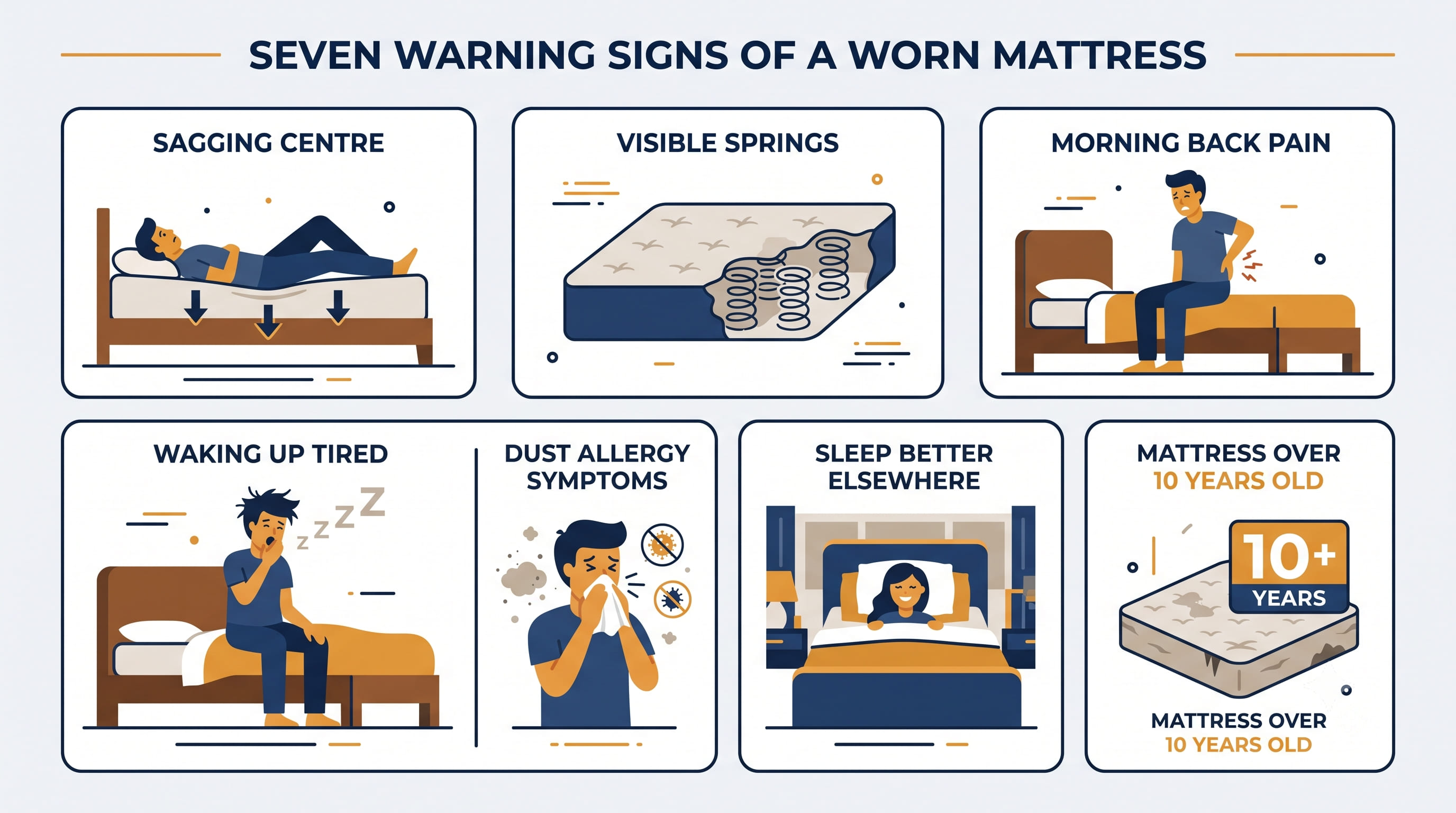
1. Visible Sagging or Body Impressions
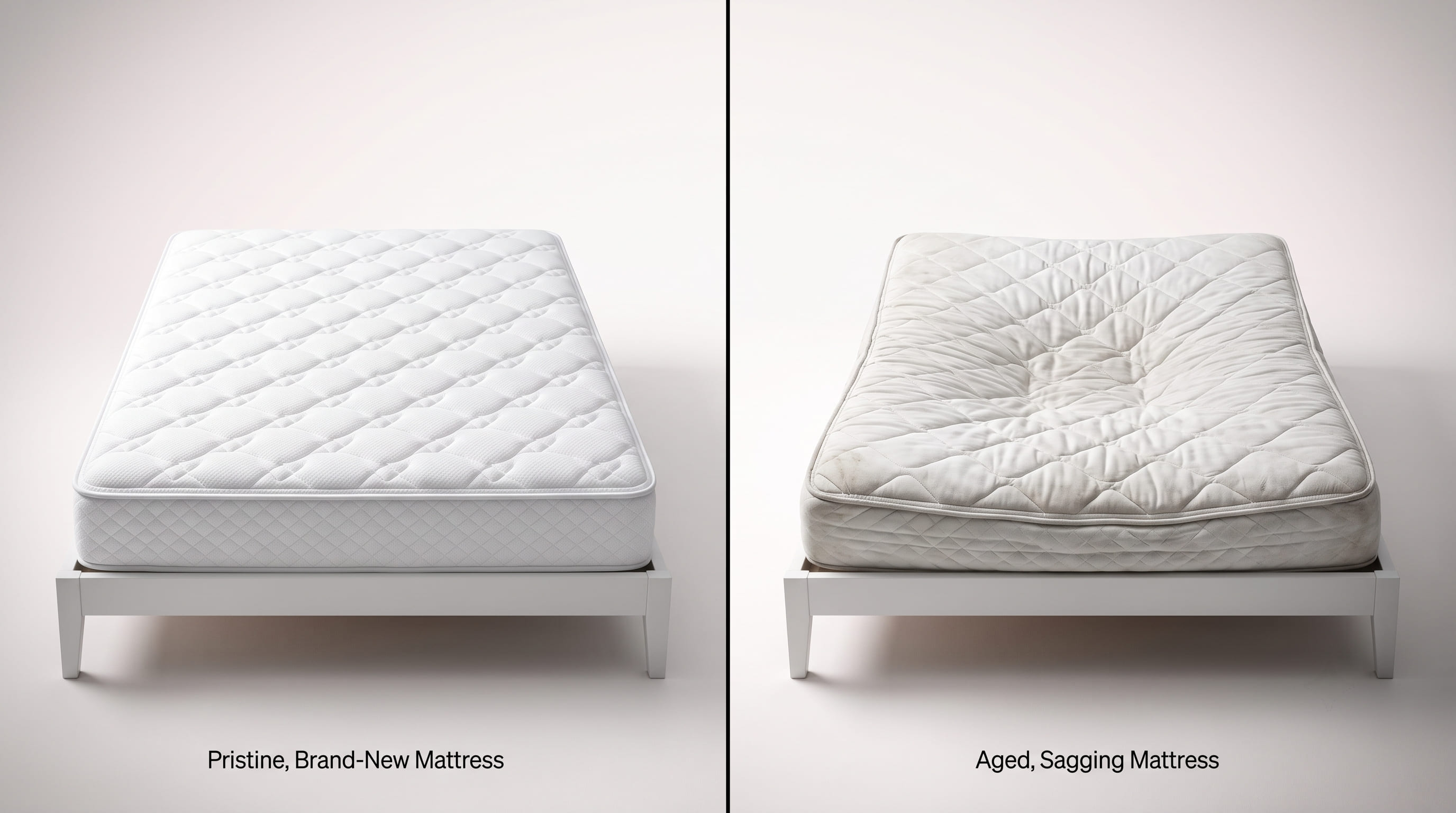
The most obvious and most impactful sign. Memory foam and innerspring mattresses develop visible depressions where you sleep most frequently. A body impression deeper than 3/4 inch to 1 inch is the threshold at which spinal alignment is measurably compromised during sleep.
Place a straight edge (ruler, broom handle) across the mattress surface to measure depression depth if you are unsure. Most warranties cover impressions deeper than 1–1.5 inches — but noticeable spinal alignment issues begin well before that.
2. You Wake Up with Pain That Wasn't There Before
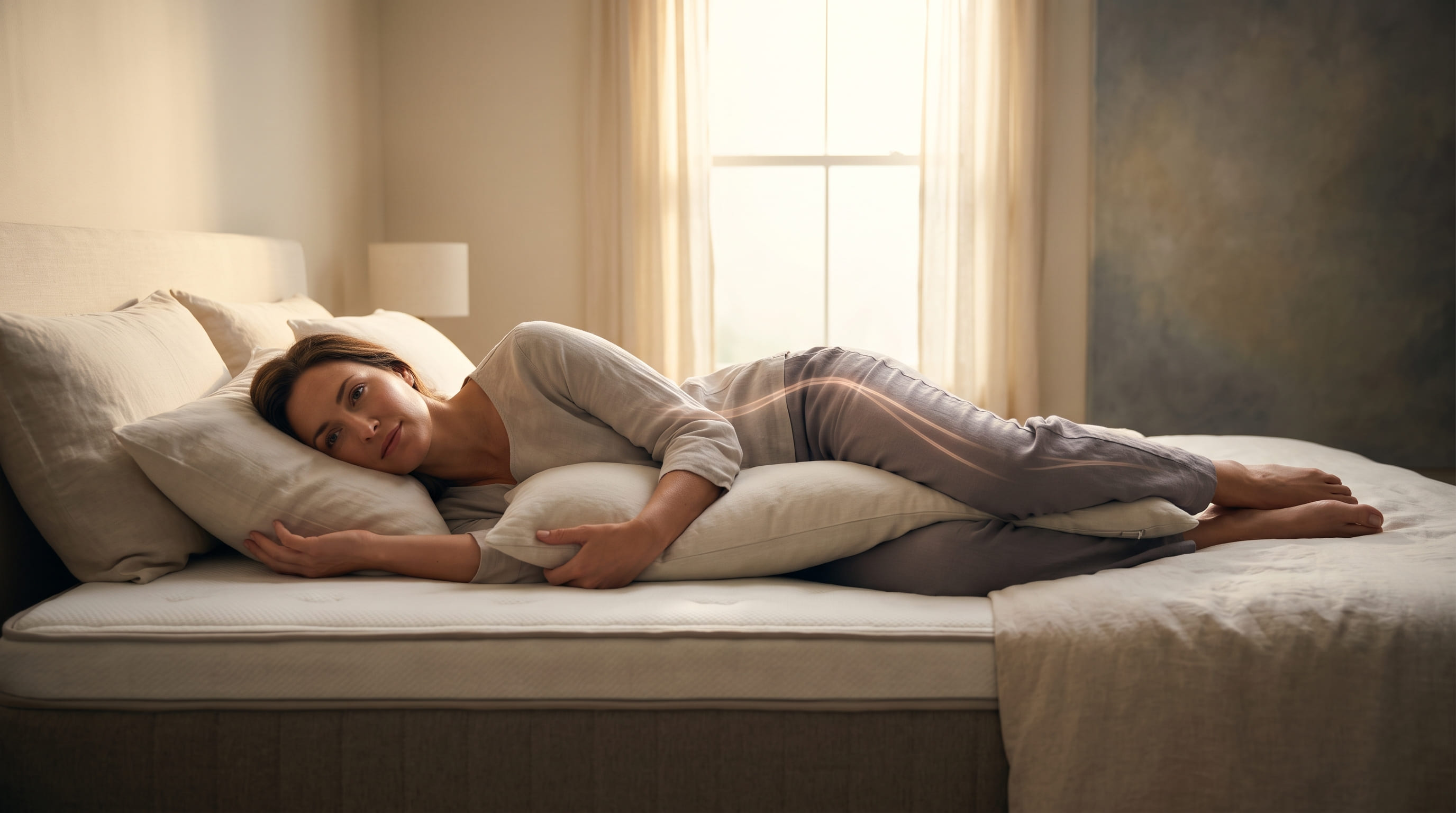
Morning back pain, hip stiffness, or shoulder aching that resolves within 20–30 minutes of being up and moving is a classic sign of mattress degradation. A worn mattress no longer maintains proper spinal alignment — the lower back sags into the softer centre, creating overnight strain that manifests as morning pain.
If this pain did not exist two years ago and no other explanation applies, the mattress is the most likely cause.
3. You Sleep Better Away From Home
Sleeping at a hotel, a friend's house, or on a guest mattress and waking up more rested and pain-free than at home is a reliable indicator that your mattress is the problem. It is easy to dismiss this as "holiday effect," but if it happens consistently on different beds away from home, the common variable is your mattress.
4. The Mattress Is Noisy
Innerspring and hybrid mattresses should be silent. Squeaking, creaking, or popping from the coil system indicates that coils have worn through their fabric enclosures or that the coil-to-coil connections have loosened. A noisy mattress transfers movement more readily — compounding both the noise issue and disrupted sleep for partners.
5. You Notice Increased Allergy or Asthma Symptoms
Mattresses accumulate dust mites, dead skin cells, mould spores, and pet dander over time. A study by Allergy UK found that a used mattress can contain up to 10 million dust mites after several years of use. If your allergy or asthma symptoms have worsened without another clear cause, the mattress may be a significant contributor — particularly if symptoms are worst in the morning.
Regular deep cleaning extends mattress life but cannot fully reverse biological accumulation after 8–10 years.
6. You Feel the Springs or the Edge Has Collapsed
If you can feel the coil system through the comfort layers while lying down, or if the edge of the mattress collapses under your weight when sitting, the comfort layers have compressed to the point of ineffectiveness. This also reduces the usable sleep surface — you feel pushed toward the centre — and makes getting in and out of bed more difficult.
7. The Mattress Is Over 8–10 Years Old
Even without visible symptoms, a mattress older than 8–10 years has experienced enough material fatigue to be meaningfully less supportive than when new — even if it does not look or feel dramatically different. Sleep research consistently shows that replacing an 8–10 year old mattress improves sleep quality, reduces back pain, and reduces stress markers — regardless of how "fine" the old mattress seemed.
If your mattress is over 10 years old, the question is not whether to replace it, but when.
Does Mattress Warranty = Mattress Lifespan?
No — and this is one of the most common misconceptions in mattress buying.
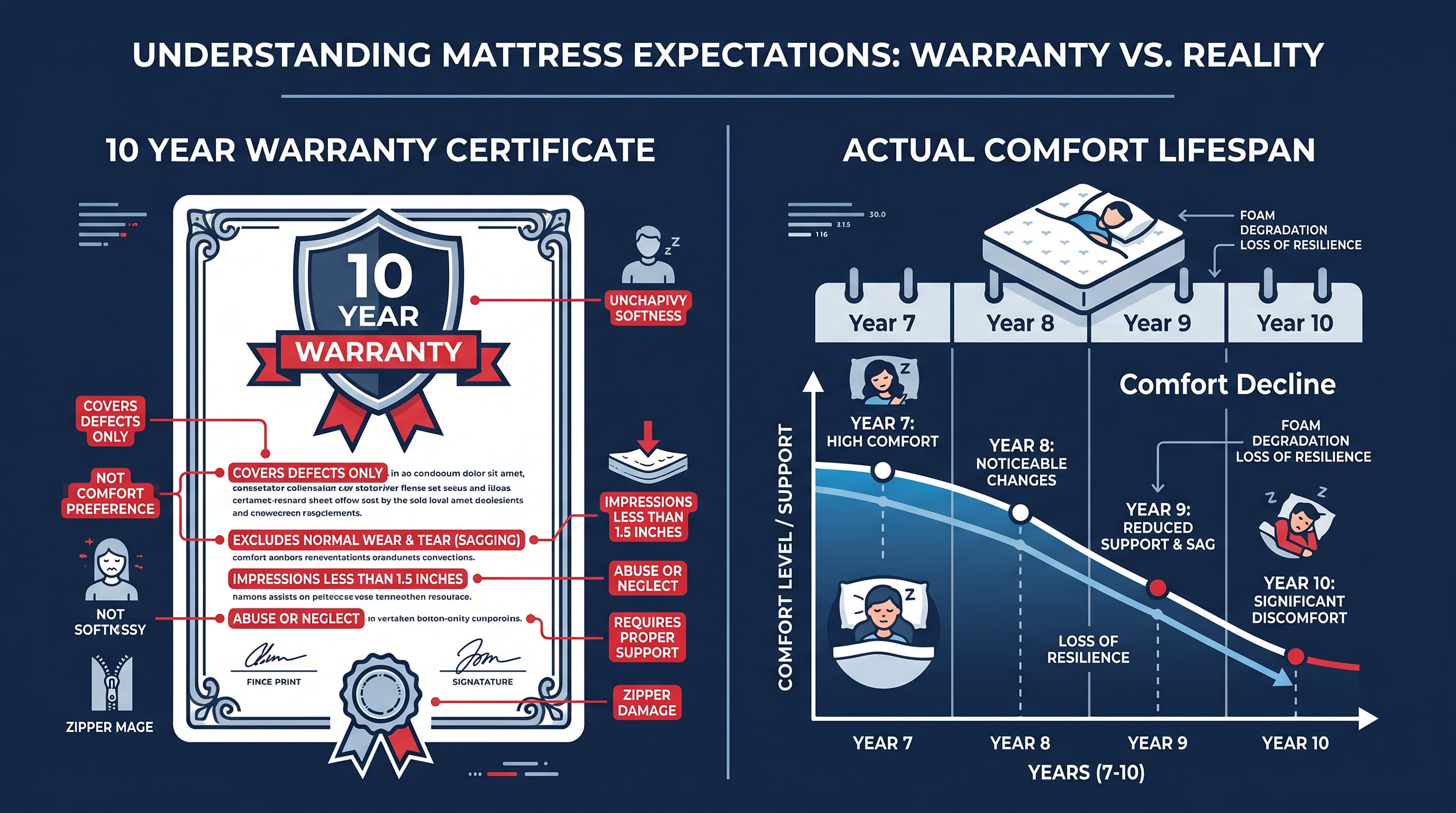
A 10-year warranty does not mean the mattress performs well for 10 years. Mattress warranties cover manufacturing defects — specifically, body impressions deeper than the stated threshold (commonly 1–1.5 inches) and physical defects in materials. They do not cover:
- Normal comfort layer softening and compression
- Changes in feel or firmness over time
- Loss of support that falls below the warranty impression threshold
- Body impressions between 0.5 and 1 inch that still affect sleep quality
In practice, most mattresses begin their comfort decline at 5–7 years — well within their warranty period — but the decline does not meet the warranty claim threshold. The warranty protects against defects; it does not guarantee ongoing sleep quality.
A 25-year warranty from a premium mattress brand is a signal of build quality confidence, not a promise that the mattress sleeps as well at year 20 as year 1.
How to Make Your Mattress Last Longer
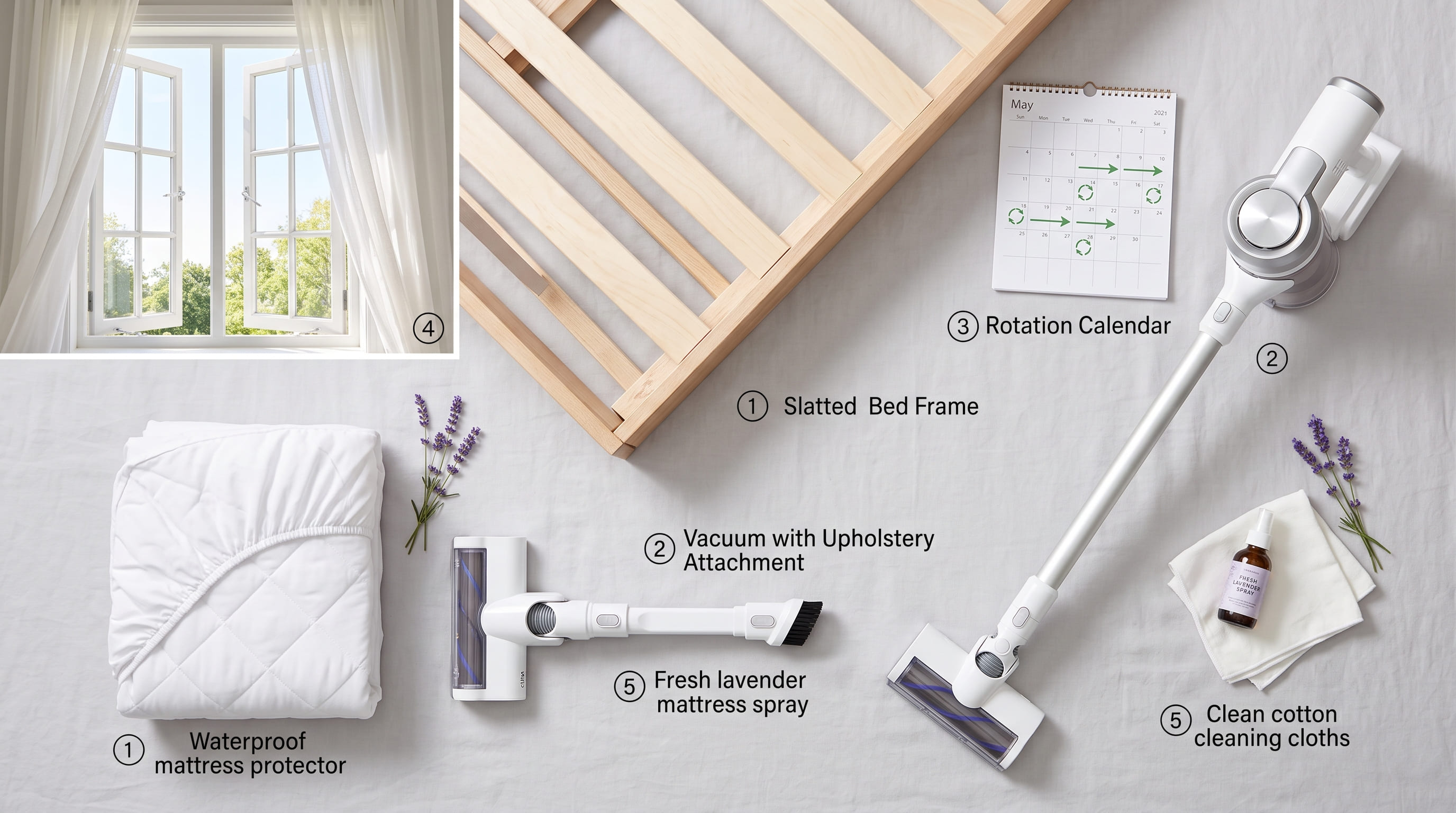
The gap between a 7-year mattress and a 12-year mattress is almost always maintenance. Here is what actually extends mattress life:
Use a Mattress Protector From Day One
A waterproof mattress protector is the single highest-impact thing you can do for mattress longevity. Moisture — from sweat, spills, or humidity — accelerates foam breakdown, promotes mould growth, and voids most manufacturer warranties. A quality protector (TENCEL or cotton-top, waterproof membrane backing) adds less than $50 to your investment and can meaningfully extend mattress life by 2–3 years.
Rotate Every 3–6 Months
Rotating your mattress 180° (head to foot) every 3–6 months redistributes compression wear across the foam or comfort layers. Most modern mattresses are single-sided (no flip), but rotation alone reduces the rate of body impression development in the areas where you sleep most frequently.
Set a calendar reminder — this is the most commonly neglected and most impactful maintenance step.
Use a Proper Bed Frame With Centre Support
A mattress is only as good as what supports it. A queen or king mattress without a centre support leg allows the middle of the foundation to sag — which transfers directly to the mattress surface above it. Most mattress sagging complaints that show up early are foundation problems, not mattress problems.
Check that your bed frame has:
- Centre support legs for queen and king sizes
- Slats no more than 3 inches apart (foam mattresses need closer slat spacing than innerspring)
- No broken or missing slats
Keep It Clean
Spot-clean spills immediately with cold water and mild detergent — never saturate the mattress. Vacuum the surface every 3–6 months using an upholstery attachment to remove dust, dead skin, and allergens. Baking soda left on the surface for 30 minutes before vacuuming neutralises odours.
Do not steam-clean a foam or latex mattress — the moisture and heat accelerate material breakdown.
Let It Air Out
Strip the bedding once a month and let the mattress breathe for a few hours. This allows accumulated moisture from body heat and sweat to evaporate rather than settling into the foam layers. Particularly important in humid climates.
Avoid Jumping on the Bed
Concentrated impact stress is the fastest way to damage coil systems and foam comfort layers. This is relevant if you have children — a few minutes of bouncing can create structural damage that compounds over time.
When to Replace vs. When to Improve
Not every mattress problem requires a full replacement. Before spending $800–$2,000 on a new mattress, consider whether a lower-cost intervention solves the issue:
| Problem | Replace? | Cheaper Fix? |
|---|---|---|
| Too firm — back pain | Maybe | Mattress topper (2–3") |
| Too soft — sinking | Yes (foam worn out) | No — topper won't help a sagging base |
| Squeaking springs | Maybe | Check bed frame first |
| Too warm | Maybe | Cooling topper or protector |
| Visible sagging 1"+ | Yes | No effective fix |
| Allergy symptoms | Yes (after 8+ years) | Deep clean first |
| Mattress over 10 years | Yes | Time has come |
A mattress topper can restore surface comfort on a structurally sound mattress — but it cannot fix a mattress that is sagging, has broken coils, or has compressed foam at the base. If the problem is the support core, only a new mattress solves it.
How to Dispose of Your Old Mattress Responsibly
Most landfills accept mattresses but it is one of the least environmentally friendly disposal options — a mattress takes decades to break down. Better alternatives:
- Manufacturer take-back: Many mattress brands (Saatva, Avocado, Purple) offer removal of your old mattress at delivery. Ask when ordering.
- Mattress recycling: Mattress Firm, Sleep Number, and many independent retailers offer recycling programmes. The Steel Recycling Institute estimates that 80–90% of a mattress by weight is recyclable (steel, foam, cotton, wood).
- Donation: Salvation Army, Habitat for Humanity ReStores, and local shelters accept mattresses in good condition (no stains, no sagging, no structural damage).
- Local council collection: Many councils offer large item collection — check your local service.
Frequently Asked Questions
How do I know if my mattress is worn out if there's no visible sagging?
Look for indirect signs: morning stiffness or back pain that resolves quickly after getting up, sleeping better in hotels or on other mattresses, waking more frequently during the night, or noticeable changes in how "comfortable" the mattress feels compared to when you bought it. Foam breakdown reduces support before it creates visible impressions — the feel changes before the surface visibly sags.
Does sleeping with a partner wear out a mattress faster?
Yes. Two adults sleeping nightly doubles the compression load on the mattress relative to a single sleeper. A mattress shared by two people will typically reach its lifespan threshold 1–2 years sooner than the same mattress used by one person. Higher-weight sleepers accelerate this further — consider a higher-density foam or Dunlop latex mattress if combined body weight exceeds 400 lbs.
Can I extend my mattress life by flipping it?
Only if it is a double-sided mattress — most modern mattresses are single-sided with a defined comfort side and a non-comfort base. Check the manufacturer's guidance. Rotating (head to foot) is appropriate for all single-sided mattresses and should be done every 3–6 months.
Does a mattress topper extend mattress life?
A topper protects the mattress surface from direct compression wear and can slow comfort layer degradation — particularly useful from year 3–5 onward. But a topper cannot restore a mattress that has already lost its support. Use a topper as a preventive investment, not a cure for a worn mattress.
My mattress is 6 years old and feels fine — should I replace it?
Not necessarily. If you wake up pain-free, sleep through the night, and feel genuinely rested, your mattress is doing its job. The 7–10 year guideline is an average, not a deadline. Begin monitoring for the warning signs listed above and replace when you notice them — not on a fixed schedule.
What type of mattress lasts the longest?
Natural Dunlop latex consistently outperforms all other mattress types for longevity — 12–15 years is achievable with proper care. It is also the most resistant to body impressions and does not break down through heat exposure the way foam does. See our How to Choose a Mattress guide for a full material comparison. Routine care also extends any mattress's lifespan — see our How to Clean a Mattress guide and check for structural issues in our Why Does My Mattress Make Noise guide.
Dr. Sarah Mitchell is a sleep health researcher and certified sleep science coach at Mattress Guide Pro. She has evaluated mattress durability across categories for over a decade, with a focus on long-term material performance and sleep health outcomes.
Ready to shop? Browse our expert mattress reviews to find your perfect match.