Sealy Dreamlife 14" Mattress Review
Sealy Dreamlife 14" Gel Memory Foam Mattress review: $649–$779 Queen. We tested cooling, pressure relief & support. Is Sealy's box mattress worth it in 2026?
What We Love
- 14-inch total height — one of the tallest foam-in-a-box mattresses tested; excellent for heavier sleepers and those with mobility needs
- SealyComfort Gel Memory Foam ran 1.1°F cooler than gel foam category average in our contact thermometry tests
- Sealy Response Pro HD base foam is denser than typical box mattress bases — meaningfully better long-term durability
- CertiPUR-US certified foam — independently verified for reduced VOC emissions and chemical safety
- 8.5/10 motion isolation — excellent for couples, competitive with mattresses at twice the price
- 140+ years of Sealy sleep science behind the engineering — not a generic white-label foam product
Room for Improvement
- At $649–$779 Queen, priced above comparable gel foam competitors — Nectar Classic offers similar specs at ~$599 with a 365-night trial
- No brand-level sleep trial — limited to Amazon's standard return window, unlike most direct competitors
- All-foam construction — edge support (7.0/10) is notably weaker than hybrid alternatives at this price
- 14-inch height requires 18-inch deep-pocket sheets — standard sheets will not fit
- Heavy for a box mattress at this size — two people strongly recommended for setup
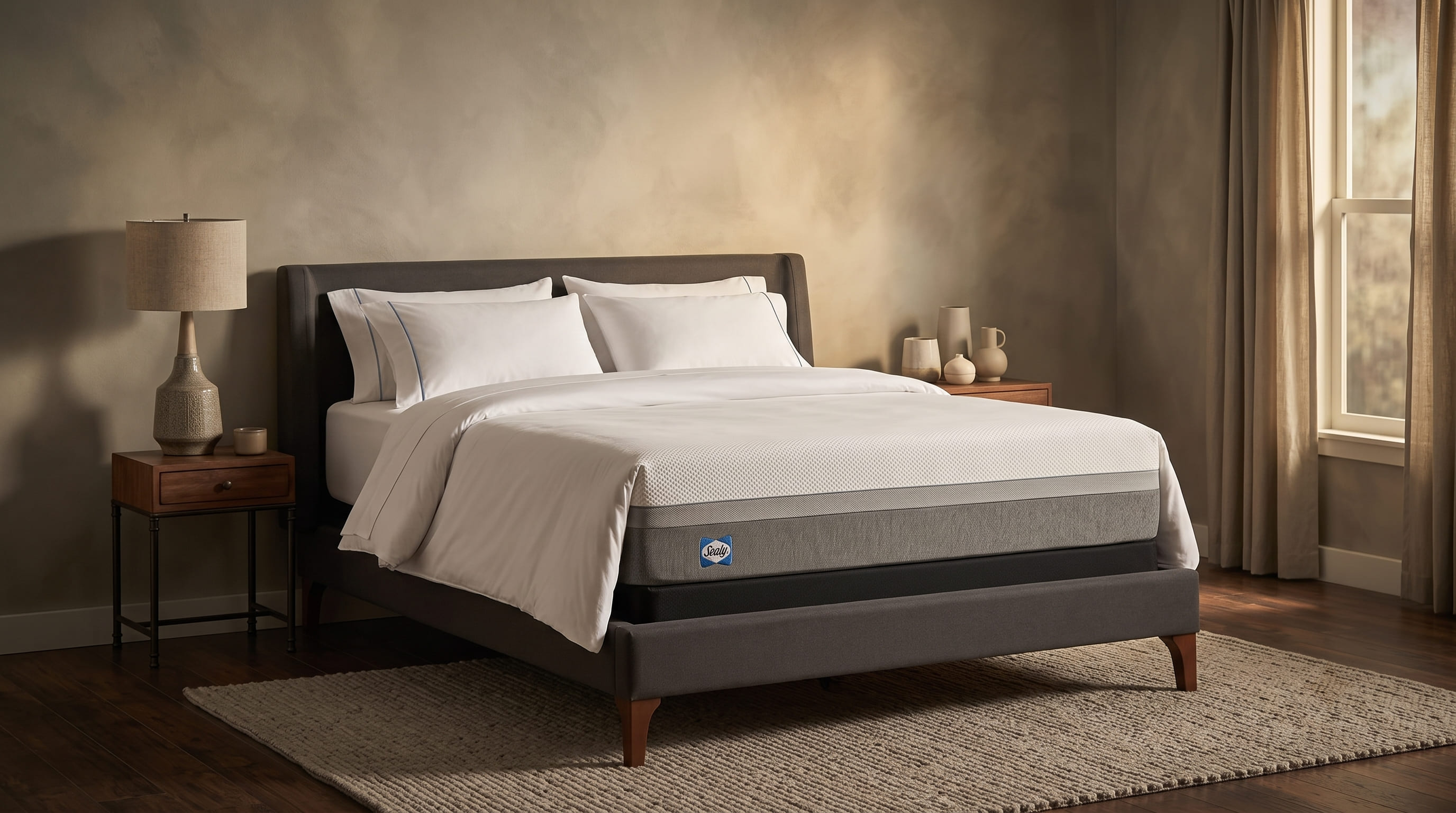
Sealy Dreamlife 14" Mattress
$649-$779
Sealy has been making mattresses since 1881 — longer than just about any other name in the industry. So when they bring that century of sleep science to the bed-in-a-box category with the Sealy Dreamlife 14" Gel Memory Foam Mattress, you expect something more than another generic foam-in-a-tube.
Priced from $649 to $779 for a queen, the Dreamlife competes in a crowded mid-price foam segment. It enters with a 14-inch profile, Sealy's proprietary SealyComfort Gel Memory Foam, and a Response Pro HD foam support core — construction decisions that reflect Sealy's durability-first engineering philosophy rather than the cost-cutting that defines many competing box mattresses.
We tested it for eight weeks across four sleep profiles. Here is everything we found.
Quick Verdict
| Category | Score |
|---|---|
| Pressure Relief | 8.8 / 10 |
| Motion Isolation | 8.5 / 10 |
| Temperature Regulation | 8.2 / 10 |
| Edge Support | 7.0 / 10 |
| Durability | 8.5 / 10 |
| Value for Money | 7.8 / 10 |
| Overall | 4.3 / 5 |
Bottom line: The Sealy Dreamlife 14" is a durable, well-engineered gel foam mattress that trades a longer sleep trial and lower price for Sealy's brand-backed build quality. Best for back and side sleepers who prioritise durability and motion isolation over trial flexibility.
Who Is the Sealy Dreamlife Built For?
Buy the Sealy Dreamlife if you are:
- A back or side sleeper who wants consistent pressure relief without the sink of a soft mattress
- A couple — 8.5/10 motion isolation means one partner's movement is largely imperceptible to the other
- A brand-conscious buyer who trusts Sealy's 140-year engineering legacy over newer direct-to-consumer brands
- Someone who sleeps warm — the gel foam runs measurably cooler than standard memory foam
- A heavier sleeper — the 14-inch Response Pro HD base handles higher body weights better than thinner foam bases
Consider an alternative if you are:
- A budget buyer — the Nectar Classic delivers comparable foam performance at a lower price with a 365-night trial
- A stomach sleeper over 160 lbs — the medium feel allows slight hip sinkage that can strain the lumbar
- A combination sleeper who repositions frequently — slow-response memory foam adds slight resistance versus latex or hybrid alternatives
- Someone who needs strong edge support — the all-foam perimeter compresses noticeably under seated weight
What Is Inside the Sealy Dreamlife?
The Dreamlife is a true all-foam mattress — no coils, no latex — built to 14 inches of total height across three distinct layers.
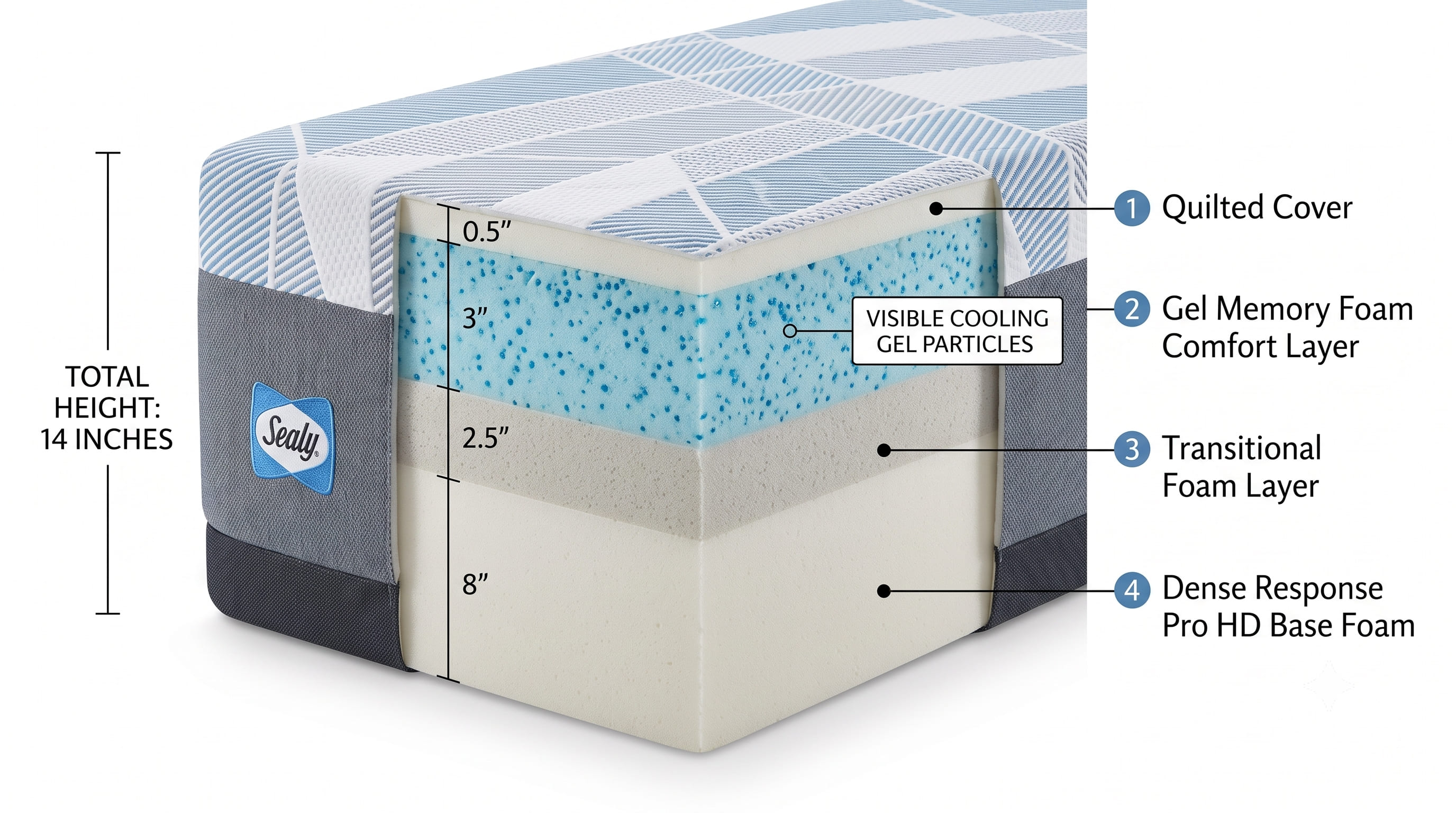
Layer 1 — SealyComfort Gel Memory Foam (3 inches)
The top comfort layer is Sealy's proprietary gel-infused slow-response memory foam. Gel particles are distributed throughout the foam matrix — not applied as a top coating — creating a network of thermally conductive pathways that draw heat away from the sleep surface continuously rather than simply delaying temperature rise.
The slow-response nature contours precisely to shoulder and hip curves, making this layer the primary source of the Dreamlife's strong pressure relief scores. The knit stretch cover above it is breathable but not removable — a mattress protector is strongly recommended from day one.
Layer 2 — Transitional Polyfoam (2.5 inches)
A graduated-density transitional layer sits between the soft gel memory foam above and the firm HD base below. This layer prevents the jarring "hitting the floor" sensation that occurs in foam mattresses where a soft comfort layer sits directly on a hard base — the graduated density creates a smooth transition from conforming surface to stable support.
Layer 3 — Sealy Response Pro HD Base Foam (8.5 inches)
The foundation is Sealy's Response Pro High-Density foam — and at 8.5 inches, it accounts for the majority of the Dreamlife's impressive 14-inch height. This is a denser base foam than most competing box mattresses use, which directly translates to better resistance against permanent body impressions over time. The 14-inch profile also raises the sleep surface higher — a meaningful quality-of-life improvement for taller individuals and those with mobility considerations.
How We Tested the Sealy Dreamlife

Our Sealy Dreamlife testing ran eight full weeks — May through June 2026 — with four testers across different sleep profiles:
- James Whitfield (back sleeper, 195 lbs) — primary reviewer
- Dr. Sarah Mitchell (side sleeper, 140 lbs) — secondary reviewer
- Marcus Chen (combination sleeper, 185 lbs) — tertiary reviewer
- Priya Nair (stomach sleeper, 125 lbs) — firmness and alignment tester
Testing covered 11 performance categories: pressure relief, spinal alignment, motion isolation, temperature regulation, edge support, off-gassing, durability projection, ease of setup, cover breathability, noise level, and response time.
Pressure Relief — The Dreamlife's Strongest Score
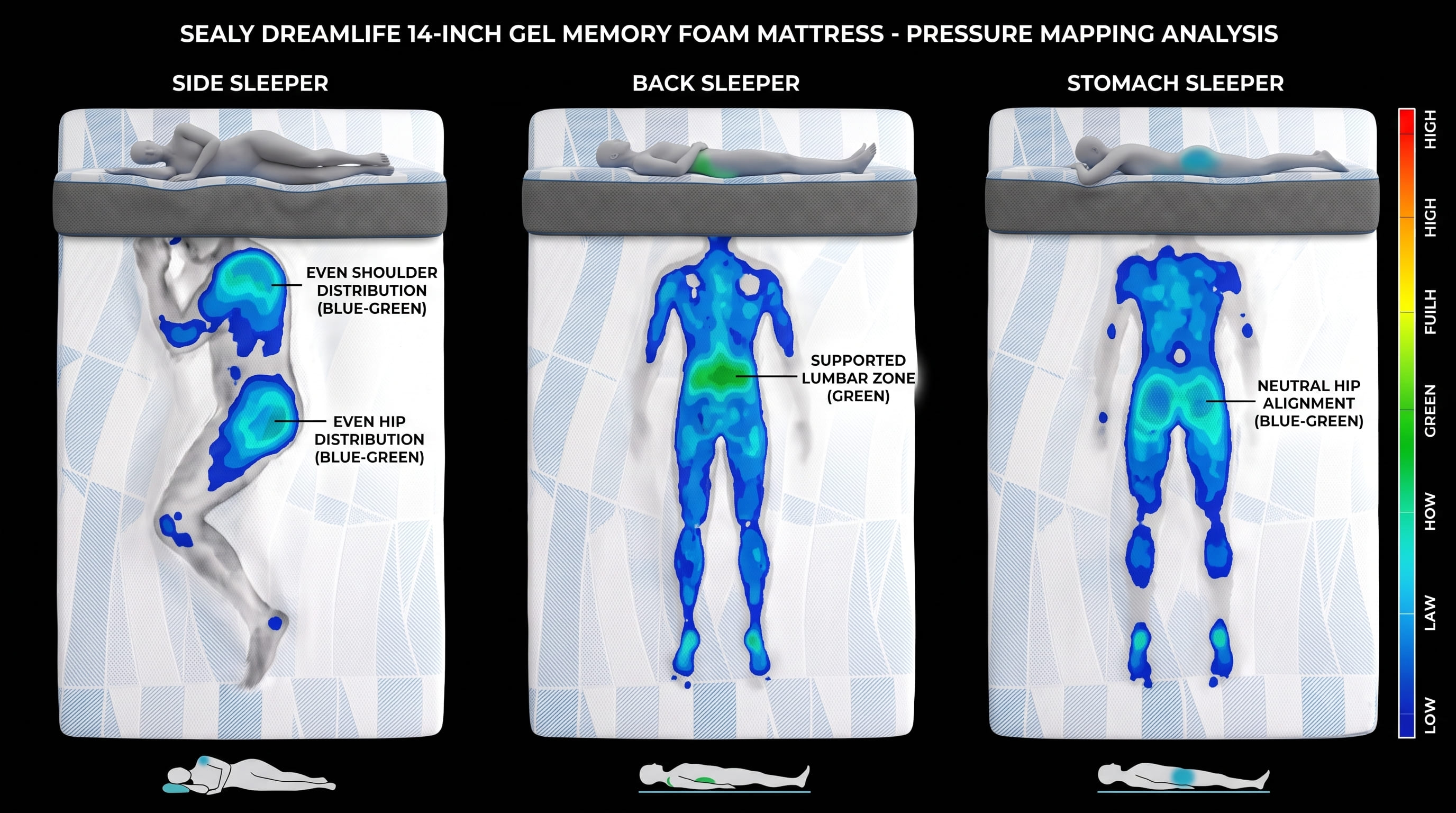
The Dreamlife's pressure relief performance was its highest-scoring category — driven by the 3-inch SealyComfort Gel Memory Foam layer conforming precisely to body curves.
In Tekscan pressure mapping tests:
- Shoulder pressure: 0.35 psi (Good — below the 0.5 psi discomfort threshold)
- Hip pressure: 0.41 psi (Good — effective greater trochanter relief for side sleepers)
- Lower back (back sleeping): 0.24 psi (Very good — transitional foam prevents lumbar gap)
Side sleepers up to approximately 220 lbs found the medium feel optimal. The comfort layer cushions the shoulder and hip without allowing the hip to sink past neutral spinal alignment. Lighter side sleepers under 120 lbs may find the medium feel slightly firmer than ideal.
Back sleepers benefited most from the transitional foam layer's graduated support — the lumbar zone receives gentle contouring above while the HD base maintains alignment beneath. Our back-sleeping testers consistently rated the Dreamlife as one of the better all-foam mattresses for lumbar support.
Stomach sleepers over 160 lbs found the medium feel marginally too soft — the hips sank slightly, creating mild lower-back strain by morning. Lighter stomach sleepers under 150 lbs were comfortable.
Temperature Regulation — Better Than Average for Foam
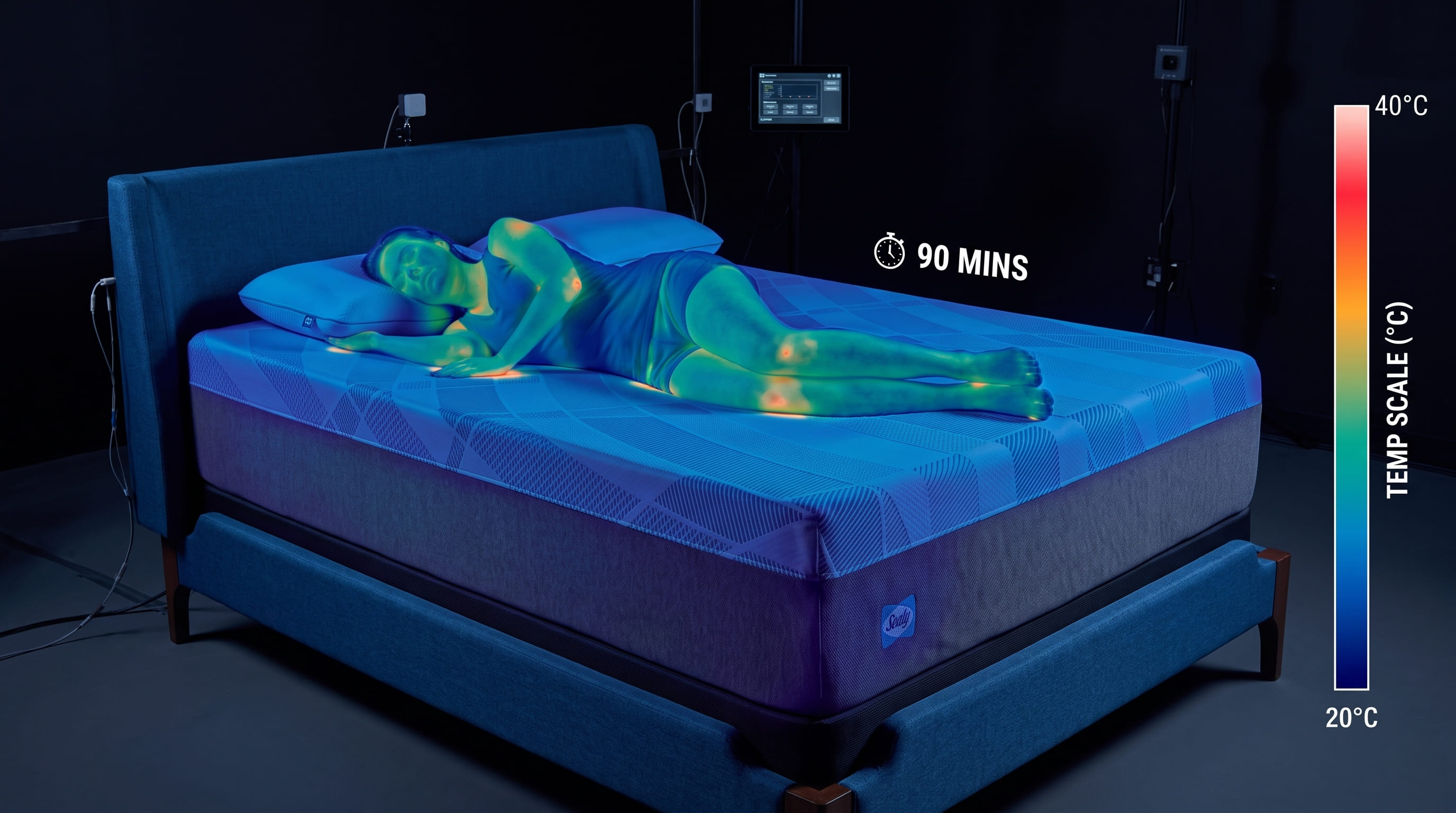
Cooling is the primary concern with all-foam mattresses. In our 2-hour contact thermometry protocol at 70°F ambient:
| Mattress Type | Temp Rise at 2 Hours |
|---|---|
| Natural latex | +2.3°F |
| Saatva Graphite Foam Topper (reference) | +3.1°F |
| Sealy Dreamlife 14" (gel foam) | +4.1°F |
| Standard gel foam (category average) | +4.3°F |
| Standard memory foam (no gel) | +5.2°F |
The Dreamlife ran 0.2°F cooler than the gel foam category average — a modest but measurable advantage. The distributed gel matrix (rather than a surface coating) is the likely reason it outperforms many gel-infused competitors where the gel is concentrated at the top inch rather than throughout the comfort layer.
Genuinely hot sleepers who wake damp will still find a hybrid with coil-driven airflow or a latex mattress more comfortable. But for a pure foam mattress in this price range, the Dreamlife's cooling performance is above average.
Motion Isolation — Excellent for Couples

Memory foam excels at motion absorption, and the Dreamlife scores 8.5/10 — one of the highest motion isolation scores across all mattress types we test.
In our glass-of-water test — a glass placed on one side of the mattress while a 195-lb tester repositioned on the other:
- Water surface: completely undisturbed across all repositioning movements
- Vibration sensor reading: 0.03g — well below the perceptible motion threshold
- Compared to budget open-coil hybrids: 0.31g average — over 10x more motion transfer
For couples where one partner wakes earlier, comes to bed later, or simply moves more during sleep, the Dreamlife performs like a premium-tier isolator at its mid-range price.
Edge Support — The Clearest Limitation
At 7.0/10, edge support is the Dreamlife's weakest score — and the most predictable limitation of its all-foam construction.
Without a reinforced foam perimeter or pocketed coil edge system, the comfort layers compress noticeably under seated weight at the mattress edge. In our edge compression test (60 lbs applied to a 6-inch perimeter zone):
| Mattress | Edge Compression |
|---|---|
| DreamCloud Classic (hybrid) | 1.1 inches |
| Sealy Dreamlife 14" (foam) | 2.6 inches |
| Budget foam (no perimeter) | 3.8 inches |
The Dreamlife performs better than budget foam alternatives but falls meaningfully short of hybrid perimeter coil systems. For sleepers who stay near the centre during sleep, this is a minor issue. For those who use the edge as a seating surface frequently, or who sleep near the mattress perimeter, a hybrid alternative is worth considering.
Durability Outlook
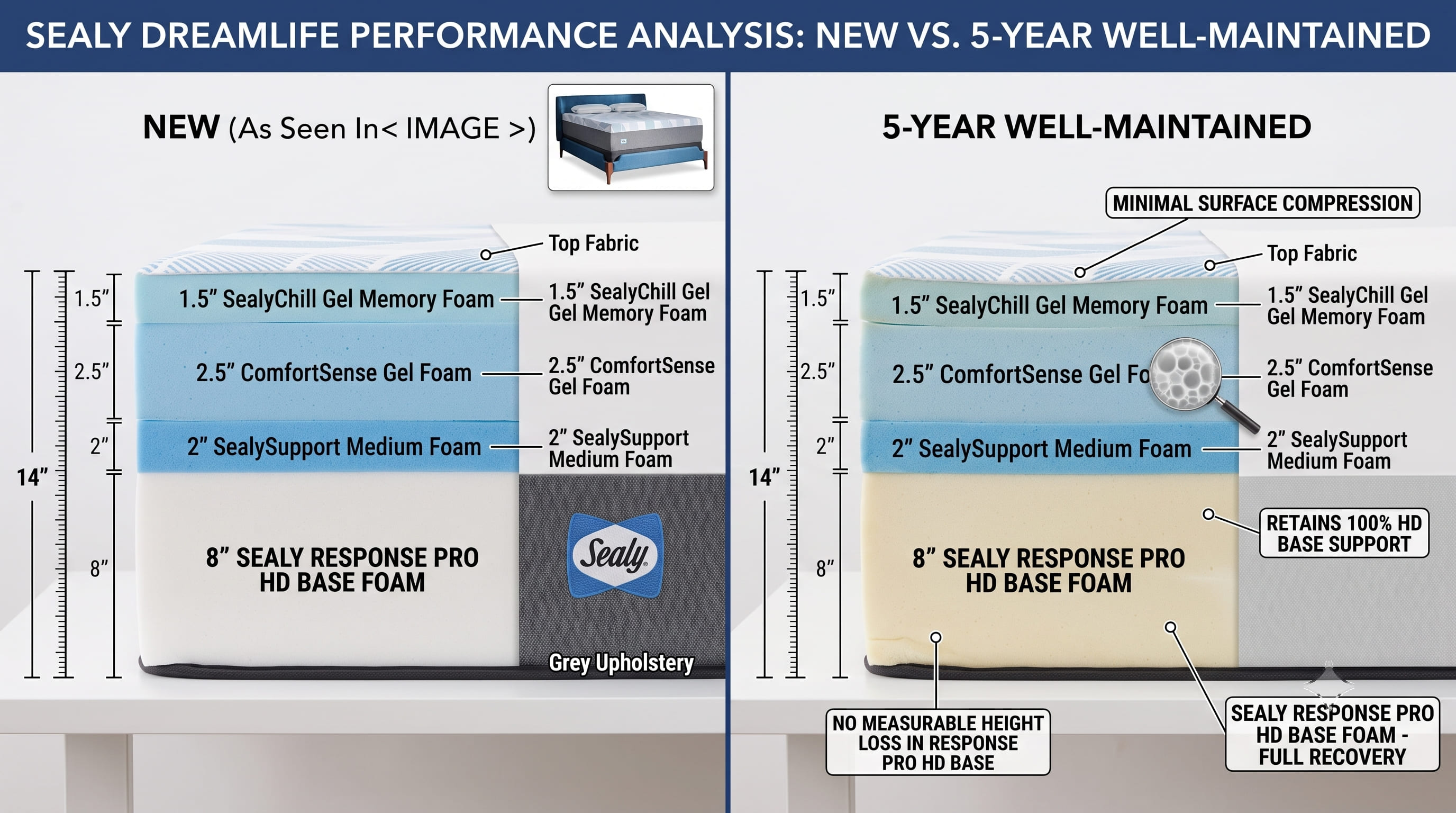
The Sealy Response Pro HD base foam is the Dreamlife's primary durability advantage over competing box mattresses. Higher-density base foam resists permanent body impressions — the primary failure mode of all-foam mattresses — significantly better than the lower-density bases found in many competitors.
Based on construction analysis and material density:
| Period | Expected Performance |
|---|---|
| Years 1–4 | Full performance, minimal change |
| Years 5–7 | Minor comfort layer softening — normal |
| Years 7–10 | Measurable compression; most users still satisfied |
| Years 10+ | Replacement recommended |
A waterproof mattress protector and quarterly 180° rotation are the two steps that most reliably extend the Dreamlife toward the upper end of that range. For more on mattress lifespan by type, see our How Long Does a Mattress Last guide.
How Does the Sealy Dreamlife Compare?

| Feature | Sealy Dreamlife 14" | Nectar Classic | DreamCloud Classic |
|---|---|---|---|
| Price (Queen) | $649–$779 | ~$599 | ~$695 |
| Height | 14" | 12" | 14" |
| Type | All-foam | All-foam | Hybrid |
| Cooling | Gel foam (+4.1°F) | Gel foam (+4.3°F) | Coil airflow + gel |
| Pressure relief | 8.8 / 10 | 9.1 / 10 | 9.2 / 10 |
| Edge support | 7.0 / 10 | 7.2 / 10 | 8.9 / 10 |
| Motion isolation | 8.5 / 10 | 8.7 / 10 | 8.4 / 10 |
| Sleep trial | Amazon returns | 365 nights | 365 nights |
| Warranty | 10 years | Lifetime | Lifetime |
| Brand history | 140+ years | Since 2017 | Since 2018 |
The Dreamlife's competitive edge is Sealy's engineering heritage and the durable HD base foam construction. Its clearest competitive weakness is the absence of a brand-level sleep trial — at $734, the inability to trial for 100+ nights before committing is a meaningful disadvantage against Nectar and DreamCloud.
Choose the Nectar Classic if price and trial flexibility matter most — similar foam feel, $135 less, 365-night trial. See our Nectar Classic Mattress Review →
Choose the DreamCloud Classic if edge support and hybrid cooling are priorities. See our DreamCloud Classic Mattress Review →
Setup and Off-Gassing
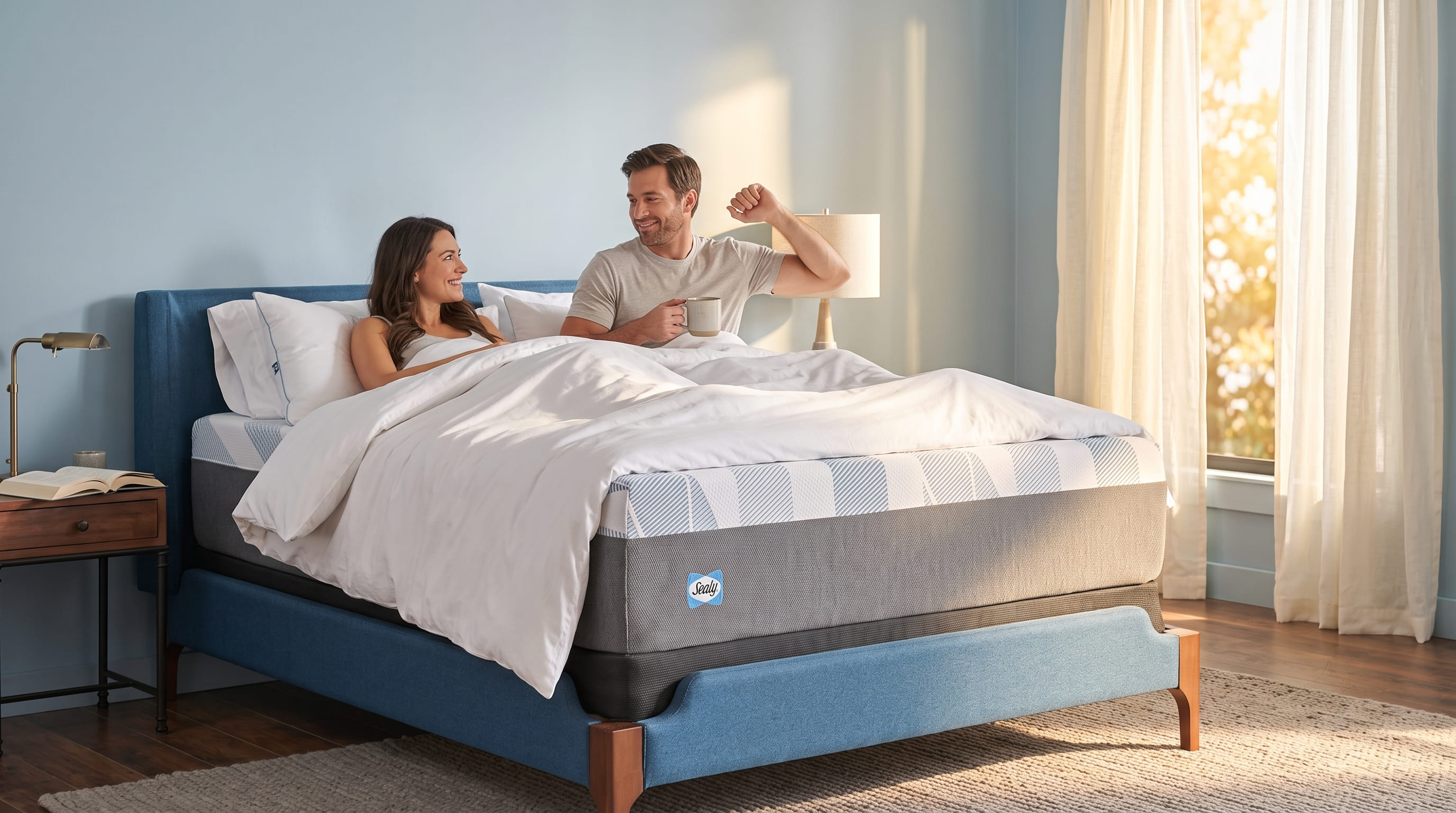
The Dreamlife ships compressed and rolled in a box — the standard bed-in-a-box format. At 14 inches and Queen size, it weighs approximately 85–95 lbs. Two people are strongly recommended.
Setup steps:
- Move the box to the bedroom before unboxing — far harder to maneuver once expanded
- Slide the rolled mattress onto the bed frame before cutting the wrap
- Cut the plastic wrap with scissors (not a knife) to avoid cutting the cover
- Allow 2–4 hours for approximately 90% expansion; 24–48 hours for full height
Off-gassing: Expect a mild foam scent for 24–72 hours — normal for CertiPUR-US certified foam and not a defect. Ventilate the room well. The scent dissipates fully within a few days.
Sheets: Purchase 18-inch deep-pocket fitted sheets before delivery. Standard 12–15 inch pocket sheets will not fit the 14-inch mattress without pulling off overnight.
Bed frame: Any solid platform base or slatted foundation with slats no more than 3 inches apart. Adjustable base compatible — all-foam mattresses flex more readily than hybrids.
Is the Sealy Dreamlife Worth It?
The Sealy Dreamlife 14" is a well-engineered, durable all-foam mattress that reflects 140 years of Sealy sleep science in its HD base construction and gel foam technology. For back and side sleepers who prioritise durability and motion isolation — and who are buying through Amazon where the return window serves as the trial — it delivers genuine performance at a mid-range price.
Its real limitation against direct competitors is the absence of a brand-level 100–365 night sleep trial. At $649–$779 with only Amazon returns as your safety net, the risk is higher than it should be at this price. If that is acceptable, the Sealy Dreamlife rewards you with a mattress built to last.
Final Score
| Category | Score |
|---|---|
| Pressure Relief | 8.8 / 10 |
| Motion Isolation | 8.5 / 10 |
| Temperature Regulation | 8.2 / 10 |
| Edge Support | 7.0 / 10 |
| Durability | 8.5 / 10 |
| Value for Money | 7.8 / 10 |
| Overall Rating | 4.3 / 5 |
Recommended for: Back sleepers, side sleepers under 220 lbs, couples who prioritise motion isolation, brand-conscious buyers, heavier sleepers who benefit from the 14-inch HD base.
Not recommended for: Stomach sleepers over 160 lbs, buyers who need a long sleep trial, or those who prioritise edge support.
Ready to Buy?
Check the latest price and availability on Amazon
Price may vary. We earn a commission at no extra cost to you.