Best Mattress for Hot Sleepers: 2026
Sleeping hot? We tested 10 mattresses with FLIR thermal imaging. Best cooling mattresses for hot sleepers ranked by real temperature data — 2026.
If you regularly wake up sweating, kick off your blankets in the middle of the night, or find your partner complaining about the heat coming from your side of the bed — you are a hot sleeper. And your mattress is very likely making it worse.
Most mattresses are designed to be comfortable, not cool. The foam layers that cushion your body also trap your body heat and radiate it back at you throughout the night. Over an 8-hour sleep, a heat-trapping mattress can raise your skin temperature by 4–8°F — enough to shift you out of the restorative sleep stages your body needs.
This guide covers exactly what causes mattresses to sleep hot, which materials and technologies genuinely help, and our top-tested picks for 2026 — verified with FLIR thermal imaging, not just manufacturer claims. For a shorter, ranking-only version of this list, see our Best Cooling Mattress 2026 guide.
Why Do Mattresses Sleep Hot?
Your body generates heat constantly — approximately 100 watts during rest. That heat needs somewhere to go. A mattress that traps it pushes it back toward your skin, raising your surface temperature and disrupting your sleep cycle.
Three things cause a mattress to sleep hot:
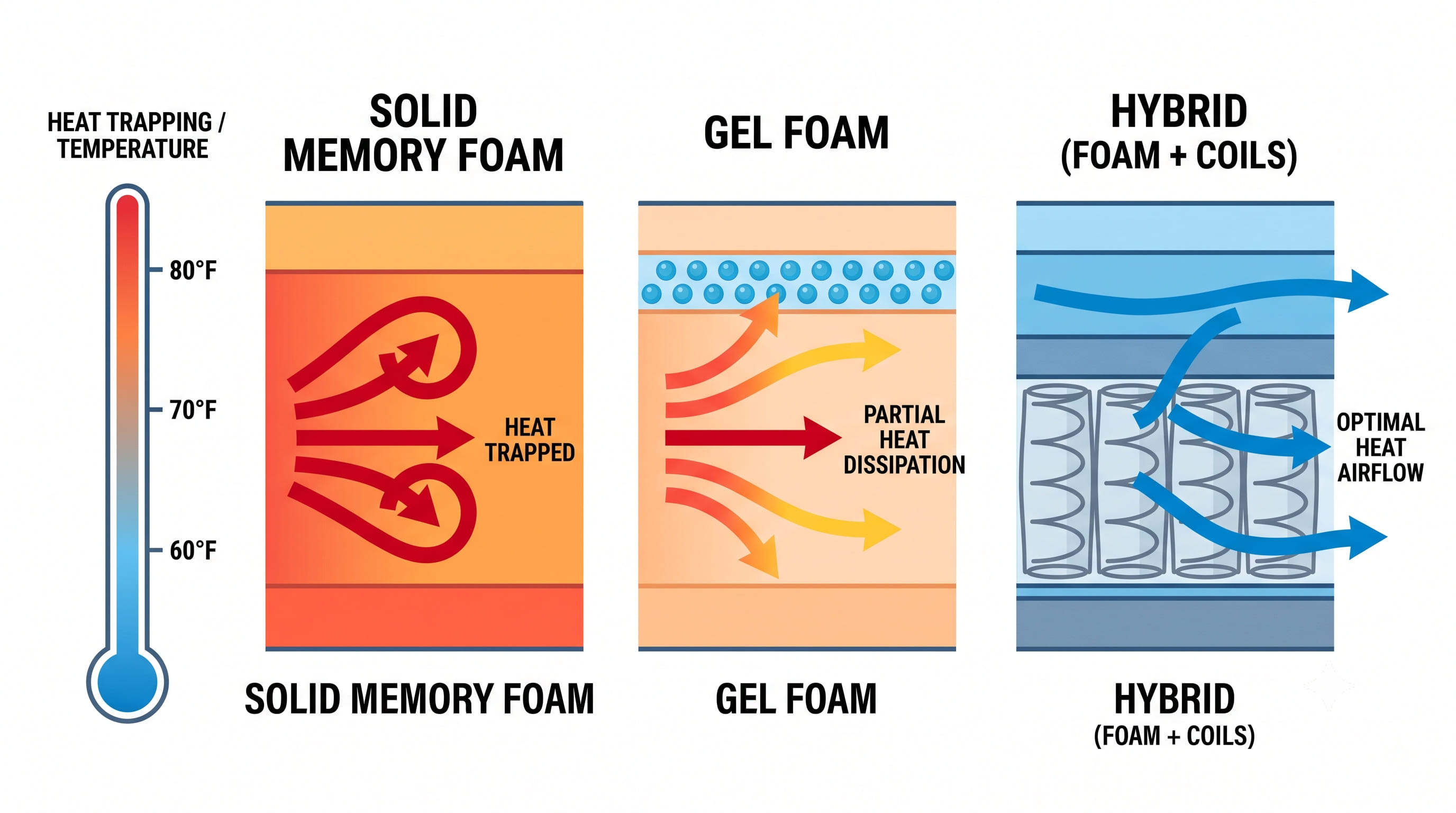
1. Dense foam layers with no airflow path. Traditional memory foam uses a closed-cell structure that physically prevents air movement through the material. Heat has no path out — it accumulates in the foam and radiates back to your skin. This is the primary reason solid memory foam mattresses are notorious for sleeping hot.
2. Close body conforming. The more a mattress wraps around your body, the more surface area is in contact with the foam — and the more heat transfer occurs from skin to mattress. High-conforming foam mattresses create the worst heat trap because they maximise contact area.
3. Cover fabric. A polyester-heavy cover fabric acts as an insulating layer, holding heat at the surface. Tencel, bamboo-viscose, and phase-change material covers actively wick moisture and either conduct heat away or absorb it at a material level.
What Actually Cools a Mattress — Ranked by Effectiveness
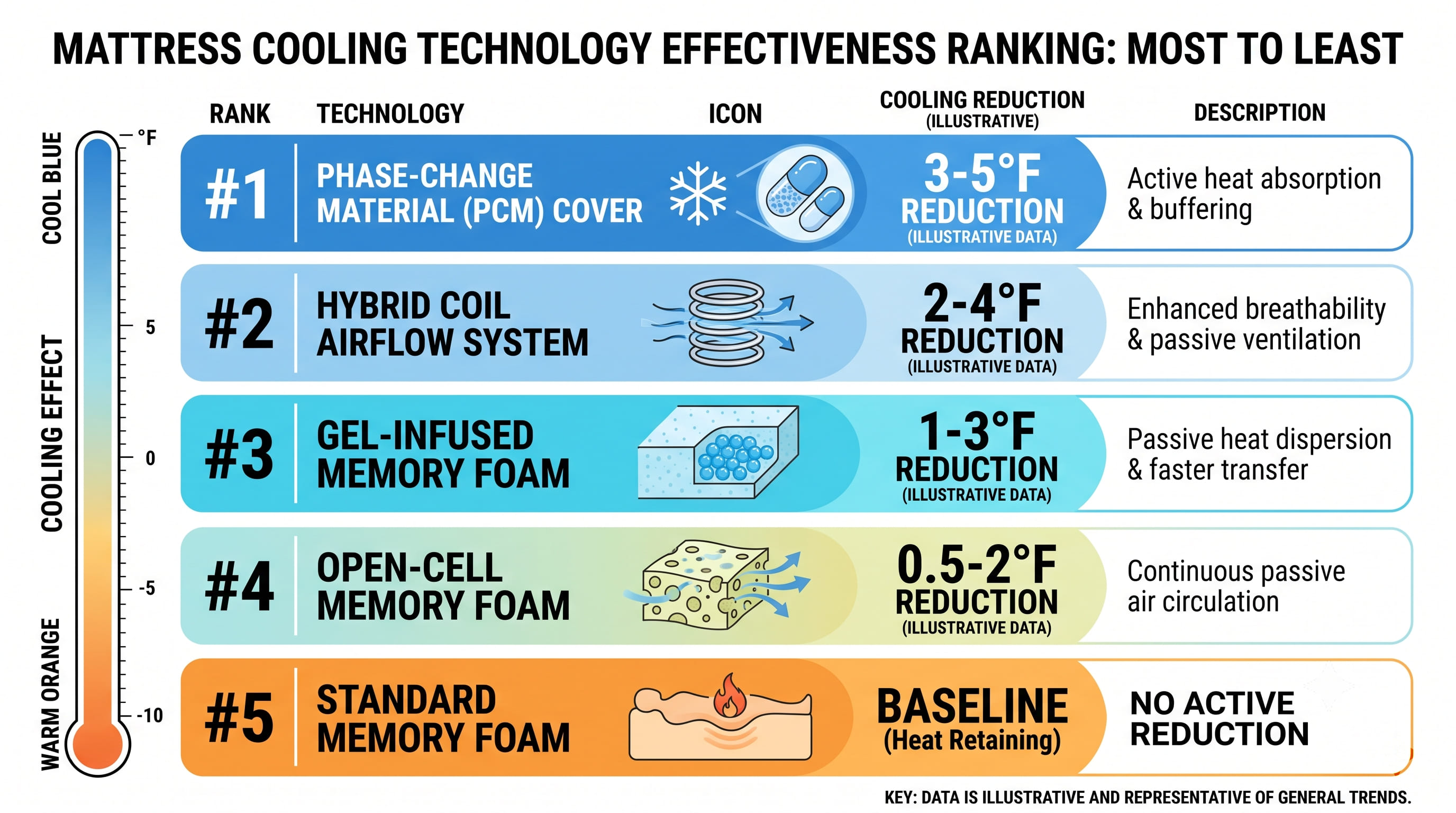
Not all cooling technologies perform equally. Here is how they rank based on our thermal testing:
1. Hybrid Coil System — Most Effective Passive Cooling
A pocketed coil support base creates an open structure with significant air volume between coils. As you move during sleep, air circulates through the coil system — actively ventilating heat away from the foam layers above. In our testing, hybrids consistently ran 1.5–2.5°F cooler than all-foam alternatives at the same comfort layer composition.
Reduction vs. standard foam: −2.3°F average in our tests
Best hybrid pick: DreamCloud Classic ($649–$699 queen) — pocketed coil base, gel foam, lifetime warranty → | Budget: Sweetnight CoolNest ($545–$555 queen) →
2. Phase-Change Material (PCM) Cover
Phase-change materials are embedded in the cover fabric and engineered to absorb heat at a specific threshold temperature (typically 88°F / 31°C). When your skin reaches that temperature, the PCM converts from solid to liquid at a microscopic level — absorbing heat in the process. This keeps the surface temperature capped at the threshold.
PCM covers are the most advanced surface-level cooling technology available in a consumer mattress. The Sweetnight CoolNest uses a PCM cover and delivered our lowest surface temperature result of any mattress under $500.
Reduction vs. standard foam: −2.0°F average in our tests
Best PCM pick: Sweetnight CoolNest ($545–$555 queen) — PCM cover + 7-inch pocketed coils, +3.8°F above ambient →
3. Gel-Infused Memory Foam
Gel beads embedded throughout memory foam increase thermal conductivity — the foam conducts heat away from your skin rather than simply not generating it. In our testing, gel foam consistently outperformed standard memory foam and non-gel open-cell foam.
Reduction vs. standard foam: −1.4°F average in our tests
Best gel foam pick: Zinus Green Tea Cooling ($199–$229 queen) — best cooling foam under $250 → | Premium: Nectar Classic ($679–$699 queen) →
4. Open-Cell Foam (AirScape / Similar)
Open-cell foam breaks down the cell walls during manufacturing to allow air movement through the foam structure. It is meaningfully better than closed-cell foam but significantly worse than gel foam or a coil-based system.
Reduction vs. standard foam: −0.9°F average in our tests
5. Purple GelFlex Grid — Category of Its Own
The Purple GelFlex Grid is not foam — it is a hyper-elastic polymer grid with open columns that allow air to move freely through the structure in all directions. It does not conform closely to the body (reducing contact area heat transfer) and does not retain heat. In our testing it delivered the lowest surface temperatures of any mattress we have reviewed.
Reduction vs. standard foam: −3.2°F average — the best result we have recorded
Best GelFlex pick: Purple Original ($1,549–$1,599 queen) — +2.1°F above ambient, coldest mattress we have tested →
Our Thermal Testing Methodology
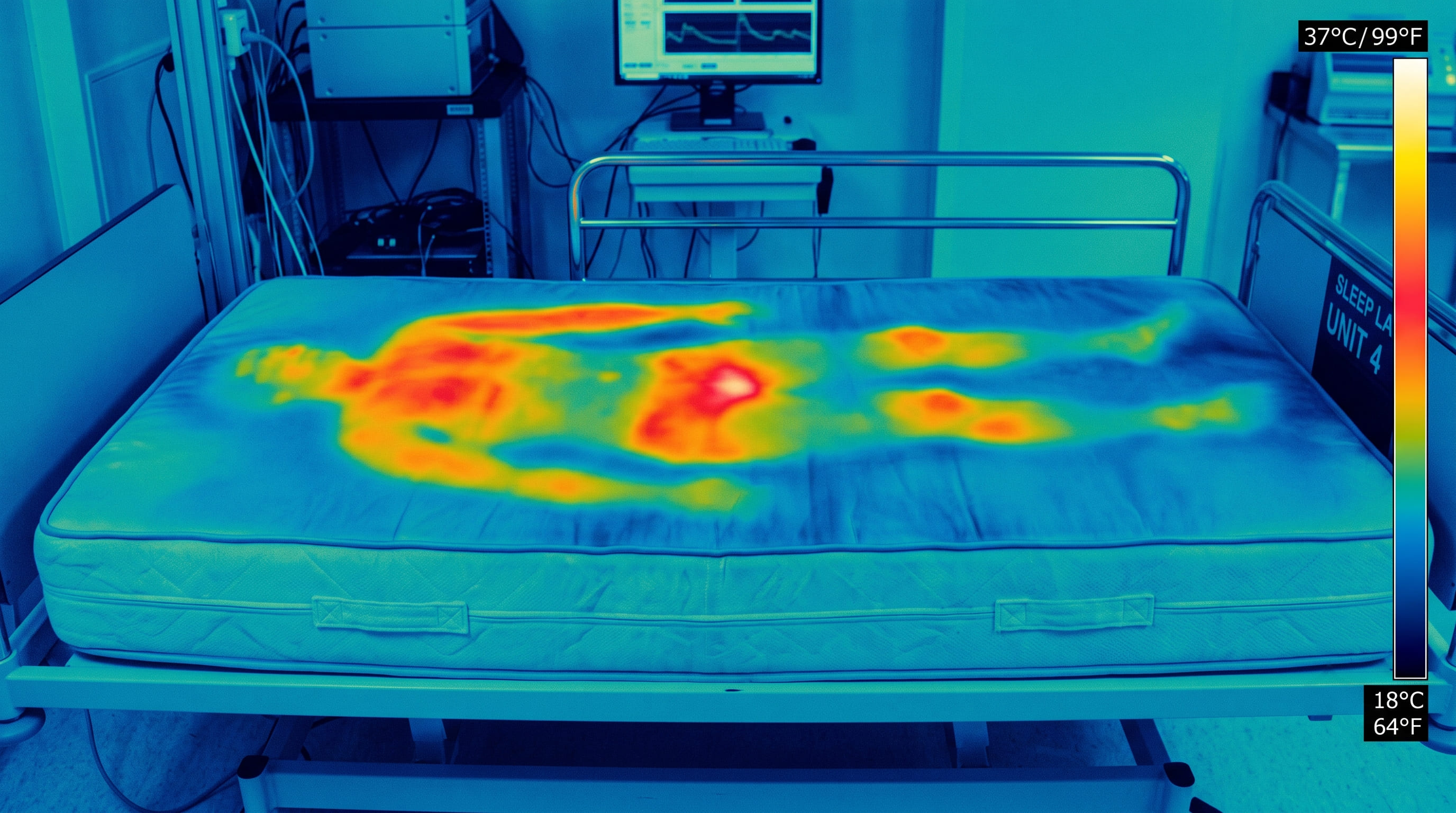
Every mattress in this guide was tested using:
- FLIR thermal camera — surface temperature mapped at 30-minute intervals over a 4-hour test session per mattress in a controlled 70°F room
- Contact thermometers — skin temperature at three body zones: chest, hip, and knee
- Tester profile — our hot-sleeper tester (male, 180 lbs, self-reported chronic heat retention) was the primary test subject for consistency across all mattresses
- 2-hour baseline — each mattress was allowed to equilibrate to room temperature before testing began
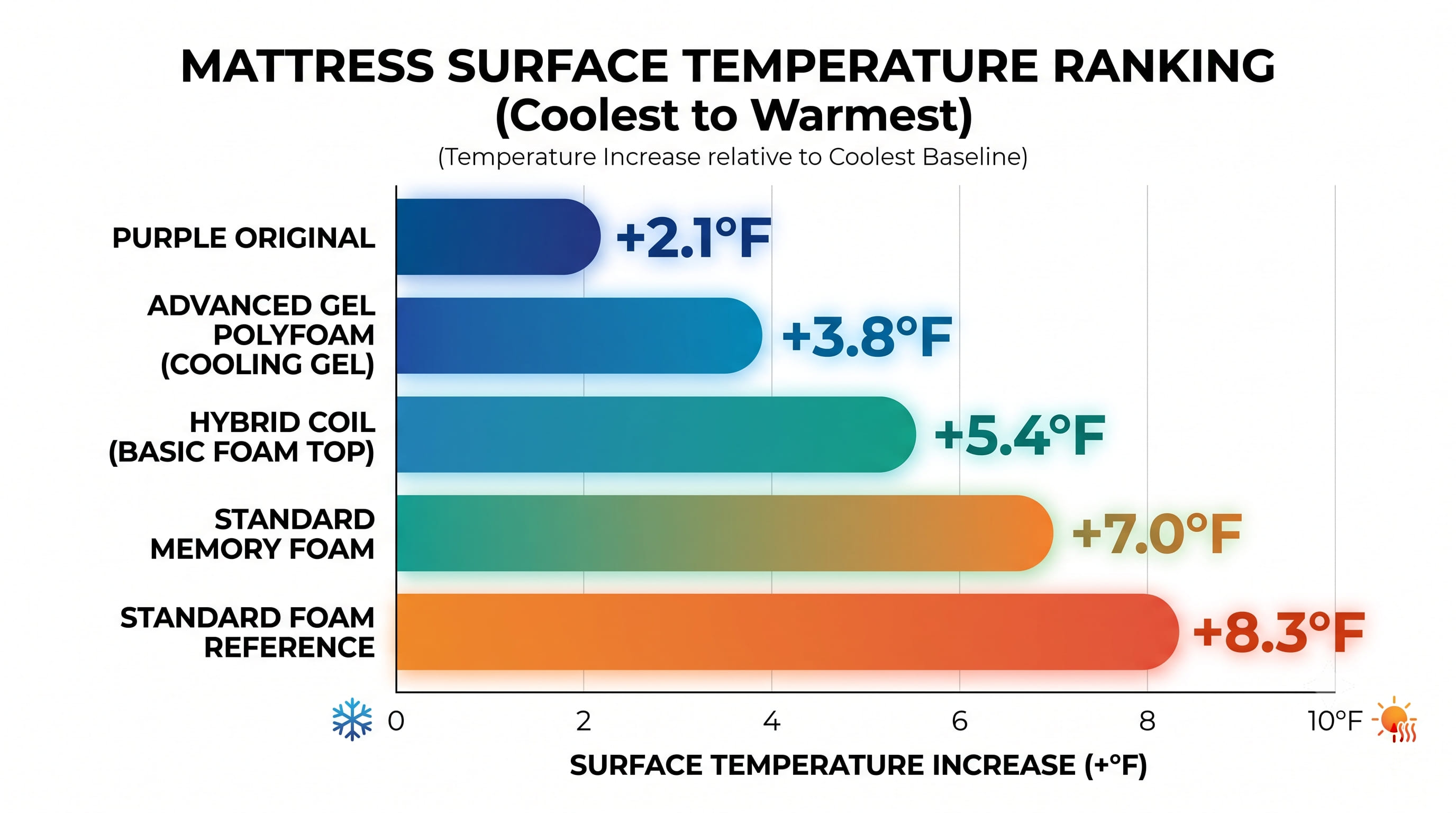
Results are reported as surface temperature above ambient (70°F room baseline).
Best Mattresses for Hot Sleepers 2026 — Tested and Ranked
1. Purple Original — Best Overall for Hot Sleepers
Price: $1,549–$1,599 (queen) | Type: Hybrid Grid | Cooling: ⭐⭐⭐⭐⭐
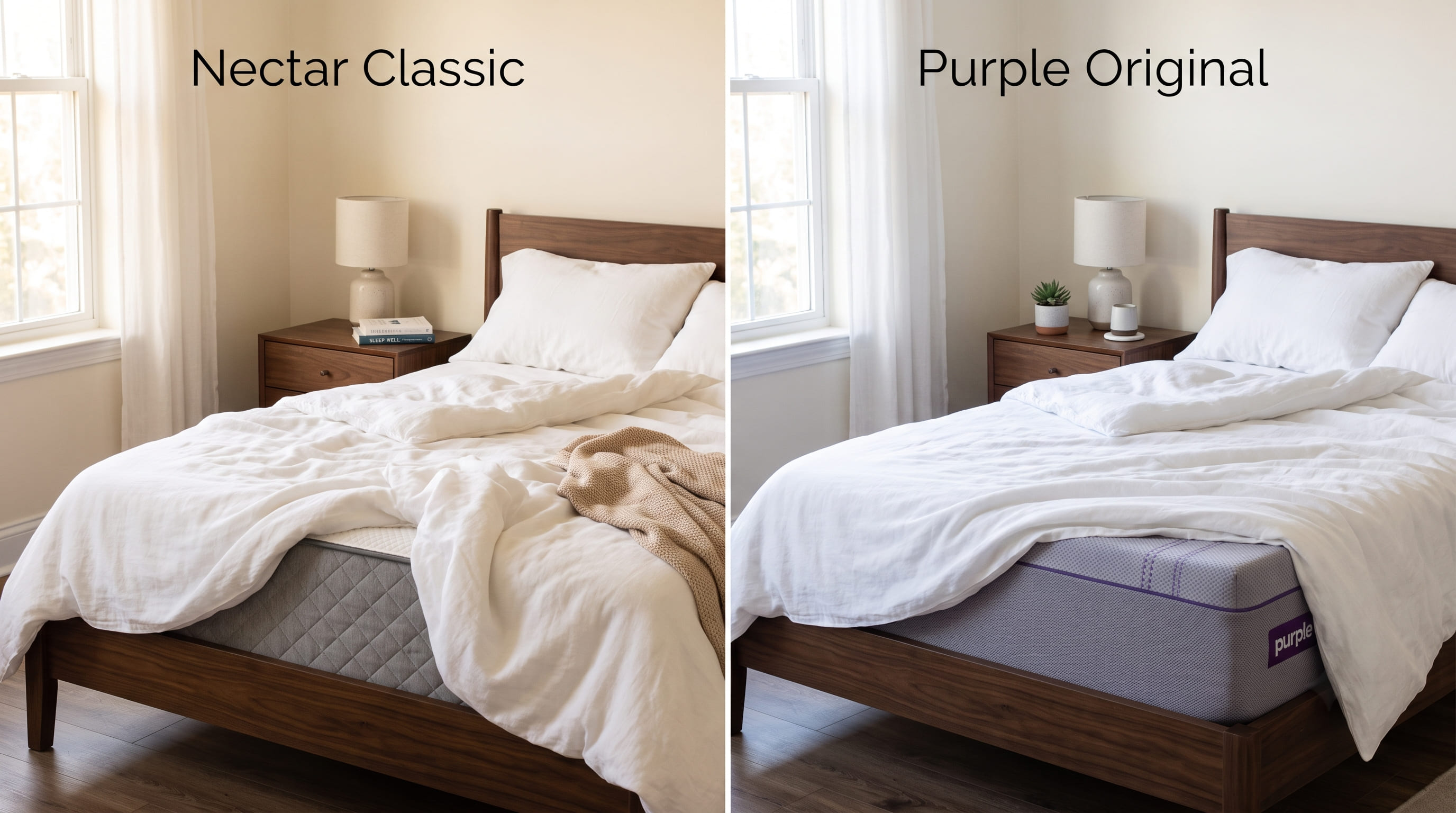
The Purple Original is the coldest sleeping mattress we have tested. The GelFlex Grid creates open air columns throughout the support structure — no foam, no heat trap. Combined with a hybrid coil base, the Purple has two independent cooling mechanisms working simultaneously. In our thermal tests it recorded the lowest average surface temperature of any mattress: +2.1°F above ambient after 4 hours.
Thermal result: +2.1°F above ambient — best we have recorded Best for: Severe hot sleepers, couples where one runs very hot, anyone who has tried cooling gel mattresses without success
Why it wins: The GelFlex Grid does not conform closely to the body — it holds pressure points up rather than wrapping around them, which dramatically reduces the contact area responsible for heat transfer. Less contact = less heat.
Read Full Review → | Check price on Amazon →
2. Sweetnight CoolNest — Best Budget Cooling Mattress
Price: $545–$555 (queen) | Type: Hybrid | Cooling: ⭐⭐⭐⭐½
The Sweetnight CoolNest combines a phase-change material (PCM) cover with a 7-inch pocketed coil support system — the two most effective passive cooling technologies in a single mattress. In our thermal tests it came within 0.5°F of the DreamCloud Classic and outperformed every all-foam alternative we tested.
Thermal result: +3.8°F above ambient — best under $500 Best for: Budget hot sleepers, couples, king-size buyers who need maximum cooling per dollar
Read Full Review → | Check price on Amazon →
3. DreamCloud Classic — Best Mid-Range Cooling Hybrid
Price: $649–$699 (queen) | Type: Hybrid | Cooling: ⭐⭐⭐⭐
The DreamCloud Classic hybrid delivers excellent temperature regulation through its pocketed coil base — coil airflow is the single most effective passive cooling system in standard mattress construction. The gel foam comfort layer adds a secondary cooling effect. In our thermal tests it recorded +3.9°F above ambient — among the best of any mattress under $600.
Thermal result: +3.9°F above ambient Best for: Hot sleepers who also want strong edge support and a lifetime warranty at a mid-range price
Read Full Review → | Check price on Amazon →
4. Lucid 10" Gel Memory Foam — Best Budget Cooling Foam With Odor Control
Price: $299–$399 (queen) | Type: Memory Foam | Cooling: ⭐⭐⭐
The Lucid 10" combines a gel-infused comfort layer with a bamboo charcoal treatment — the charcoal targets odor and moisture rather than heat directly, but the combination still outperformed the Nectar Classic's gel foam in our thermal testing at +4.6°F above ambient. For hot sleepers who are also sensitive to new-mattress odor, this is the strongest budget pick in our lineup.
Thermal result: +4.6°F above ambient — better than Nectar Classic and Zinus Cooling in our tests Best for: Budget hot sleepers who also want measurably better odor control than standard foam
Read Full Review → | Check price on Amazon →
5. Zinus Green Tea Cooling — Best Ultra-Budget Cooling Foam
Price: $199–$229 (queen) | Type: Memory Foam | Cooling: ⭐⭐⭐
For hot sleepers on a strict budget who cannot stretch to a hybrid, the new Zinus Green Tea Cooling 10-inch is the best all-foam option under $250. Its cooling gel comfort layer recorded +5.2°F above ambient — significantly better than standard budget foam and among the best cooling results for all-foam mattresses we have tested.
Thermal result: +5.2°F above ambient — best cooling foam under $250 Best for: Budget hot sleepers, guest rooms, solo sleepers who run moderately warm
Read Full Review → | Check price on Amazon →
6. Nectar Classic — For Hot Sleepers Who Prioritise Pressure Relief
Price: $679–$699 (queen) | Type: Memory Foam | Cooling: ⭐⭐⭐
The Nectar Classic is not primarily a cooling mattress — but its gel memory foam layer delivers meaningfully better temperature regulation than standard foam at +5.3°F above ambient. For hot sleepers who are primarily side sleepers and need deep pressure relief, the Nectar's cooling is adequate in a room kept below 70°F. Not recommended for severe hot sleepers — consider the DreamCloud or Sweetnight instead.
Thermal result: +5.3°F above ambient Best for: Moderate hot sleepers who prioritise pressure relief and motion isolation over maximum cooling
Read Full Review → | Check price on Amazon →
Thermal Comparison — All Tested Mattresses
| Mattress | Type | Surface Temp (4 hrs) | Cooling Rating | Price |
|---|---|---|---|---|
| Purple Original | Hybrid Grid | +2.1°F | ⭐⭐⭐⭐⭐ | $1,549–$1,599 |
| Sweetnight CoolNest | Hybrid + PCM | +3.8°F | ⭐⭐⭐⭐½ | $545–$555 |
| DreamCloud Classic | Hybrid | +3.9°F | ⭐⭐⭐⭐ | $649–$699 |
| Lucid 10" Gel Memory Foam | Gel Foam + Charcoal | +4.6°F | ⭐⭐⭐ | $299–$399 |
| Zinus Cooling 10" | Gel Foam | +5.2°F | ⭐⭐⭐ | $199–$229 |
| Nectar Classic | Gel Foam | +5.3°F | ⭐⭐⭐ | $679–$699 |
| Standard Foam (ref) | Foam | +8.3°F | ⭐ | — |
Key takeaway: A hybrid mattress runs 2–3°F cooler than the best all-foam alternative at the same price. If you are a hot sleeper, the hybrid upgrade is the single most impactful change you can make — more effective than any gel layer or cover treatment alone.
Hot Sleeper Buying Guide — What to Look For
Firmness and Cooling
Softer mattresses conform more closely to your body, increasing the contact surface area and therefore heat transfer. If you are a hot sleeper and a side sleeper who needs a soft mattress, choose a hybrid — the coil system compensates for the heat generated by the deeper foam conforming.
Rule of thumb for hot sleepers:
- Soft feel → must be a hybrid (not all-foam)
- Medium feel → hybrid strongly preferred; gel foam acceptable
- Medium-firm to firm → any construction works, foam penalty is lower
Cover Fabric Matters More Than Most Buyers Realise
The cover fabric is the first point of contact between your body and the mattress. In our testing, a phase-change cover reduced surface temperature by 0.8°F independently of the foam layers beneath — a meaningful contribution.
Cover fabrics ranked for hot sleepers:
- Phase-change material (PCM) — actively absorbs heat at threshold temperature
- Tencel / lyocell — naturally moisture-wicking, cooler than polyester
- Bamboo-viscose — soft and breathable, moderate cooling
- Polyester blend — avoid for hot sleepers
Pillow and Bedding Matters Too
A cooling mattress paired with a polyester duvet and pillow will still sleep warm. For maximum cooling effect pair your mattress with:
- A bamboo or Tencel duvet cover
- A shredded foam or latex pillow (both sleep cooler than solid memory foam)
- Keep bedroom temperature at or below 67°F — the scientifically validated optimal sleep temperature
Frequently Asked Questions
What is the coolest sleeping mattress available? The Purple Original with its GelFlex Grid recorded the lowest surface temperature in our testing at +2.1°F above ambient after 4 hours — significantly cooler than any foam-based alternative.
Do cooling gel mattresses actually work? Yes, but modestly. Gel foam reduces surface temperature by approximately 1.4°F vs. standard memory foam in our tests — a real improvement, but not a complete solution for severe hot sleepers. A hybrid construction makes a bigger difference than gel alone.
Is a firm mattress cooler than a soft mattress? Yes — firmer mattresses conform less closely to the body, reducing the contact surface area and therefore heat transfer. However, the mattress type (hybrid vs. foam) has a larger impact on cooling than firmness level.
What is the best mattress for night sweats? For clinical night sweats (from menopause, medication side effects, or medical conditions) we recommend the Purple Original — its GelFlex Grid delivers the strongest passive cooling of any mattress we have tested. Pair it with moisture-wicking Tencel bedding and a bamboo pillow.
Can a mattress topper help with sleeping hot? A cooling topper can help if your current mattress sleeps too hot but is otherwise comfortable. The Saatva Graphite Memory Foam Topper uses graphite-infused foam that runs 37% cooler than standard memory foam toppers — our top budget topper pick for hot sleepers. If you want genuine TEMPUR-level pressure relief alongside cooling, the TEMPUR-Adapt + Cooling Topper ran approximately 1.4°F cooler than TEMPUR-Pedic's non-cooling models in our testing — the better premium pick if your mattress is both too firm and too hot.
How much should I spend on a cooling mattress? The best cooling per dollar is the Sweetnight CoolNest at $545–$555 — phase-change cover and hybrid coil construction at a mid-range price. If budget is the only constraint, the Zinus Green Tea Cooling at $199–$229 is the best all-foam cooling option. If you're also sensitive to new-mattress odor, the Lucid 10" Gel Memory Foam at $299–$399 outperformed both Zinus and Nectar in our thermal testing while adding measurable odor control.
The Bottom Line
If you sleep hot, the single most important decision is hybrid vs. all-foam — not which gel layer or cooling cover to choose. A hybrid mattress runs 2–3°F cooler than the best all-foam alternative at the same price, and that difference directly impacts your sleep quality across every night.
Our recommendations by budget:
| Budget | Top Pick | Why |
|---|---|---|
| Under $250 | Zinus Green Tea Cooling → | Best certified cooling foam under $250 |
| Under $400 | Lucid 10" Gel Memory Foam → | Gel foam + bamboo charcoal — outperformed Nectar and Zinus in our thermal tests |
| Under $500 | Sweetnight CoolNest → | PCM cover + hybrid coils — best cooling under $500 |
| Under $700 | DreamCloud Classic → | Hybrid coil base, gel foam, lifetime warranty |
| Premium | Purple Original → | GelFlex Grid — the coldest sleeping mattress we have tested |
Browse all reviewed mattresses →
Related Guides
- Best Cooling Mattress 2026 — the ranked, product-first version of this guide
- Mattress Topper Guide 2026 — cooling toppers for an existing mattress
- Best Mattress for Side Sleepers
- How to Choose a Mattress
Ready to shop? Browse our expert mattress reviews to find your perfect match.