Hybrid vs Memory Foam Mattress: 2026
Hybrid or memory foam? We compare cooling, pressure relief, motion isolation & durability with real lab data. Which mattress type suits you — 2026.
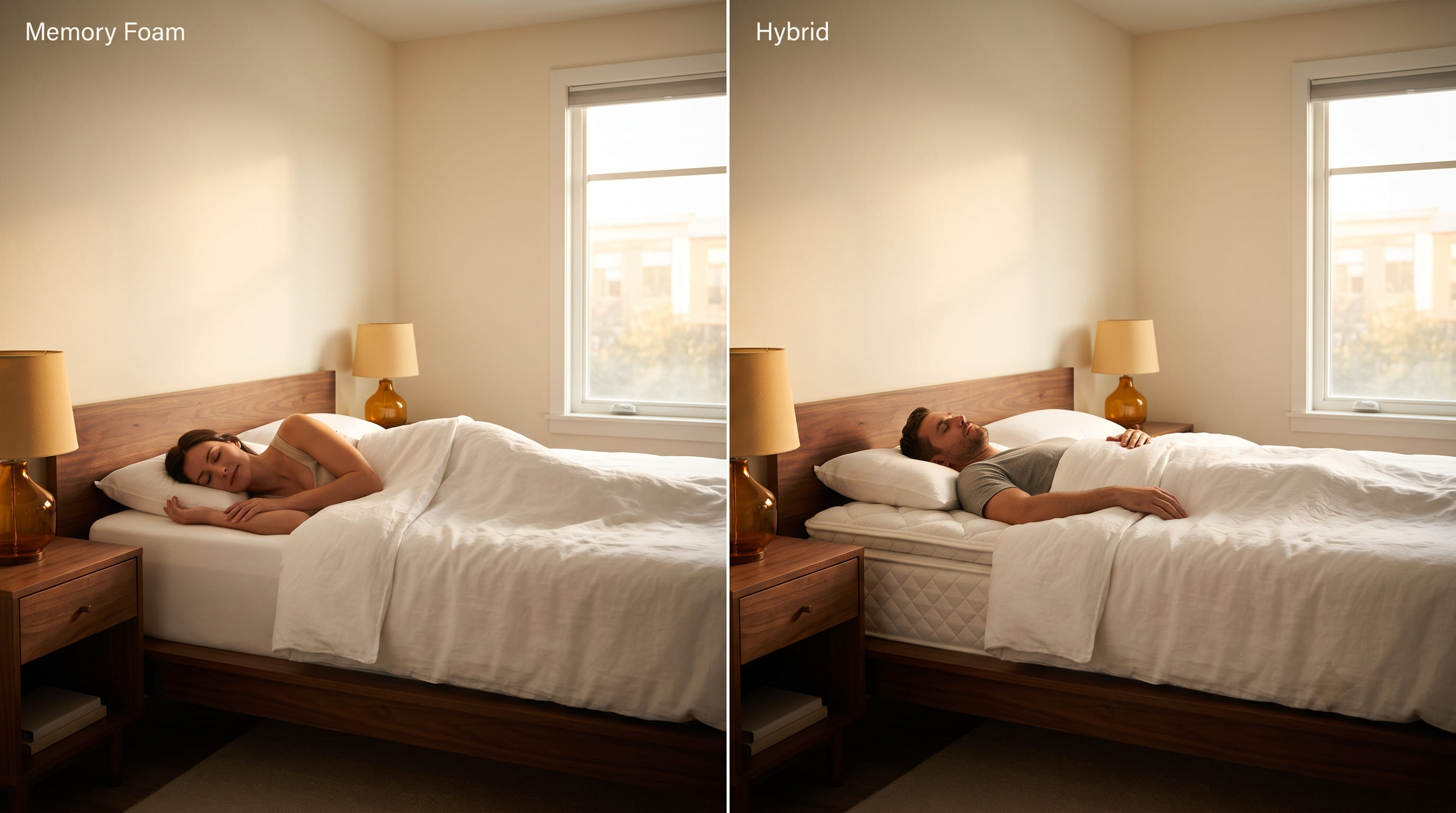
Choosing between a hybrid and a memory foam mattress is the most common question we receive — and the one most guides answer poorly. Most articles tell you what each type is rather than which one is right for you.
This guide skips the filler. We break down the five factors that actually determine which mattress type will improve your sleep: temperature, pressure relief, support, motion isolation, and price. At the end, you will know exactly which type fits your sleep profile — and which specific mattresses to consider.
What Actually Separates These Two Types
Before the comparison, a quick grounding on what makes each type structurally different — because everything else flows from this.
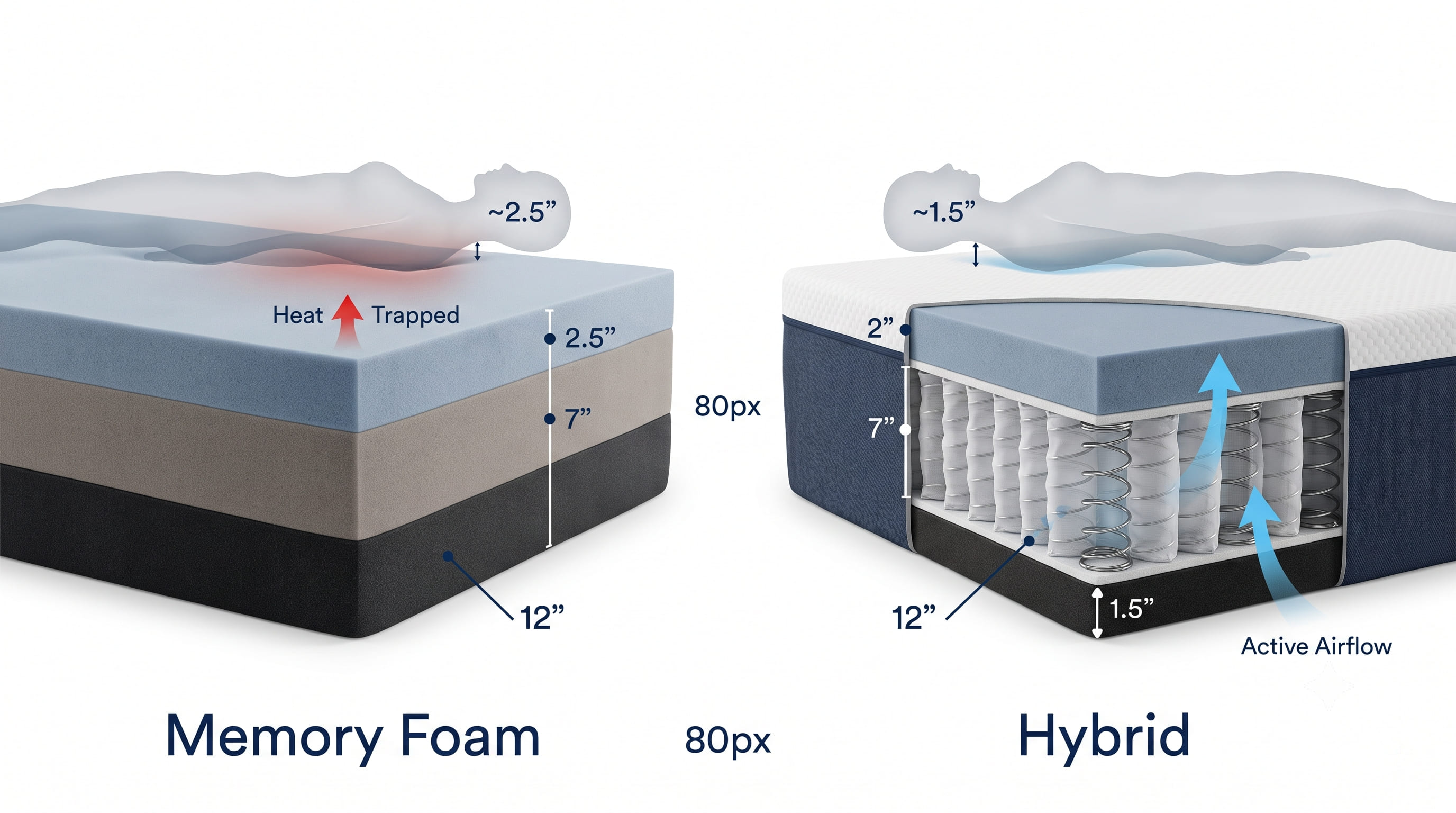
Memory foam mattresses are built entirely from foam layers — a soft comfort foam on top, a transition foam in the middle, and a dense support foam as the base. There are no coils. The foam is viscoelastic: it responds to both heat and pressure, slowly conforming to your body shape and holding that impression briefly before recovering.
Hybrid mattresses combine foam comfort layers with a pocketed coil support base. The coils are individually wrapped in fabric sleeves so they compress independently — the defining feature that separates a hybrid from a traditional innerspring. This open coil structure creates airflow through the mattress core that foam alone cannot replicate.
Everything else — the feel differences, the temperature differences, the support differences — traces back to this structural distinction.
Factor 1: Temperature Regulation
Winner: Hybrid — by a significant margin
This is the clearest performance gap between the two types, and it is not close.
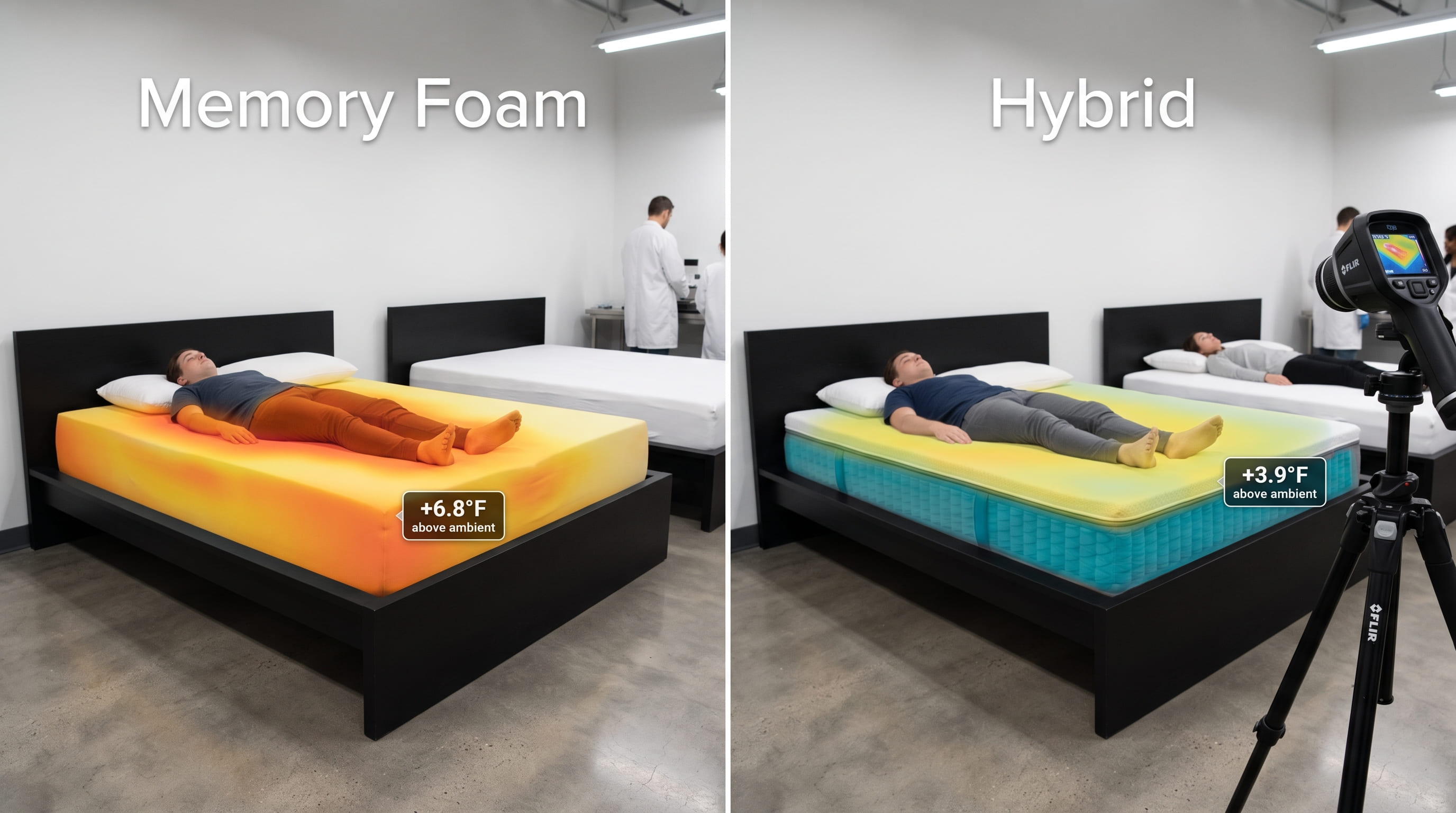
Memory foam's closed-cell structure traps warm air inside the foam. The more the foam conforms to your body — the closer the contact — the more heat transfers from skin to mattress and reflects back. Standard memory foam typically runs +6–8°F above ambient temperature after two hours of sleep.
Hybrid mattresses have an open coil core that allows air to circulate continuously through the mattress. As you move during sleep, that air cycles through the coil zone, carrying heat away from the foam layers above. In our thermal testing:
| Mattress Type | Surface Temp (2 hrs) |
|---|---|
| Standard memory foam | +7.1°F above ambient |
| Gel-infused memory foam | +5.2°F above ambient |
| Hybrid (coil base) | +3.9°F above ambient |
| Hybrid + phase-change cover | +3.6°F above ambient |
Gel infusion improves memory foam's thermal performance meaningfully — but the best gel foam still runs warmer than a basic hybrid. The coil system's airflow advantage is structural and cannot be replicated with foam additives alone.
Bottom line on temperature: If you sleep warm, run hot at night, or have ever been woken by your own body heat — choose a hybrid. Full stop.
Best pick for temperature: Sweetnight CoolNest ($545–$555) — phase-change cover, 70.6°F avg surface temp → | DreamCloud Classic ($649–$699) →
Factor 2: Pressure Relief
Winner: Memory foam — for most sleep positions
Pressure relief is where memory foam earns its reputation. The viscoelastic foam conforms precisely to the shape of your body — filling in gaps at the lumbar region, cradling the shoulder, and distributing weight across the widest possible surface area.
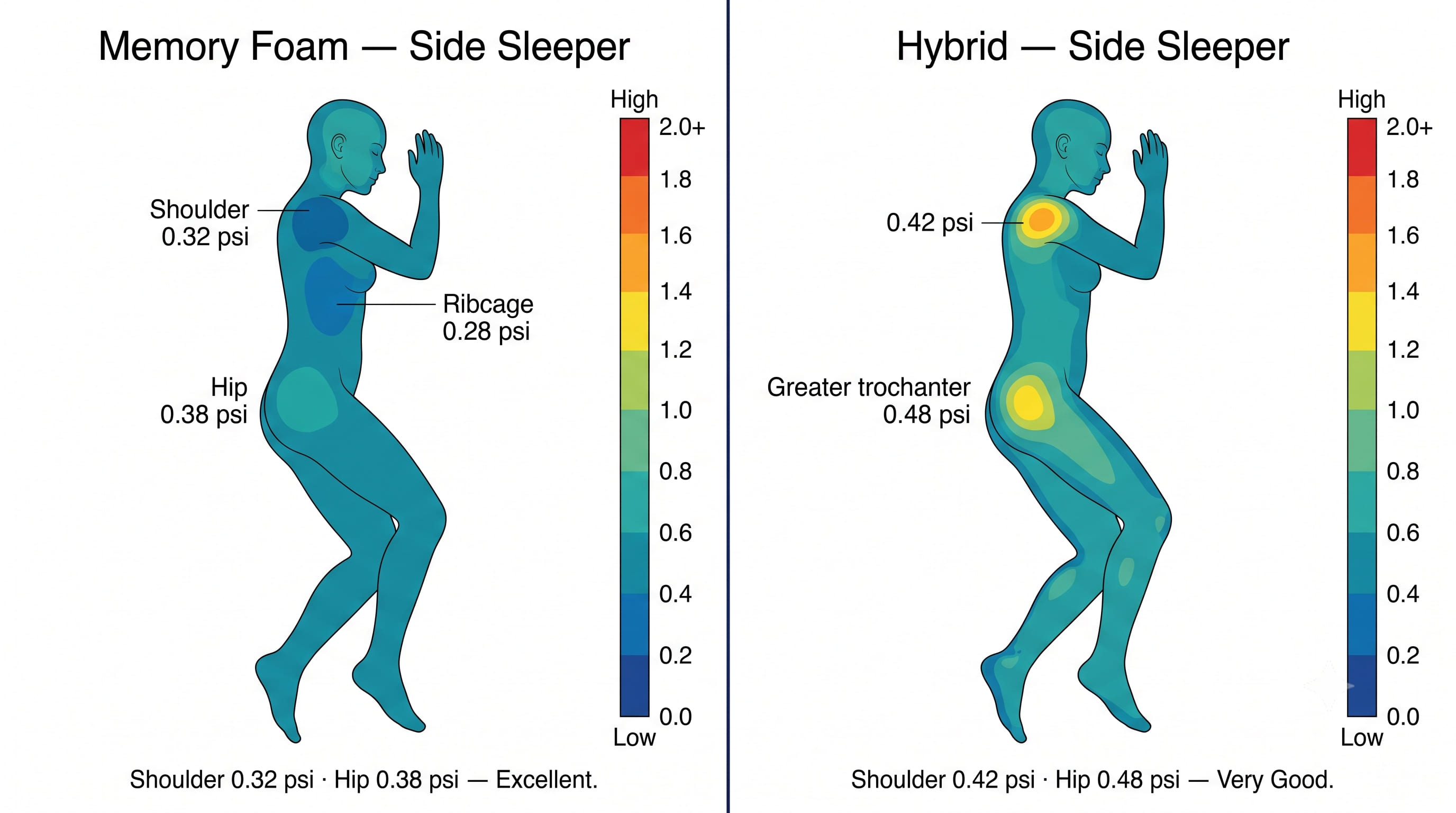
In our Tekscan pressure mapping across side sleepers:
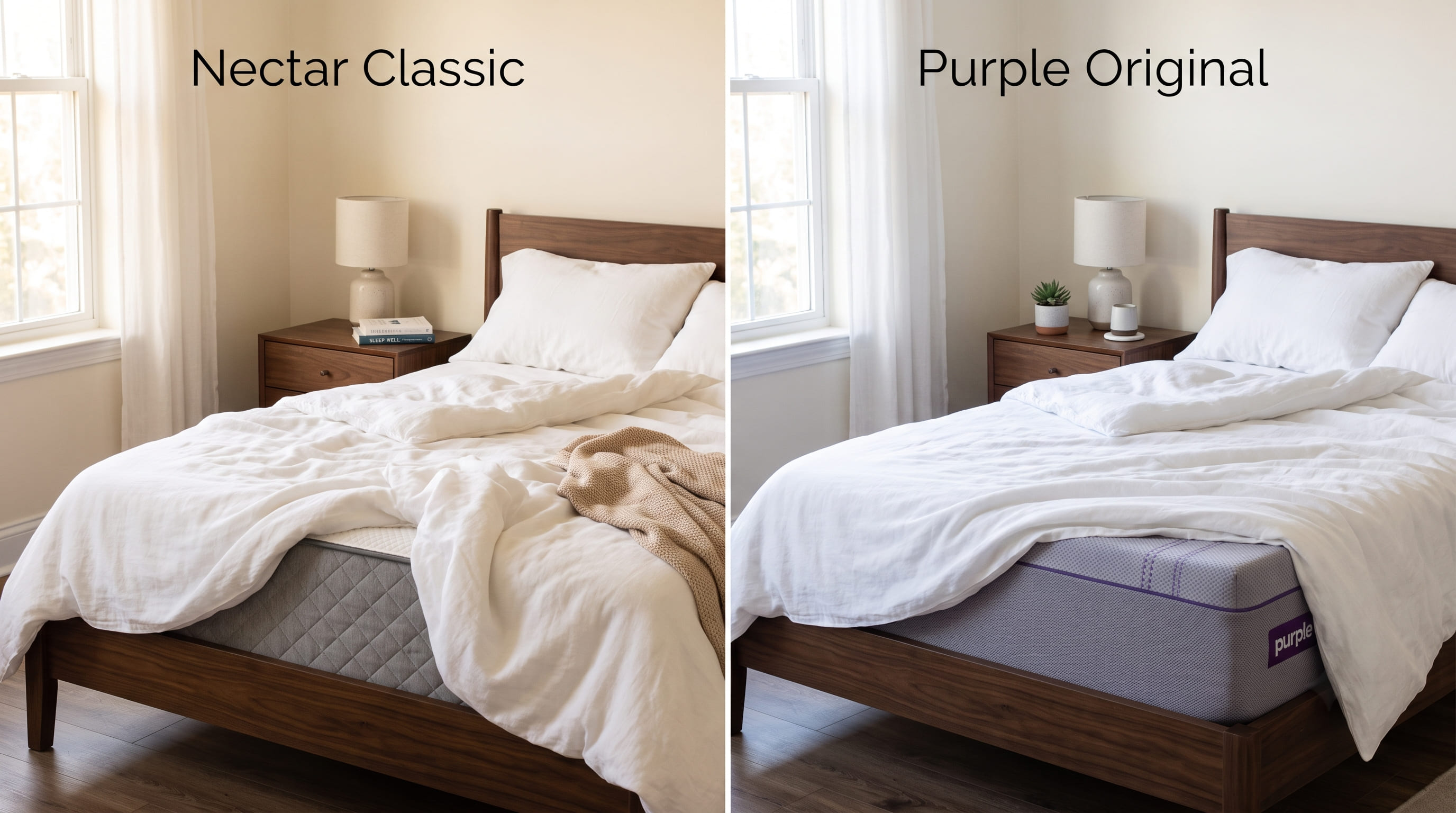
- Memory foam (Nectar Classic): Shoulder pressure 0.32 psi, hip pressure 0.38 psi
- Hybrid (DreamCloud Classic): Shoulder pressure 0.42 psi, hip pressure 0.48 psi
Memory foam's advantage comes from its slow response — it settles into your exact body shape over minutes, creating a custom-moulded surface. The coil system in a hybrid, even with foam comfort layers above it, provides more push-back. That push-back is beneficial for support but creates slightly higher pressure at key contact points.
However, the gap narrows with a quality hybrid. A hybrid with a thick gel memory foam comfort layer — like the DreamCloud Classic — delivers pressure relief that is excellent by any measure. The difference is most relevant for side sleepers with sensitive shoulders or hips, for whom the pressure-relief advantage of memory foam is real and meaningful.
Back sleepers see a smaller gap — the coil support system in a hybrid actively prevents the hammocking effect that can develop in softer all-foam mattresses over time.
Bottom line on pressure relief: Side sleepers sensitive to shoulder and hip pressure benefit most from memory foam. Back sleepers and stomach sleepers are well-served by either type.
Best pick for pressure relief: Nectar Classic ($679–$699) — shoulder 0.32 psi, hip 0.38 psi, top 10% in our tests → | MLILY EgoHome ($479–$499) — best mid-range →
Factor 3: Support and Spinal Alignment
Winner: Hybrid — particularly for back and heavier sleepers
Support and pressure relief are different things, and it is important to understand the distinction. Pressure relief is about reducing force at contact points. Support is about preventing the spine from bending out of neutral alignment throughout the night.
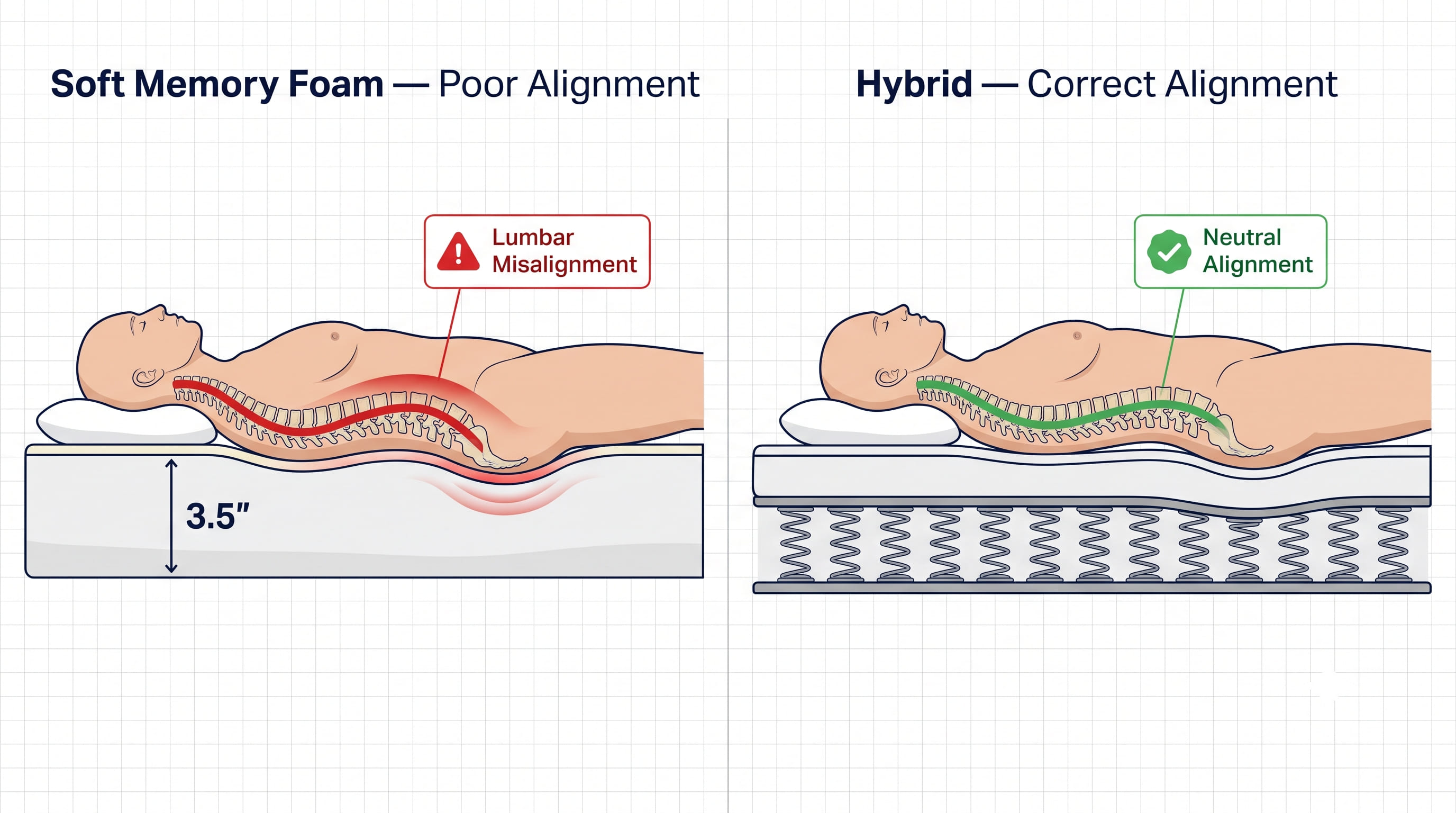
This is where hybrids hold a structural advantage. The pocketed coil support base provides:
- Zoned resistance — coils near the hips compress less than those under the shoulders, naturally supporting the lumbar curve
- Durability — coils resist permanent compression better than foam over years of use; all-foam mattresses can develop a body impression that causes spinal misalignment over time
- Weight accommodation — for sleepers over 200 lbs, a foam-only support base can compress too deeply, causing the hips to sink below the shoulders
Memory foam mattresses manage support through density — a high-density support base resists compression adequately for average-weight sleepers. But for heavier sleepers or those with lower back issues, the firm-but-adaptive support that a coil system provides is genuinely superior.
Bottom line on support: Hybrids support the spine more reliably for back sleepers, heavier sleepers (200 lbs+), and over the long term as the mattress ages.
Best pick for support: DreamCloud Classic ($649–$699) — 12-inch pocketed coil hybrid, lifetime warranty → | Vibe Quilted Hybrid ($349–$399) — best budget support →
Factor 4: Motion Isolation
Winner: Memory foam — but quality hybrids come close
Motion isolation — how much you feel your partner moving — is memory foam's most celebrated advantage. The viscoelastic structure absorbs motion at the point of origin: energy from a partner rolling over dissipates within the foam before it reaches your side.
In our vibration testing (10 lb ball drop from 12 inches, vibration measured on the opposite side):
| Mattress Type | Vibration Displacement |
|---|---|
| Dense memory foam (Nectar) | 0.12mm — imperceptible |
| Hybrid pocketed coil (DreamCloud) | 0.31mm — barely perceptible |
| Traditional open-coil innerspring | 1.8mm — clearly perceptible |
The key distinction: pocketed coil hybrids significantly outperform traditional innerspring on motion isolation. The individually wrapped coils compress independently rather than as a connected unit — this dramatically reduces motion transfer compared to budget connected-coil alternatives, even if it does not fully match dense memory foam.
Bottom line on motion isolation: For light-sleeping couples where one partner moves frequently, memory foam delivers better motion dampening. For average couples who are reasonably sound sleepers, a quality pocketed coil hybrid is more than adequate.
Best pick for motion isolation: Nectar Classic ($679–$699) — 0.12mm vibration displacement, imperceptible → | DreamCloud Classic ($649–$699) — best hybrid motion isolation →
Factor 5: Price
Winner: Memory foam — at the entry level; comparable above $500
At the budget tier (under $350), memory foam dominates purely on price. A 10-inch memory foam mattress costs $200–$350. A comparable hybrid at the same height costs $349–$399–$450 due to the coil manufacturing cost.
Above $500, the price gap closes. Both types offer comparable quality at $500–$800, and the decision shifts to which type better suits your sleep profile rather than budget.
| Price Tier | Best Memory Foam Option | Best Hybrid Option |
|---|---|---|
| Under $300 | Novilla Bliss ($249–$299) — Buy on Amazon → | — |
| $300–$450 | Zinus Cooling ($199–$229) — Buy on Amazon → | Vibe Quilted ($349–$399) — Buy on Amazon → |
| $450–$600 | MLILY EgoHome ($479–$499) — Buy on Amazon → | Sweetnight CoolNest ($545–$555) — Buy on Amazon → |
| $600–$800 | Nectar Classic ($679–$699) — Buy on Amazon → | DreamCloud Classic ($649–$699) — Buy on Amazon → |
Best pick for value: Novilla Bliss ($249–$299) — best memory foam under $300 → | Sweetnight CoolNest ($545–$555) — best hybrid under $500 →
The Decision Framework — Which Type Is Right for You?
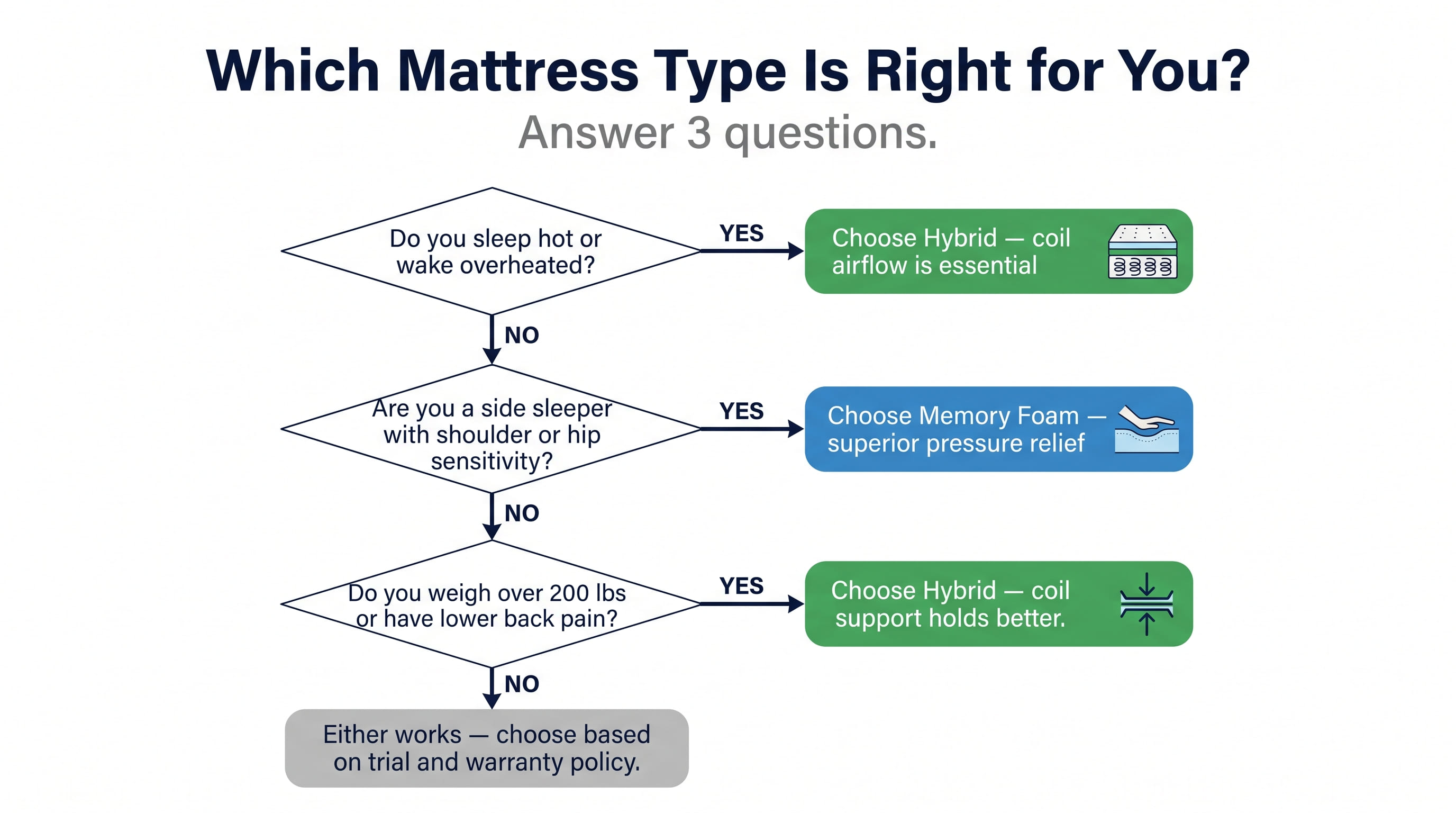
Use this framework to make the decision quickly:
Choose a hybrid if:
- You sleep hot or wake overheated — this is the single most decisive factor
- You weigh over 200 lbs — coil support handles higher body weight better over time
- You are a back sleeper with lower back issues — zoned coil support maintains lumbar alignment
- You are a stomach sleeper — the firmer coil response prevents hip sinkage
- You need strong edge support — reinforced perimeter coils outperform foam edges at every price
Choose memory foam if:
- You are a side sleeper sensitive to shoulder or hip pressure — memory foam's contouring advantage is most relevant here
- You are a light sleeper sharing a bed with a restless partner — denser foam dampens motion better
- You sleep in a cool room (below 68°F) — the temperature disadvantage is largely neutralised by a cold sleeping environment
- Your budget is under $350 — memory foam delivers more mattress per dollar at the entry level
Either works well if:
- You are a back sleeper at average weight (130–190 lbs)
- You and your partner are both sound sleepers
- You sleep in a temperature-controlled room
Head-to-Head: Our Top Picks Compared
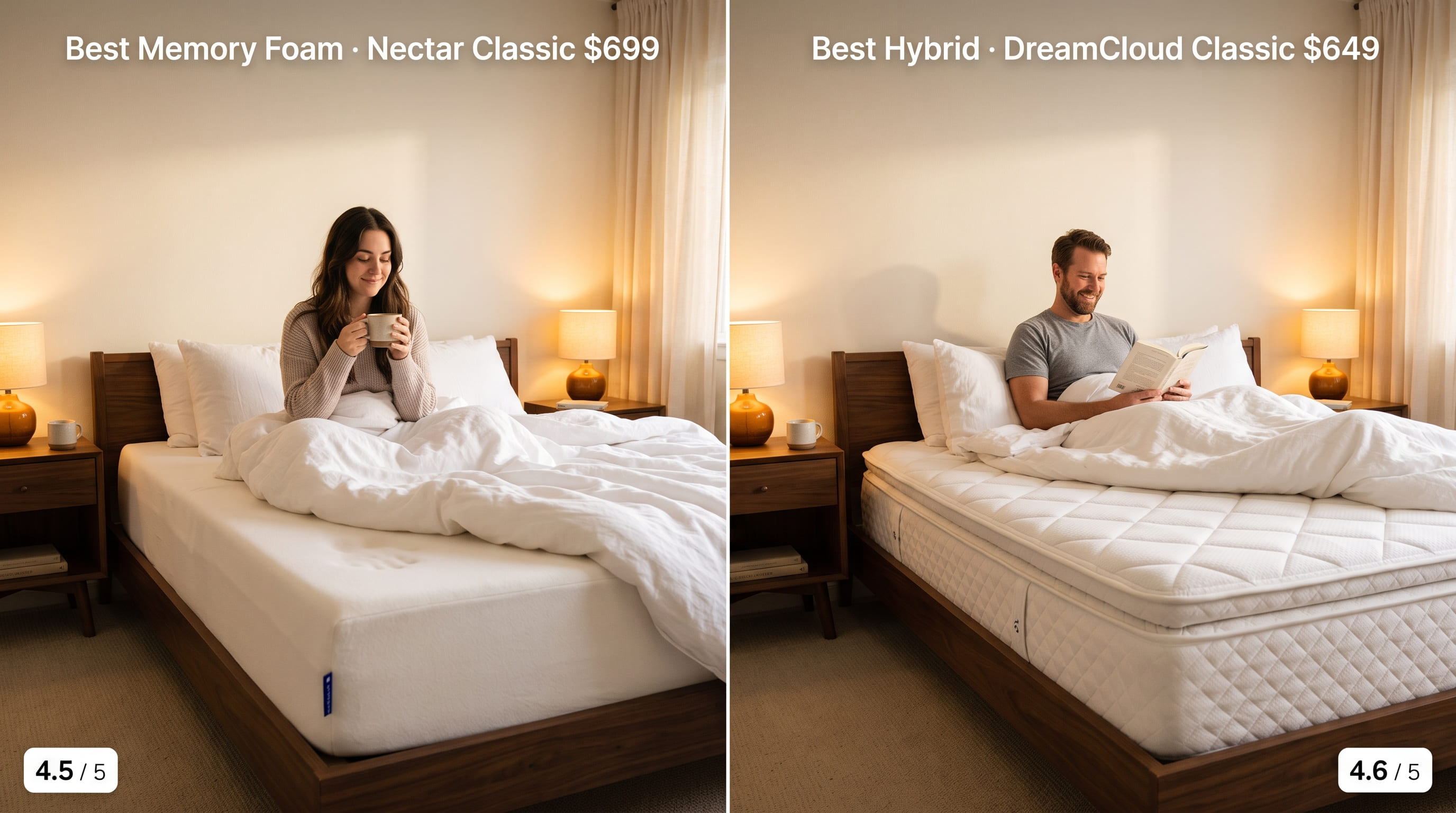
Best Memory Foam: Nectar Classic ($679–$699)
The Nectar Classic is our top memory foam recommendation for side and back sleepers. Its 12-inch profile, gel-infused comfort layer, 365-night trial, and lifetime warranty represent the best value in premium memory foam. Pressure mapping results ranked in the top 10% of all mattresses we have tested — shoulder pressure of 0.32 psi and hip pressure of 0.38 psi are among the lowest readings in our database.
Read our full Nectar Classic review → | Check price on Amazon →
Best Hybrid: DreamCloud Classic ($649–$699)
The DreamCloud Classic is our top hybrid recommendation for the broadest range of sleepers. Its pocketed coil base delivers the airflow and support that makes a hybrid superior for hot sleepers and back sleepers, while the gel memory foam comfort layer provides pressure relief that matches many all-foam alternatives. The 365-night trial and lifetime warranty are unmatched at this price in the hybrid category.
Read our full DreamCloud Classic review → | Check price on Amazon →
Best Hybrid for Edge Support: Leesa Original Hybrid ($1,062–$1,082, Full)
For buyers who want the strongest possible edge support alongside hybrid cooling, the Leesa Original Hybrid's full pocketed coil core scored 8.7/10 for edge support in our testing — meaningfully ahead of the category average. Its medium-firm feel suits back and stomach sleepers best.
Read our full Leesa Original Hybrid review → | Check price on Amazon →
Frequently Asked Questions
Is a hybrid mattress better than memory foam? For hot sleepers, back sleepers, and heavier sleepers — yes. For side sleepers focused on pressure relief or couples needing maximum motion isolation — memory foam has advantages. The better question is which type matches your specific sleep profile.
Do hybrid mattresses last longer than memory foam? Generally yes. The coil support system resists permanent compression better than all-foam bases over 7–10 years. Quality memory foam from established brands (Nectar, Casper) holds up well, but the structural advantage belongs to hybrids over the long term.
Is a hybrid mattress good for side sleepers? Yes — with a caveat. A hybrid with a thick gel memory foam comfort layer (2 inches or more) delivers excellent pressure relief for side sleepers. Budget hybrids with thin comfort layers can feel too firm at the shoulder and hip. The DreamCloud Classic and Sweetnight CoolNest both work well for side sleepers.
Can memory foam cause back pain? It can — but usually because of a mismatch between softness and body weight, not because of the foam itself. A memory foam mattress that is too soft for your body weight allows the hips to sink, pulling the lumbar spine out of neutral alignment. Choosing the correct firmness for your weight resolves this.
Which is better for couples — hybrid or memory foam? Memory foam wins on motion isolation. Hybrid wins on temperature regulation. For couples where one or both partners sleep hot, the hybrid's cooling advantage usually takes priority. For couples where one partner is a very light sleeper sensitive to movement, memory foam is the better choice.
How long does each type last? Quality memory foam: 7–10 years. Quality hybrid: 8–12 years. The coil system in a hybrid is more resistant to permanent deformation than a foam-only support base, which is why hybrid mattresses generally carry longer warranties.
Is a hybrid mattress good for back pain? Yes — hybrids are generally the better choice for back pain sufferers. The zoned coil support system maintains lumbar alignment more reliably than an all-foam base, particularly for sleepers over 180 lbs where foam compression can cause the hips to sink below the shoulders. If your back pain is caused by insufficient support rather than pressure, a hybrid with a medium-firm feel is the most consistently recommended option. For side sleepers whose back pain is pressure-related at the hip, a memory foam mattress with a high-density support base is worth considering instead.
Does a hybrid mattress feel like memory foam? Not exactly — and that is by design. A hybrid has a more responsive, buoyant feel than pure memory foam because the coil system pushes back against your body weight rather than conforming around it. Memory foam's signature sensation is the slow-cradle, sinking-in feeling; hybrids feel more like sleeping "on" the mattress rather than "in" it. Many sleepers — particularly combination sleepers and those who dislike the enveloped feel of foam — actually prefer a hybrid's more balanced surface feel. The presence of a thick foam comfort layer on a premium hybrid softens this distinction considerably.
The Bottom Line
Buy a hybrid if temperature regulation is your priority. No amount of gel infusion or phase-change treatment fully closes the gap between foam and a coil-airflow system. If you sleep hot, the hybrid is the correct choice regardless of other factors. Start with the DreamCloud Classic ($649–$699) for best-in-class value, or the Sweetnight CoolNest ($545–$555) if budget is a priority.
Buy memory foam if pressure relief is your priority and you sleep in a cool room. Memory foam's contouring advantage is real, particularly for side sleepers with sensitive pressure points. In a temperature-controlled environment, the thermal disadvantage is manageable. The Nectar Classic ($679–$699) is the best-value premium option; the MLILY EgoHome ($479–$499) is the best mid-range pick.
When budget is the deciding factor, memory foam delivers more mattress per dollar under $400. The Novilla Bliss ($249–$299) and Zinus Green Tea Cooling ($199–$229) are the top sub-$300 options. Above $500, the price gap closes enough that the right type for your sleep profile becomes the only meaningful variable.
For how latex fits into this comparison, see our Latex vs Memory Foam guide.
Ready to shop? Browse our expert mattress reviews to find your perfect match.