Best Mattress for Shoulder Pain: 2026
Shoulder pain at night? We pressure-mapped mattresses to find the ones that actually relieve shoulder pressure for side sleepers. Top picks, 2026.
In our pressure-mapping tests across sixteen mattresses, the lowest recorded shoulder-pressure reading for a side sleeper was 0.32 psi — on a mattress that let the shoulder sink in enough to distribute weight across the surrounding tissue instead of loading the joint directly. The highest readings on firmer mattresses in the same test set ran well above 1 psi, concentrated almost entirely at the point of the shoulder.
That gap is the entire story of shoulder pain at night: it's one of the few pain points where "firm support" and "pressure relief" pull in genuinely opposite directions, and getting the balance wrong is often the real reason side sleepers wake up with a numb arm or a sore rotator cuff. This guide is built around that pressure data — what's actually happening mechanically when a shoulder hurts at night, how sleep position changes the right answer, and which of our tested picks produced the lowest shoulder-pressure readings for your situation.
Start Here: What's Causing Your Shoulder Pain at Night?
| Your Situation | Likely Cause | Jump To |
|---|---|---|
| Pain or numbness starts right when you lie on your side | Direct shoulder compression — mattress too firm at the shoulder | Firmness sweet spot ↓ |
| You wake with your arm asleep or tingling | Nerve compression from sustained pressure on one side | Mattress types ↓ |
| You have diagnosed rotator cuff damage or frozen shoulder | Need genuine pressure-point relief, not just softness | Grid hybrid pick ↓ |
| Shoulder pain comes with neck stiffness too | Pillow height is likely involved as much as the mattress | Best Pillow for Neck Pain guide → |
| You want the ranked picks | — | Jump to top picks ↓ |
What Causes Shoulder Pain to Worsen at Night?
Shoulder pain at night almost always comes down to how much of your body weight concentrates on that one joint in your sleep position, and whether the mattress helps or fights that weight distribution.
Three ways a mattress worsens shoulder pain:
-
Too firm: With minimal give, a firm mattress presses directly against the point of the shoulder — the acromion and the rotator cuff tendons running underneath it. This is the single most common mattress-related trigger for side sleepers, since the shoulder bears concentrated weight for hours in that position with nowhere to redistribute it.
-
Too soft without support underneath: A mattress that's soft everywhere, not just at the shoulder, can let the whole upper body sink unevenly, pulling the shoulder and neck out of alignment and straining the surrounding muscles even if the joint itself isn't under direct pressure.
-
Sustained nerve compression: Even moderate pressure, held in the same position for 7–8 hours without the shoulder able to shift, can compress the nerves running through the shoulder and down the arm — the mechanism behind waking up with a numb or tingling arm, independent of any underlying joint damage.
The Firmness Sweet Spot for Shoulder Pain
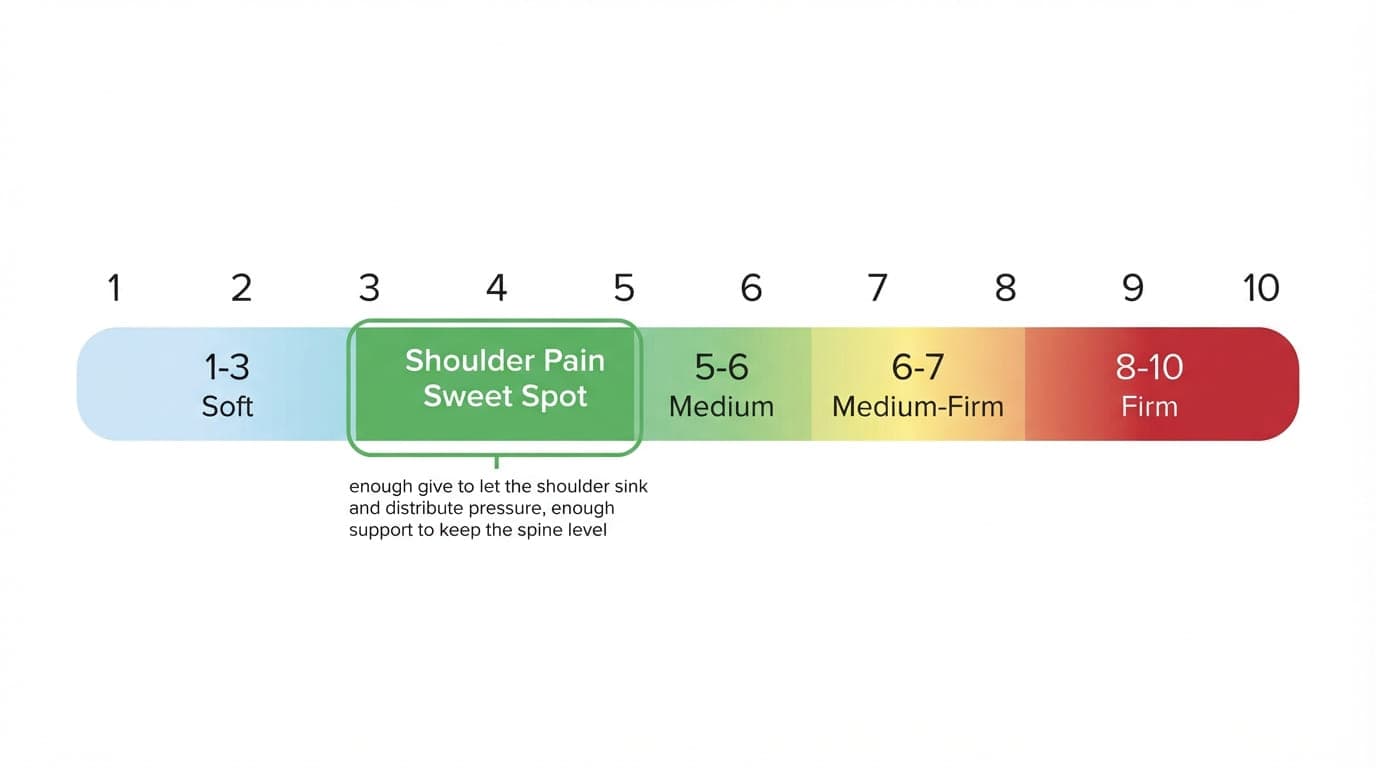
For most people with shoulder pain, the ideal range sits softer than the general back-pain recommendation — soft to medium (3–5 on a 10-point scale) — because the shoulder specifically needs enough sink depth to take pressure off the joint, not just overall spinal support.
| Sleep Position | Body Weight | Recommended Firmness |
|---|---|---|
| Side | Under 150 lbs | Soft (2–4) |
| Side | 150–220 lbs | Soft to Medium (3–5) |
| Side | Over 220 lbs | Medium (5–6) |
| Back | Any weight | Medium (5–6) |
| Combination (mostly side) | Any weight | Medium-Soft (4–5) |
Why this skews softer than most pain guides: Back pain and hip pain both benefit from a mattress that resists excessive sinkage to keep the spine and pelvis level. The shoulder is different — for a side sleeper, it's the single highest-pressure contact point on the entire body, and it needs more give than the rest of the mattress to avoid direct joint compression. A mattress tuned for general back support can still be the wrong choice for shoulder pain specifically.
Best Mattress Types for Shoulder Pain
Not all mattress materials relieve shoulder pressure equally well. Here's how each performs specifically for shoulder pain rather than general comfort.
Memory Foam — Best for Direct Shoulder Pressure Relief
How it helps: Memory foam's slow, deep contouring is the most effective material for side sleepers whose pain concentrates directly at the shoulder joint. It allows the shoulder to sink in fully, spreading weight across the upper arm and chest rather than loading the acromion and rotator cuff directly.
Limitation: Very soft memory foam without a supportive base can let the spine curve out of alignment — pair deep shoulder contouring with adequate underlying support, not softness everywhere.
Best for: Side sleepers with shoulder-focused pain, lighter to average-weight sleepers.
Our tested pick: Nectar Classic Mattress — pressure mapping recorded shoulder pressure of 0.32 psi, the lowest reading across our full tested range, at $679–$699.
Pressure-Sensitive Hybrid Grid — Best for Rotator Cuff and Frozen Shoulder
How it helps: Grid-based hybrid materials hold firm under broadly distributed weight but collapse specifically under concentrated pressure — exactly the behavior needed for an already-damaged or inflamed joint. Rather than resisting the shoulder uniformly the way foam does, the grid yields right at the point of contact while staying supportive everywhere else.
Limitation: Premium pricing — this construction costs meaningfully more than standard foam or hybrid alternatives.
Best for: Diagnosed rotator cuff tears, frozen shoulder, post-surgical shoulder sensitivity.
Our tested pick: Purple Original Mattress — its GelFlex Grid construction is engineered specifically to relieve concentrated pressure points rather than conforming broadly, at $1,549–$1,599.
Zoned Hybrid — Best for Shoulder Pain Combined With Hip Pain
How it helps: A mattress with zoned coil support — softer under the shoulders and hips, firmer through the lumbar region — addresses both of side sleeping's major pressure points at once, which matters since shoulder and hip pain frequently occur together in dedicated side sleepers.
Limitation: Zoned hybrids cost more than non-zoned hybrids or straightforward foam mattresses.
Best for: Committed side sleepers dealing with both shoulder and hip discomfort.
Our tested pick: Brooklyn Bedding Aurora Luxe — its zoned coil system is built specifically to cushion the shoulder and hip while keeping the lumbar region properly supported, at $1,695–$1,705.
Thick Plush Foam — Best Budget Option for Shoulder Relief
How it helps: A genuinely thick comfort layer (10+ inches total height, 3+ inches of dedicated comfort foam) gives the shoulder real cushioning depth without stepping up to premium pricing. Thickness matters more than brand name here — a thin budget mattress bottoms out under shoulder weight regardless of how soft it feels on first touch.
Limitation: All-foam construction runs warmer than a hybrid and offers less edge support.
Best for: Budget-conscious side sleepers, lighter frames under 200 lbs.
Our tested pick: Novilla Bliss 12" Gel Foam — its 12-inch profile is noticeably thicker than most mattresses at this price, with a gel-infused comfort layer that conforms more deeply than thinner budget alternatives, at $249–$299.
Standard Innerspring — Not Recommended for Shoulder Pain
Traditional connected-coil innerspring mattresses concentrate pressure at the shoulder rather than distributing it, which is precisely the wrong characteristic for anyone dealing with shoulder pain. Unless you sleep almost exclusively on your back, avoid this category entirely.
Shoulder Pain by Sleep Position
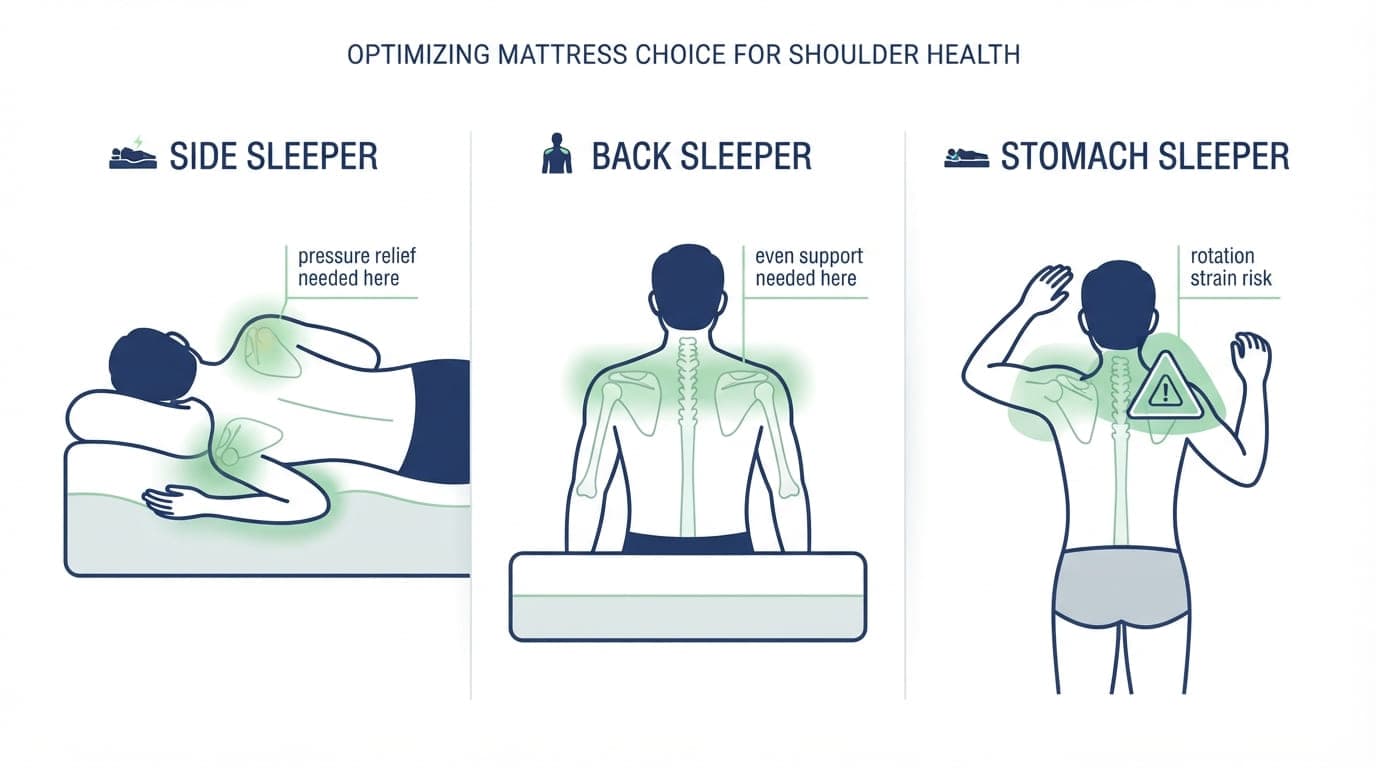
Side Sleeping With Shoulder Pain
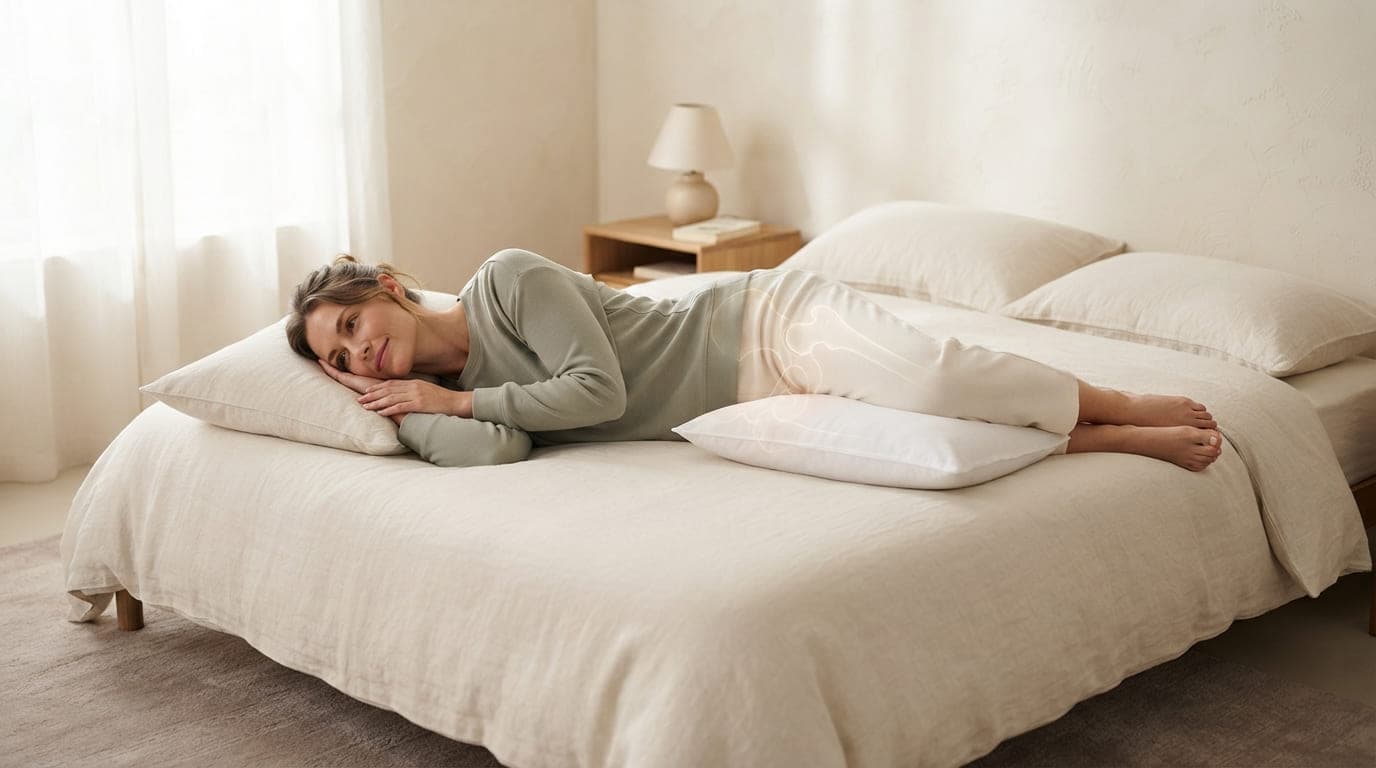
Side sleeping puts more direct, sustained pressure on the shoulder than any other position, which is why it's the position most associated with nighttime shoulder pain and the one where mattress choice matters most. Try to avoid tucking the bottom arm underneath your body or pillow — resting it in front of you reduces additional compression on top of what the mattress itself is already managing.
What to look for: A soft to medium comfort layer with genuine shoulder contouring — enough sink to spread pressure across the upper arm and chest rather than loading the joint directly.
Back Sleeping With Shoulder Pain
Back sleeping generally produces far less direct shoulder pressure than side sleeping, since weight is distributed evenly across both shoulder blades rather than concentrated on one joint. Shoulder pain in back sleepers is more often linked to an unsupportive pillow pushing the neck and shoulders out of alignment than to the mattress itself.
What to look for: Medium support that keeps both shoulders and the spine in a level line — see our Best Pillow for Neck Pain guide if pillow height is the likelier culprit.
Stomach Sleeping With Shoulder Pain
Stomach sleeping often involves one or both arms overhead or rotated outward to support breathing, which places unusual strain on the shoulder joint and surrounding muscles regardless of mattress firmness. This is one of the few cases where a mattress change alone is unlikely to fully resolve the pain — transitioning toward side or back sleeping typically helps more than any firmness adjustment.
What to look for: If stomach sleeping is non-negotiable, a medium-firm surface that doesn't let the shoulders twist further into the mattress is the safer compromise.
Our Top Picks for Shoulder Pain — Ranked
1. Nectar Classic — Best Overall for Shoulder Pain
Why it wins: For the majority of shoulder pain cases — side sleepers whose pain concentrates directly at the joint — the Nectar Classic's deep, slow-conforming memory foam delivered the lowest shoulder pressure reading in our full tested range. Its 365-night trial gives you real time to confirm the mattress is genuinely reducing nighttime discomfort before committing.
- Price: $679–$699 (queen)
- Firmness: Medium-Firm (6/10)
- Type: Memory Foam
- Trial / Warranty: 365 nights / Lifetime
- Best for: Side sleepers with shoulder-focused pain
Read Full Nectar Classic Review →
2. Purple Original — Best for Rotator Cuff and Frozen Shoulder
Why it wins: For shoulder pain driven by an already-damaged or inflamed joint — a rotator cuff tear, frozen shoulder, or post-surgical sensitivity — the Purple GelFlex Grid's pressure-collapsing behavior at concentrated contact points is the most targeted relief mechanism we've tested. It holds firm under the broader upper body while genuinely yielding right at the shoulder itself.
- Price: $1,549–$1,599 (queen)
- Firmness: Medium (5/10)
- Type: Hybrid Grid
- Trial / Warranty: 100 nights / 10 years
- Best for: Diagnosed shoulder conditions, severe or hypersensitive joint pain
Read Full Purple Original Review →
3. Brooklyn Bedding Aurora Luxe — Best for Shoulder and Hip Pain Together
Why it wins: Shoulder and hip pain frequently show up as a pair in dedicated side sleepers, and the Aurora Luxe's zoned coil system is purpose-built around exactly that combination — softer cushioning under both pressure points, with firmer support running through the lumbar region to keep the spine from sagging between them.
- Price: $1,695–$1,705 (queen)
- Firmness: Medium (5.5/10)
- Type: Zoned Hybrid
- Trial / Warranty: 120 nights / 10 years
- Best for: Side sleepers with combined shoulder and hip discomfort
Read Full Brooklyn Bedding Aurora Luxe Review →
4. Novilla Bliss 12" Gel Foam — Best Budget Pick
Why it wins: Shoulder pain relief has historically meant paying a premium, and the Novilla Bliss is the clearest exception we've tested. Its 12-inch profile gives the shoulder meaningfully more cushioning depth than typical budget mattresses, and the gel-infused comfort layer adds real pressure-conforming give without stepping up to a $600+ price point.
- Price: $249–$299 (queen)
- Firmness: Medium (5/10)
- Type: Memory Foam
- Trial / Warranty: 100 nights / 10 years
- Best for: Budget-conscious side sleepers under 200 lbs
Read Full Novilla Bliss Review →
Comparison: All Tested Mattresses for Shoulder Pain
| Mattress | Price | Type | Firmness | Key Advantage | Trial |
|---|---|---|---|---|---|
| Nectar Classic | $679–$699 | Memory Foam | Med-Firm | Lowest shoulder pressure reading | 365 nights |
| Purple Original | $1,549–$1,599 | Hybrid Grid | Medium | Pressure-point-specific relief | 100 nights |
| Brooklyn Bedding Aurora Luxe | $1,695–$1,705 | Zoned Hybrid | Medium | Combined shoulder + hip zoning | 120 nights |
| Novilla Bliss 12" | $249–$299 | Memory Foam | Medium | Best budget pressure relief | 100 nights |
Other Factors That Affect Shoulder Pain in Bed
A mattress is the most controllable factor, but not the only one that matters.
Your pillow: A pillow that's too high or too low forces the neck and shoulder out of alignment regardless of how good the mattress is underneath. Side sleepers specifically need enough loft to keep the head level with the spine — see our Best Pillow for Neck Pain guide for how to match loft to shoulder width.
Arm position: Sleeping with the bottom arm tucked under a pillow or your own body adds compression on top of whatever the mattress is already managing. Try resting the arm in front of you instead, even if it takes a few nights to feel natural.
Your mattress topper: If your current mattress is otherwise fine but too firm at the shoulder specifically, a 2–3 inch memory foam topper can add real cushioning without the cost of full replacement. See our Mattress Topper Guide for material and thickness guidance.
Gentle shoulder mobility work: Light stretching or rotator cuff activation exercises during the day can reduce the stiffness that compounds nighttime shoulder pain, complementing rather than replacing the right mattress and sleep position.
When to see a doctor: A mattress can reduce nighttime pressure and improve sleep quality, but it does not treat a torn rotator cuff, frozen shoulder, or impingement. If shoulder pain is severe, worsening, limits your range of motion, or follows an injury, seek medical evaluation rather than relying on a mattress change alone.
Frequently Asked Questions
What firmness mattress is best for shoulder pain?
Soft to medium (3–5 on a 10-point scale) is the general sweet spot for side sleepers with shoulder pain — softer than most other pain-related firmness recommendations, because the shoulder specifically needs enough give to sink in and distribute pressure rather than loading the joint directly.
Is a firm or soft mattress better for shoulder pain?
Soft to medium is almost always better for shoulder pain, which is the opposite of the advice often given for back or hip pain. A firm mattress presses directly against the shoulder joint in side sleeping, concentrating pressure exactly where it hurts. A mattress that's too soft everywhere can still cause problems by letting the whole upper body sink unevenly, so the goal is targeted shoulder give paired with adequate underlying support.
What is the best sleeping position for shoulder pain?
Side sleeping on the unaffected shoulder, with the bottom arm resting in front of you rather than tucked underneath, is generally the most manageable position if side sleeping is your preference. Back sleeping with proper pillow support produces the least direct shoulder pressure of any position.
Can a new mattress fix shoulder pain?
A mattress can meaningfully reduce nighttime pressure triggers and improve sleep quality, but it doesn't treat an underlying issue like a rotator cuff tear or frozen shoulder. If shoulder pain is persistent, worsening, or limits movement, a mattress change should complement medical care, not replace it.
How long does it take to know if a mattress helps shoulder pain?
Give it at least 3–4 weeks after the initial adjustment period, which most new mattresses require regardless of fit. Track whether you're waking up less often to shift off the shoulder and whether morning stiffness or numbness is improving — a consistent pattern over several weeks is more reliable than judging from the first few nights.
Is memory foam or hybrid better for shoulder pain?
It depends on where your pain is coming from. Memory foam works best for shoulder-focused pain on its own, since its deep contouring relieves direct pressure at the joint. A zoned hybrid works best when shoulder pain comes paired with hip discomfort, since the reinforced zoning addresses both pressure points at once.
Ask Our Testers
"My shoulder pain is worse on my current firm mattress, but I don't want something so soft my back starts hurting instead. How do I avoid trading one problem for another?"
That's a legitimate concern, and it's why we don't recommend going straight to the softest option available. The safer move is soft-to-medium rather than soft everywhere: enough give specifically at the shoulder to relieve direct pressure, without so much overall sink that your spine loses support. The Nectar Classic's five-layer foam build is calibrated for exactly that — deep shoulder contouring with a denser base layer underneath. — Dr. Sarah Mitchell
"I have a rotator cuff injury specifically — does that change which mattress actually helps, or is it the same advice as general shoulder pain?"
It changes things somewhat. A rotator cuff injury means the tendons are already inflamed or damaged, so the goal isn't just overall softness — it's relieving pressure specifically at that one point of contact without the joint having to fight a resistant surface. That's exactly what the Purple Original's GelFlex Grid is built to do: it yields right where concentrated pressure hits rather than conforming broadly the way foam does. We'd point rotator cuff sufferers toward that pressure-point-specific behavior over a generally soft mattress. — Dr. Sarah Mitchell
"Is it the mattress or the pillow causing my shoulder pain? I can't tell."
A reasonable way to isolate it: if the pain is sharpest exactly where your shoulder presses into the mattress and eases when you shift position, that points to the mattress. If the pain is more diffuse through the shoulder and neck together, or worse when you wake up regardless of position, pillow height is often the bigger factor — a pillow that's too high or too low pulls the neck and shoulder out of alignment independent of what's underneath you. We'd start with the pillow check in our Best Pillow for Neck Pain guide before assuming the mattress is the sole cause. — Dr. Sarah Mitchell
The Bottom Line
The best mattress for shoulder pain isn't simply the softest option — it's the one that lets the shoulder sink in enough to distribute pressure across the joint while keeping the rest of the spine supported. For most side sleepers with shoulder pain, that means a soft to medium mattress (3–5 on a 10-point scale), matched to your body weight, with genuine contouring at the shoulder rather than just a plush first impression.
Our top overall recommendation is the Nectar Classic at $679–$699 — its deep memory foam contouring produced the lowest shoulder-pressure reading in our testing. For diagnosed rotator cuff or frozen shoulder issues, the Purple Original at $1,549–$1,599 offers the most targeted pressure-point relief available. Side sleepers dealing with shoulder and hip pain together should consider the Brooklyn Bedding Aurora Luxe at $1,695–$1,705, and budget-conscious buyers should look at the Novilla Bliss 12" at $249–$299.
A mattress won't cure an underlying shoulder condition, but the right one can meaningfully reduce how often it disrupts your sleep. For related guidance, see our Best Mattress for Hip Pain guide and Best Mattress for Side Sleepers guide.
Shop All Reviewed Mattresses →
Related Guides
Ready to shop? Browse our expert mattress reviews to find your perfect match.