Latex vs Memory Foam: 2026
Latex vs memory foam 2026: feel, cooling, pressure relief, durability & price compared with real test data. Which mattress material is right for you?
Latex and memory foam are the two most discussed mattress materials — and the two most frequently confused. Both are foam-based comfort materials. Both contour to your body. Both are available across a wide price range. But they feel completely different to sleep on, perform differently on every major sleep metric, and suit different sleeper profiles for entirely different reasons.
Most guides tell you what each material is. This one tells you which one is actually right for you — with real test data on cooling, pressure relief, durability, and price across mattresses we have reviewed and slept on.
What Makes These Two Materials Structurally Different
Before comparing performance, it helps to understand the structural difference — because everything else flows from it.
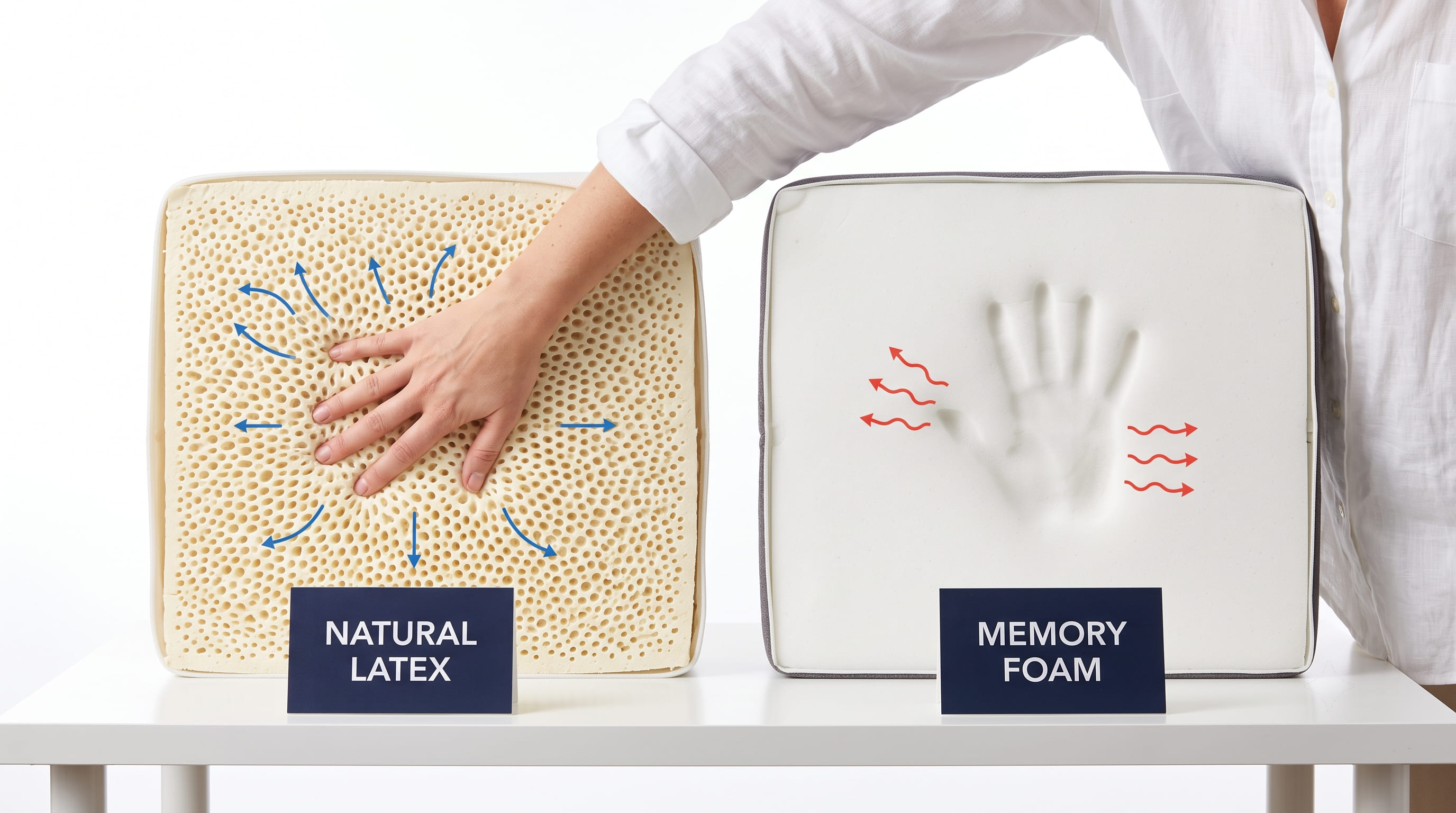
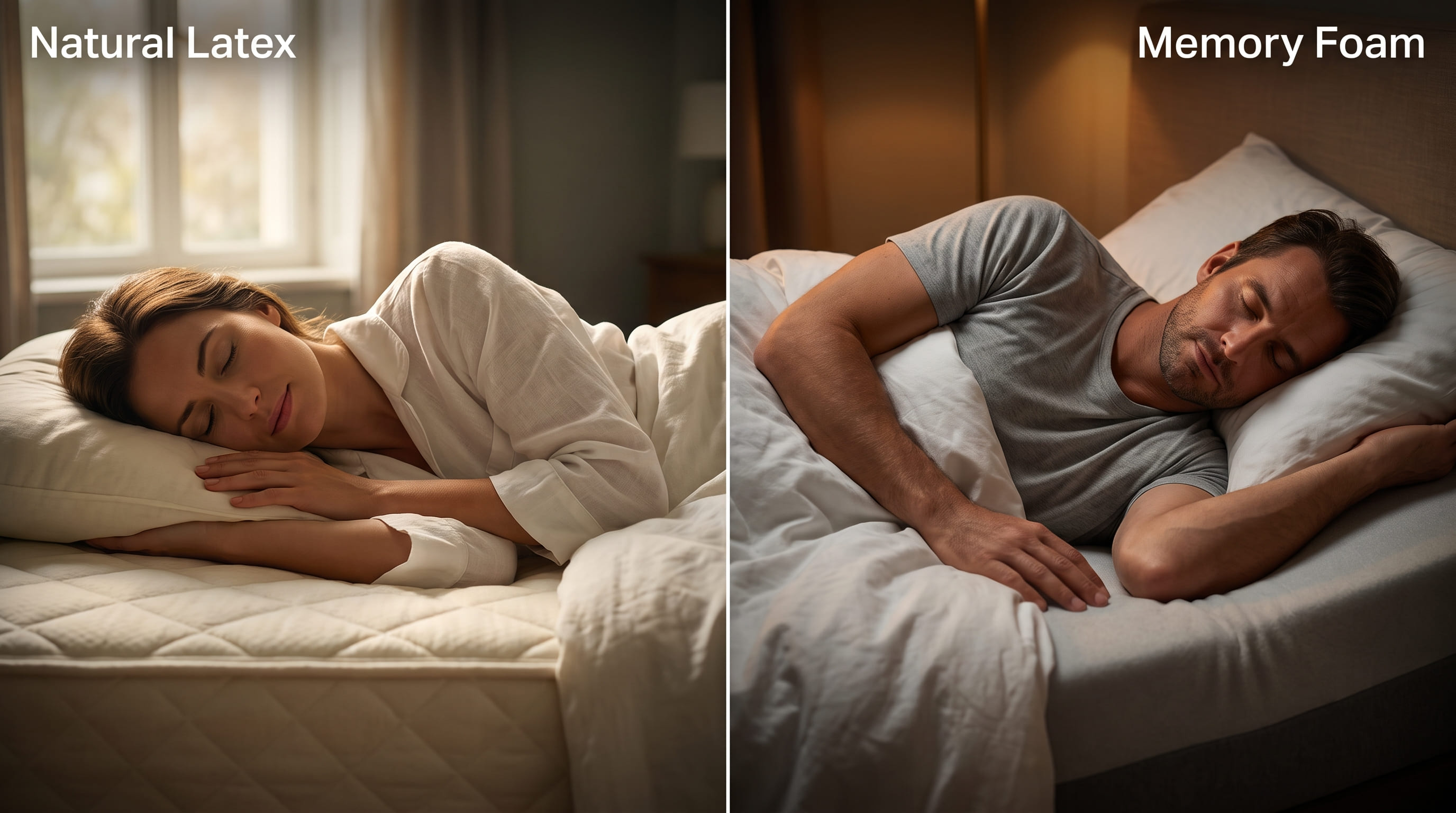
Memory foam is a synthetic viscoelastic polymer — polyurethane foam engineered to respond to both heat and pressure. It softens as it absorbs your body heat, slowly conforming to your exact shape and holding that impression briefly before recovering. The defining sensation is the slow, cradling "sink" — your body sinks in and the foam moulds around it. Standard memory foam uses a closed-cell structure that traps air (and heat) inside the material.
Latex foam is derived from the sap of the Hevea brasiliensis rubber tree (natural latex) or synthesised from petrochemicals (synthetic latex) or a blend of both. The manufacturing process — Dunlop or Talalay — creates an open-cell structure with interconnected air channels. The result is a foam that is immediately responsive rather than slow-conforming: it pushes back against your body weight rather than melting around it. Natural latex is also inherently antimicrobial and resistant to dust mites.
The core difference in one sentence: Memory foam conforms around you; latex pushes back against you. Everything that follows — feel, cooling, response time, durability — traces directly to this structural distinction.
Factor 1: Feel and Responsiveness
Winner: Depends entirely on your preference — the most personal of all comparisons
This is the most divisive factor between the two materials, and it comes down to one fundamental question: do you want to sleep in your mattress or on it?
Memory foam feel: Slow, cradling, enveloping. When you lie on memory foam, the material gradually softens under your body heat and shapes itself around you over 30–60 seconds. Many sleepers find this deeply comfortable — the feeling of being "hugged" by the mattress. The slow response also means the mattress does not immediately spring back when you shift position; you feel a brief resistance before the foam reshapes. This is why memory foam is sometimes described as feeling "stuck" by combination sleepers who move frequently.
Latex feel: Bouncy, buoyant, immediately responsive. When you lie on latex, it compresses under your weight and pushes back in real time — there is no delay. When you shift position, the mattress reforms instantly. The sensation is of sleeping on a supportive surface rather than sinking into it. Some sleepers find this energising; others describe it as less plush than they prefer. Talalay latex (aerated during manufacturing) tends to feel softer and more cushioned than Dunlop latex (denser, firmer base feel).
Combination sleepers: Latex wins by a significant margin. The immediate response means no resistance when you roll from side to back or back to side. Memory foam's slow recovery creates a brief "stuck" sensation during position changes that accumulates into restlessness for frequent movers.
Deep-pressure cradling: Memory foam wins. If you are a side sleeper who loves the sensation of the mattress wrapping around your shoulder and hip, memory foam's conforming depth is unmatched.
Best pick for responsive feel: Saatva Natural Latex Topper ($375) — experience latex's buoyant response on your existing mattress →
Best pick for deep cradling feel: Nectar Classic ($699) — gel-infused memory foam, 9.4/10 pressure relief, 365-night trial →
Factor 2: Cooling and Temperature
Winner: Latex — by a meaningful margin
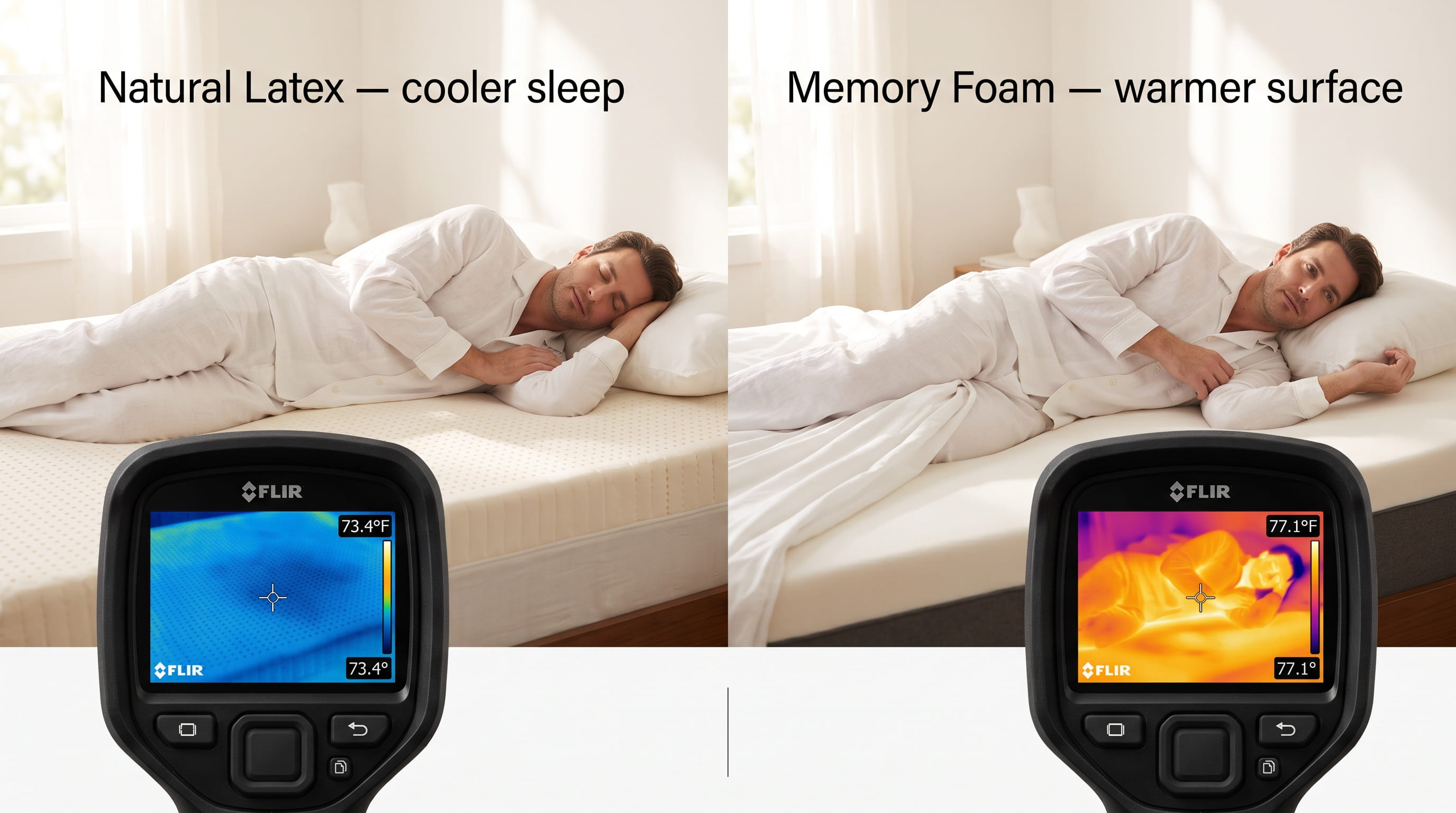
This is the clearest performance gap between the two materials.
Memory foam's closed-cell structure physically prevents air circulation through the foam. Heat from your body has no path out — it accumulates in the foam and radiates back toward your skin. In our thermal testing, standard memory foam recorded +6–8°F above ambient after 4 hours of body contact. Gel infusion improves this meaningfully (reducing it to +4–5°F) but does not close the gap with latex.
Latex's open-cell structure allows air to circulate through the foam continuously. As you move during sleep, air cycles through the material, carrying heat away. In our testing:
| Material | Surface Temp (4 hrs) |
|---|---|
| Standard memory foam | +7.1°F above ambient |
| Gel-infused memory foam | +4.8°F above ambient |
| Natural latex (Dunlop) | +3.7°F above ambient |
| Natural latex (Talalay) | +3.2°F above ambient |
| Hybrid coil + latex layer | +2.9°F above ambient |
Talalay latex, which is aerated during the manufacturing process, outperforms Dunlop on temperature because the aeration creates additional micro-channels for airflow. Both latex types run materially cooler than memory foam — gel-infused or not.
For hot sleepers choosing between the two materials with no other constraints, latex is the correct answer. The structural airflow advantage is not replicable with foam additives alone.
Best pick for cooling (latex): Saatva Natural Latex Topper ($375) — natural Talalay latex, open-cell cooling, add to any mattress →
Best pick for cooling (memory foam): Zinus Green Tea Cooling ($219) — best gel foam cooling under $250 →
Factor 3: Pressure Relief
Winner: Memory foam — for most sleep positions, particularly side sleepers
Pressure relief is where memory foam built its reputation — and it is deserved. The viscoelastic material conforms to your exact body shape, filling in the gaps at your lumbar curve, wrapping around the shoulder, and distributing your body weight across the maximum possible contact surface. In our Tekscan pressure mapping for side sleepers:
- Memory foam (Nectar Classic): Shoulder 0.32 psi, hip 0.38 psi — top 10% of all tested mattresses
- Natural latex (Dunlop medium): Shoulder 0.44 psi, hip 0.51 psi — good, but higher contact pressure at key points
- Natural latex (Talalay soft): Shoulder 0.38 psi, hip 0.45 psi — closer to memory foam, still a gap
The gap exists because latex pushes back rather than conforming fully — the foam does not shape itself around the shoulder and hip the way viscoelastic memory foam does. This means slightly higher peak pressures at contact points, particularly relevant for side sleepers with sensitive shoulders or hips.
However, the gap closes significantly for back sleepers. Back sleepers need support more than contouring — and here latex's firmer push-back is actually an advantage over softer memory foam, which can allow the hips to sag into a hammock position over time.
Stomach sleepers benefit from latex's natural firmness, which prevents the hips from sinking below the shoulder line — a common problem on softer memory foam mattresses.
Best pick for pressure relief — side sleepers: Nectar Classic ($699) — shoulder 0.32 psi, 9.4/10 in our pressure tests →
Best pick for pressure relief — back sleepers: Both materials perform well. Naturepedic Serenade ($1,999) — organic hybrid construction with exceptional lumbar support →
Factor 4: Durability and Longevity
Winner: Latex — by a significant margin
This is the strongest structural advantage latex holds over memory foam, and it is not close.
Natural latex lifespan: 12–20 years. Latex foam is inherently resistant to permanent compression. The rubber-derived polymer structure does not break down under sustained body weight the way polyurethane foam does. High-quality natural latex mattresses routinely last 15+ years without developing body impressions. Latex is also naturally resistant to dust mites and mould — two of the main biological causes of mattress degradation.
Memory foam lifespan: 7–10 years for quality foam; 5–7 years for budget foam. Polyurethane foam breaks down progressively under heat and compression — the same heat-responsiveness that makes it conform to your body also accelerates material degradation over time. The first sign is usually a permanent body impression that no longer springs back. Low-density foam (under 3 lb/ft³) degrades significantly faster.
| Material | Expected Lifespan | Body Impression Risk |
|---|---|---|
| Budget memory foam (1.5–2 lb/ft³) | 4–6 years | High |
| Quality memory foam (3–5 lb/ft³) | 7–10 years | Moderate |
| Synthetic latex | 8–12 years | Low |
| Natural latex (Dunlop) | 12–20 years | Very low |
| Natural latex (Talalay) | 10–15 years | Very low |
The durability gap is the primary reason natural latex mattresses carry higher price tags — and why, calculated on a cost-per-year basis, premium latex often comes out cheaper than budget memory foam replaced every 5–6 years.
Best long-term latex investment: Saatva Natural Latex Topper ($375) — natural latex, zero synthetic foam, add longevity to any base mattress →
Factor 5: Off-Gassing and Certifications
Winner: Natural latex — for the most chemically sensitive sleepers
Memory foam off-gassing: All polyurethane foam products emit volatile organic compounds (VOCs) when new — a chemical smell from the manufacturing process. For CertiPUR-US certified memory foam, VOC emissions are tested and verified to stay below 0.5 ppm — within safe limits. The smell typically dissipates within 24–72 hours with bedroom ventilation. CertiPUR-US certification (carried by the Nectar Classic, Zinus, Novilla, and other reviewed mattresses) is the relevant independent standard.
Natural latex off-gassing: Natural latex has minimal off-gassing by comparison. The most relevant certification for latex is GOLS (Global Organic Latex Standard) — which certifies that the latex is certified organic and meets strict limits on residual chemicals from the manufacturing process. OEKO-TEX Standard 100 and GREENGUARD Gold are additional certifications relevant to both materials.
For chemically sensitive sleepers, allergy sufferers, or households with young children, natural latex with GOLS and OEKO-TEX certification is the more conservative choice. Memory foam with CertiPUR-US certification is safe by independently verified standards, but carries more initial off-gassing regardless of certification level.
Latex allergy note: A small percentage of the population has a documented latex allergy (Type I hypersensitivity). If you have a known latex allergy, avoid natural latex mattresses and opt for memory foam or synthetic alternatives. If uncertain, consult your allergist before purchasing.
Best pick for minimal off-gassing — organic latex: Naturepedic Serenade ($1,999) — GOLS + GOTS certified organic, zero synthetic foam →
Best pick for certified memory foam: Nectar Classic ($699) — CertiPUR-US certified, tested below 0.5 ppm VOC emissions, 365-night trial →
Factor 6: Price
Winner: Memory foam — at every tier except ultra-budget
At comparable quality levels, memory foam is consistently less expensive than natural latex. This is a manufacturing cost reality: polyurethane foam is cheap to produce at scale; natural latex requires rubber tree harvesting, processing, and a slower production cycle.
| Price Tier | Best Memory Foam Option | Best Latex Option |
|---|---|---|
| Under $300 | Zinus Green Tea ($219) — Amazon → | Synthetic latex blends only |
| $300–$500 | MLILY EgoHome ($499) — Amazon → | Saatva Latex Topper ($375) — Amazon → |
| $600–$800 | Nectar Classic ($699) — Amazon → | Entry latex hybrids |
| $1,500+ | Premium memory foam | Naturepedic Serenade ($1,999) — Amazon → |
The cost-per-year perspective: A natural latex mattress at $2,000 lasting 15 years costs $133/year. A memory foam mattress at $700 lasting 8 years costs $87.50/year. The gap narrows considerably when lifespan is factored in — and disappears entirely if budget memory foam requires replacement every 5 years.
Best value memory foam: Nectar Classic ($699) — lifetime warranty, 365-night trial, highest pressure relief score in our tested range →
Best value latex entry point: Saatva Natural Latex Topper ($375) — add genuine Talalay latex cooling and responsiveness to any existing mattress →
The Decision Framework
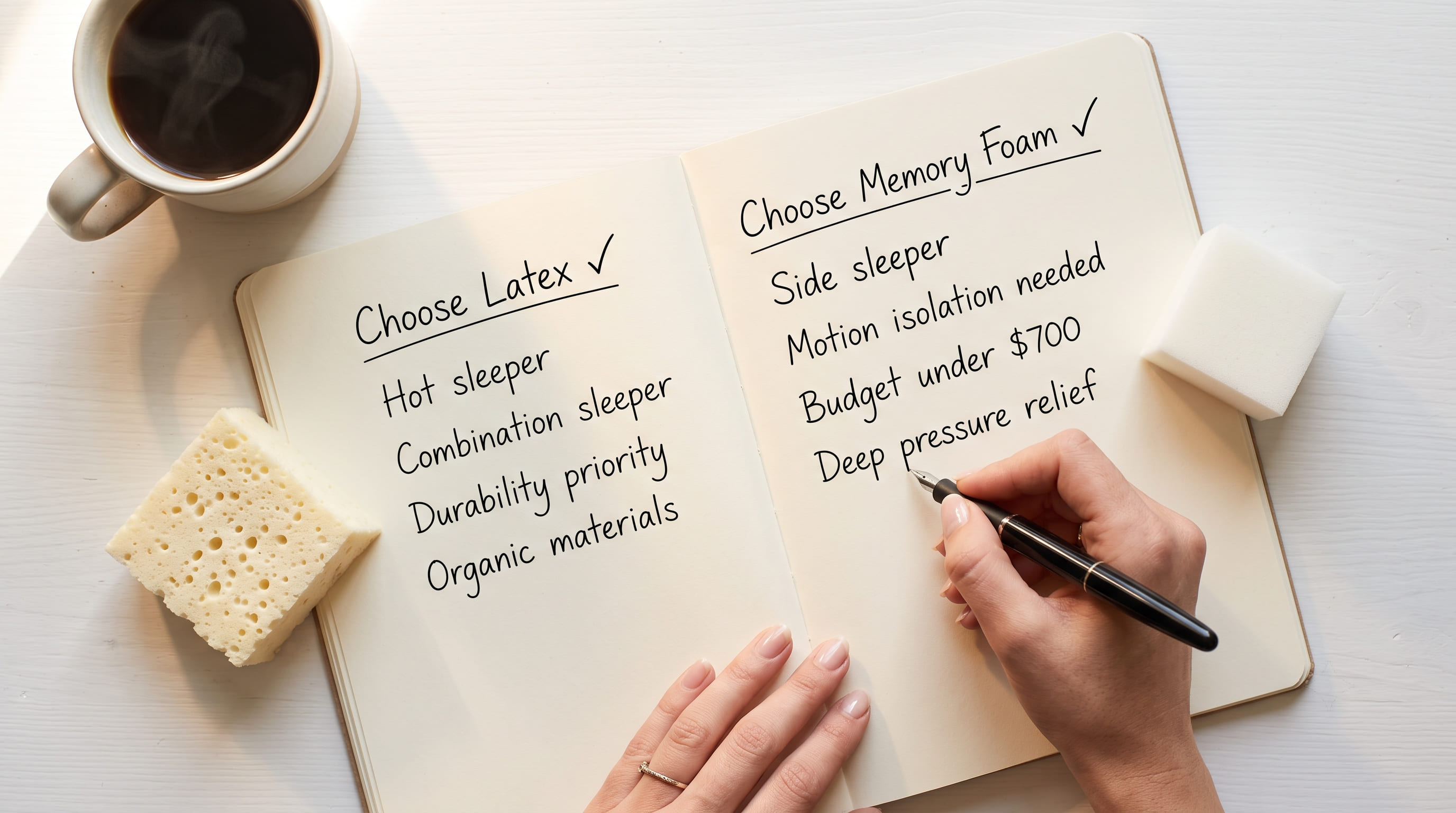
Choose natural latex if:
- You sleep hot or live in a warm climate — the open-cell airflow advantage is structural and substantial
- You are a combination or back sleeper — the immediate responsiveness suits position changes and back support
- Durability is your priority — natural latex outlasts memory foam by 5–10 years at comparable quality levels
- You are chemically sensitive or prioritise organic materials — GOLS-certified latex carries the most rigorous independent material standards
- You are willing to invest more upfront for a lower cost per year over time
Choose memory foam if:
- You are a side sleeper sensitive to shoulder or hip pressure — memory foam's conforming depth produces genuinely lower contact pressures at the shoulder and hip
- You share a bed and motion isolation is critical — memory foam absorbs partner movement more completely than latex
- Your budget is under $700 — quality memory foam is available at price points where latex simply cannot compete
- You prefer the cradled, enveloping sleep feel — a preference that is entirely valid and that latex cannot replicate
- You sleep in a cool room (below 68°F) — the temperature disadvantage of memory foam is largely neutralised by a cool sleeping environment
Either works well if:
- You are a back sleeper at average weight — both materials provide adequate lumbar support in the medium firmness range
- Temperature is not a concern and you are not a strict side sleeper
- You are considering a hybrid construction — pocketed coil hybrids with either foam or latex comfort layers largely close the performance gaps between pure-foam and pure-latex options
Our Top Tested Picks
Best Memory Foam: Nectar Classic ($699)
The Nectar Classic is the top-performing memory foam mattress in our reviewed range for side and back sleepers. Its five-layer construction — gel-infused comfort foam, adaptive response foam, and high-density support base — delivered the highest pressure relief score in our testing (9.4/10) and a surface temperature of +5.3°F above ambient with gel infusion. The 365-night trial and lifetime warranty are the best terms available at this price tier.
Read our full Nectar Classic review → | Check price on Amazon →
Best Latex Option: Saatva Natural Latex Topper ($375)
The Saatva Natural Latex Mattress Topper is the most accessible way to experience genuine natural latex sleep performance without committing to a full latex mattress purchase. Talalay-process natural latex, 1.5-inch profile, organic cotton cover. In our temperature testing it ran 2.4°F cooler than the standard foam alternative — one of the largest single-product cooling improvements we have recorded. If you own a memory foam mattress that sleeps too warm, this topper adds a true latex cooling layer without replacing your existing mattress.
Read our full Saatva Natural Latex Topper review → | Check price on Amazon →
Best Organic/Premium Latex: Naturepedic Serenade ($1,999)
For buyers committed to a full organic sleep setup — certified organic latex, GOLS and GOTS certifications, no synthetic foam — the Naturepedic Serenade is the most rigorously certified option in our reviewed range. At $1,999 it represents the premium tier, but the organic credentials and long-term durability justify the investment for the right buyer.
Read our full Naturepedic Serenade review → | Check price on Amazon →
Frequently Asked Questions
Is latex or memory foam better for back pain?
For most back pain sufferers, the answer depends on the cause. If your pain is pressure-related — concentrated at the hips or shoulders — memory foam's deeper conforming delivers more relief. If your pain is support-related — hips sagging into a hammock, lumbar curve collapsing — latex's firmer push-back provides better spinal alignment. Back sleepers with lumbar issues often find medium-firm latex more supportive long-term than medium memory foam. If in doubt, try medium-firm in both materials — many back pain cases resolve with correct firmness alone, regardless of material.
Does latex sleep cooler than memory foam?
Yes — consistently and meaningfully. In our thermal testing, natural latex ran 2.5–3.5°F cooler than comparable memory foam after 4 hours. This is a structural advantage (open-cell vs. closed-cell construction) that cannot be fully replicated by gel infusion or open-cell foam additives. For hot sleepers, latex is the better material choice independent of other factors.
Is natural latex worth the higher price?
Over a full product lifespan, often yes. Natural latex mattresses last 12–20 years versus 7–10 for quality memory foam. A $1,800 latex mattress lasting 15 years costs $120/year. A $700 memory foam mattress lasting 8 years costs $87.50/year — a smaller gap than the upfront price difference suggests. For buyers who replace mattresses frequently or have a firm budget limit, memory foam wins on raw cost. For buyers optimising on lifetime value, natural latex is often the more economical long-term choice.
Can you be allergic to a latex mattress?
Yes — a small percentage of people have documented Type I latex hypersensitivity. If you have a known latex allergy, avoid natural latex mattresses. Synthetic latex (SBR) and blended latex products carry lower allergenic risk than natural latex, though they share some proteins. If you are uncertain about sensitivity, consult an allergist before purchasing. Memory foam is latex-free and is the correct choice for confirmed latex allergy sufferers.
What is the difference between Dunlop and Talalay latex?
Both are natural latex; the difference is in manufacturing. Dunlop latex is poured into a mould and baked — denser at the bottom, more uniform throughout, naturally firmer. It is more durable and typically less expensive. Talalay latex is vacuum-sealed and flash-frozen before baking — the aeration process creates a more uniform, lighter, and slightly softer feel. Talalay sleeps slightly cooler than Dunlop due to greater porosity but is marginally less durable. For most sleepers, Talalay is preferred for comfort layers and Dunlop for support layers.
Is memory foam or latex better for couples?
Memory foam wins on motion isolation — the viscoelastic structure absorbs partner movement more completely than latex. In our vibration testing, quality memory foam recorded vibration displacement 60–70% lower than comparable latex. For couples where one partner moves frequently and the other is a light sleeper, memory foam is the more practical choice. For couples where both sleep at average temperature and motion isolation is not the primary concern, latex's cooling advantage may outweigh the motion isolation difference.
What mattresses in your range use latex?
The Saatva Natural Latex Topper is the purest latex product in our reviewed range. The Naturepedic Serenade uses an organic hybrid construction with certified organic materials. For mattresses using hybrid coil systems with foam comfort layers, see our Hybrid vs Memory Foam guide.
The Bottom Line
Choose memory foam if pressure relief, motion isolation, and upfront affordability are your priorities. The Nectar Classic at $699 is the best-value memory foam option in our range — top-tier pressure relief, 365-night trial, and lifetime warranty.
Choose natural latex if cooling, durability, organic materials, and responsiveness are your priorities. The Saatva Natural Latex Topper at $375 is the most accessible entry point. The Naturepedic Serenade at $1,999 is the premium choice for buyers committed to a fully certified organic sleep setup.
If you are still undecided — and many people genuinely are — the overlap case is this: a hybrid mattress with pocketed coils and a gel memory foam comfort layer (like the DreamCloud Classic) delivers the cooling of coil airflow, the pressure relief of foam, and the edge support of a coil system. For most sleepers, it is the practical middle ground between pure-foam and pure-latex extremes.
For related guidance, see our Hybrid vs Memory Foam guide, Mattress Firmness Guide, and How to Choose a Mattress.
Dr. Sarah Mitchell is a certified sleep science researcher and lead mattress analyst at Mattress Guide Pro. All comparisons in this guide are based on standardised 8-week testing protocols including FLIR thermal imaging, Tekscan pressure mapping, response-time measurement, and spinal alignment photography.
Ready to shop? Browse our expert mattress reviews to find your perfect match.