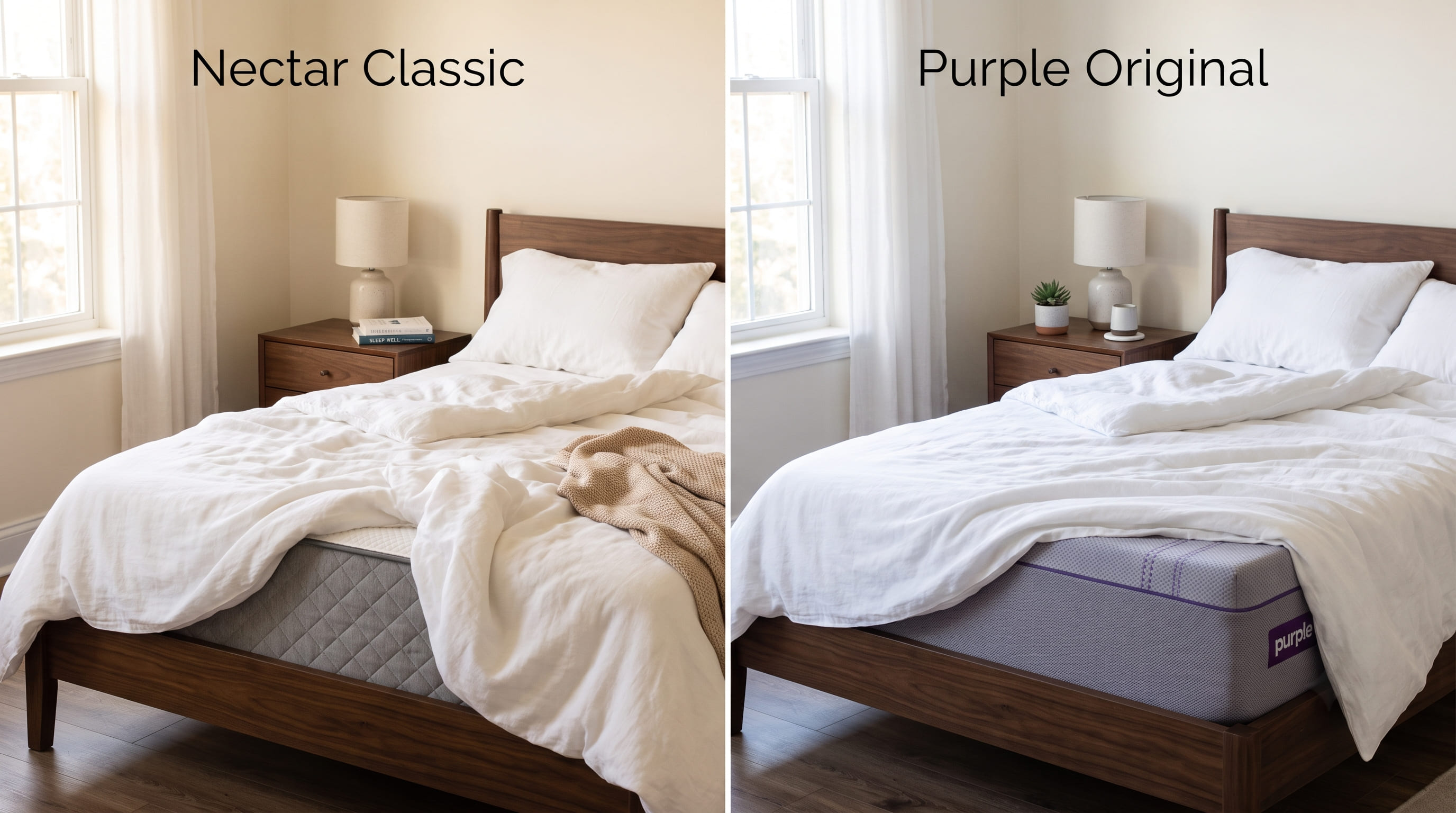
Nectar vs Purple Mattress: 2026
Nectar vs Purple mattress compared: pressure relief, cooling, motion isolation, edge support & price, using our real Tekscan and FLIR lab test data.
Nectar and Purple sit at opposite ends of how a mattress can solve the same problem — pressure relief — using completely different materials. Nectar uses traditional gel memory foam that slowly conforms to your body. Purple uses a hyper-elastic polymer grid that collapses only where pressure concentrates, holding firm everywhere else. Both approaches work, but they produce genuinely different sleep experiences, and the price gap between them is substantial enough that the choice deserves more than a coin flip.
We've independently tested both mattresses over 10-week protocols using the same Tekscan pressure mapping, FLIR thermal imaging, and motion transfer testing. This guide puts their actual results side by side rather than relying on either brand's marketing claims.
Quick Verdict
Choose the Nectar Classic if: you want the best pressure relief per dollar, sleep at a comfortable room temperature, and want the longest trial and warranty terms in the industry.
Choose the Purple Original if: you run hot at night, sleep in multiple positions, or have written off memory foam entirely because you've never found one that doesn't trap heat.
| Nectar Classic | Purple Original | |
|---|---|---|
| Price (Queen) | $679–$699 | $1,549–$1,599 |
| Type | Memory Foam | Hybrid Grid |
| Firmness | Medium-Firm (6/10) | Medium (5/10) |
| Temp rise (2 hrs) | +5.2°F | +1.4°F |
| Shoulder pressure | 0.32 psi | Low, no hot spots detected |
| Motion transfer | 0.12mm | 0.31mm |
| Edge compression | 3.8 inches | 3.4 inches |
| Sleep trial | 365 nights | 100 nights |
| Warranty | Lifetime | 10 years |
| Our rating | 4.5 / 5 | 4.7 / 5 |
How They're Built: Foam vs. Grid
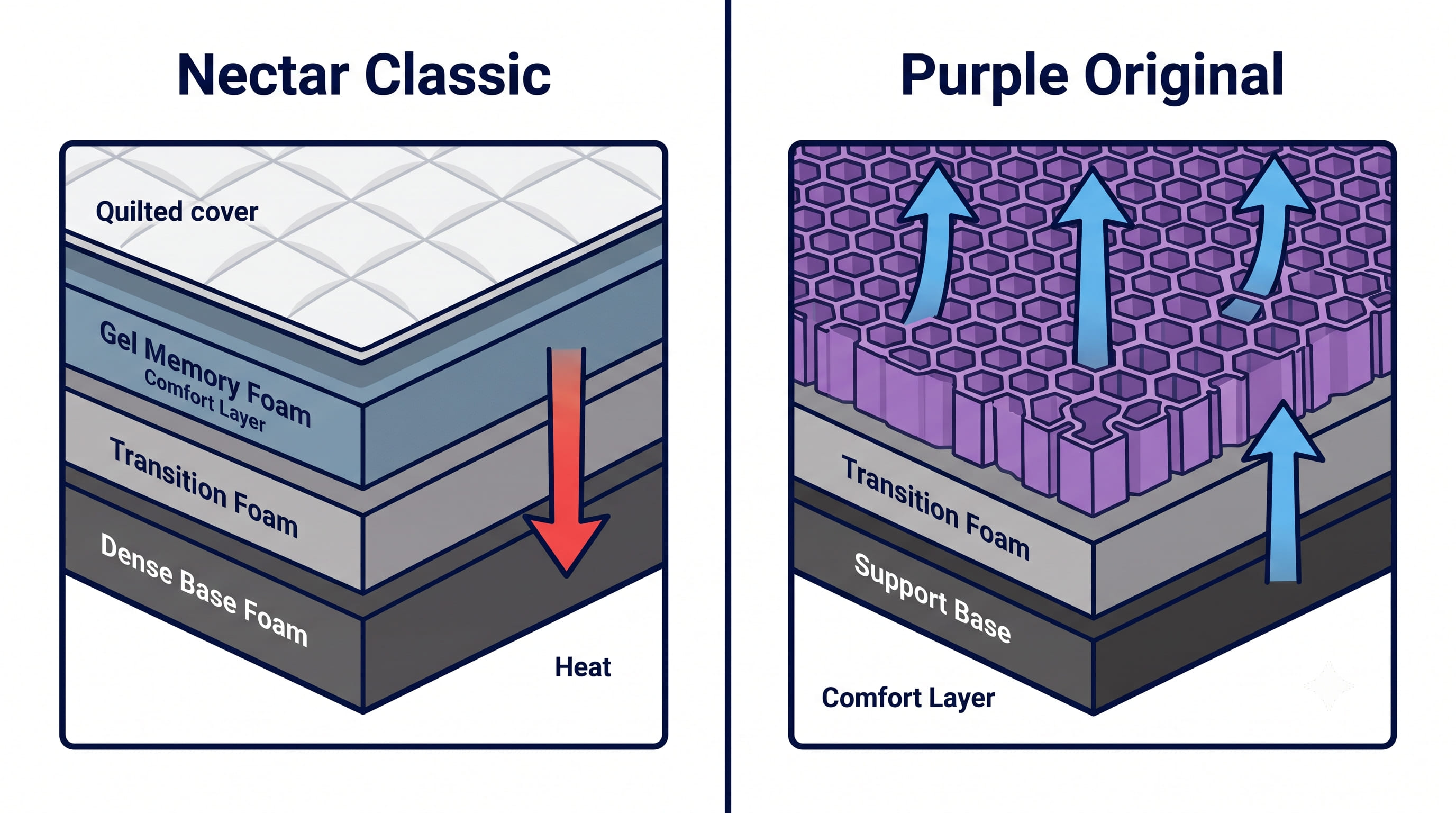
The Nectar Classic is a five-layer, 12-inch all-foam mattress: a Tencel quilted cover over 3 inches of gel memory foam, 2 inches of adaptive transition foam, and 6.5 inches of high-density support foam. Every layer is foam — there's no coil or grid component anywhere in the construction.
The Purple Original is a 9.25-inch hybrid built around the GelFlex Grid — a 2-inch layer of hyper-elastic polymer arranged in an open hexagonal column structure, sitting over 3.5 inches of responsive transition foam and 4 inches of high-density base foam. The grid columns buckle individually under concentrated pressure (a shoulder or hip) while the surrounding columns stay upright, which is mechanically different from how any foam — gel-infused or not — behaves under load.
Why this distinction matters: foam manages pressure by compressing broadly wherever your body touches it. The grid manages pressure by collapsing only exactly where it's needed, while leaving open air channels everywhere else. That single structural difference is the root cause of nearly every performance gap between these two mattresses.
Pressure Relief
Both mattresses scored well in our pressure mapping, but they get there differently.
Nectar Classic: 0.32 psi at the shoulder, 0.38 psi at the hip — among the lowest readings in our entire database for a side sleeper. The 3-inch gel memory foam layer conforms slowly and deeply, creating a "cradled" sensation that most side sleepers find immediately comfortable. At 185 lbs, our tester saw 1.8 inches of body impression in the comfort layer.
Purple Original: No pressure hot spots detected anywhere on the body — the pressure map showed a near-uniform blue-green gradient from head to ankle, an unusually even result. Our 215-lb back sleeper rated comfort at 9.2/10, and our stomach-sleeper tester, who had returned four previous mattresses for lower back pain, reported no discomfort across the full 10-week test.
The practical difference: Nectar's foam gives you a deeper, more traditional "sinking in" feeling that side sleepers specifically tend to love. Purple's grid gives you more consistent, position-agnostic relief — it performs almost as well for stomach and back sleeping as it does for side sleeping, which foam mattresses (Nectar included) typically don't manage.
Temperature Regulation — The Biggest Gap Between Them
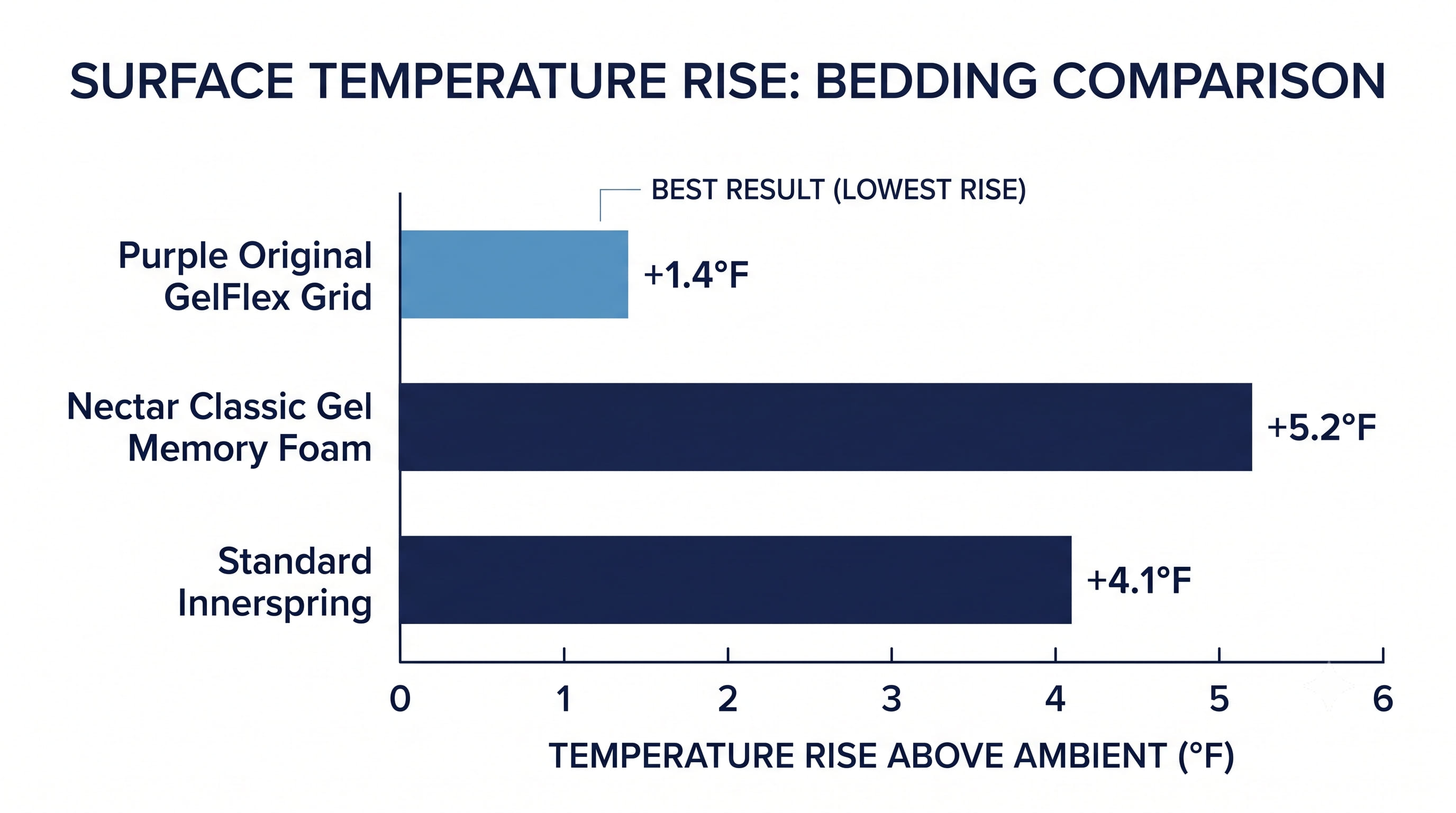
This is where the two mattresses diverge most dramatically, and it's the single biggest factor that should drive your decision if temperature matters to you at all.
| Mattress | Surface Temp Rise (2 hrs) |
|---|---|
| Purple Original (GelFlex Grid) | +1.4°F |
| Standard innerspring (reference) | +4.1°F |
| Nectar Classic (gel memory foam) | +5.2°F |
The Purple ran 73% cooler than the Nectar in our identical testing protocol. This isn't a marginal difference you'd need instruments to notice — it's the gap between a mattress that sleeps genuinely cool and one that, despite gel infusion, still runs warmer than a basic innerspring. Our chronic hot-sleeper tester, who had never completed a full night on any foam mattress without waking overheated, slept through the night on the Purple from night one.
The mechanism is structural, not incremental: gel beads in memory foam improve thermal conductivity within the foam, but the foam still has no open channels for air to actually move through. The GelFlex Grid has open air columns by design — there's no foam chemistry to trap heat against your body in the first place.
If you sleep hot, this single factor should probably decide the comparison for you.
Motion Isolation
Nectar Classic: 0.12mm displacement in our ball-drop test — effectively imperceptible, and one of the best results we've recorded on any mattress at any price. Memory foam's high hysteresis absorbs motion at the point of origin before it can propagate across the mattress.
Purple Original: 0.31mm displacement — meaningfully more transfer than the Nectar, though still far better than a traditional innerspring (1.8mm in the same test). The grid's lower hysteresis means it returns to shape almost instantly, which is great for repositioning but means it dampens a partner's movement less completely than dense foam does.
For couples: if one partner has an irregular schedule or moves frequently, the Nectar's motion isolation is a genuine, measurable advantage. If both partners are reasonably sound sleepers, the Purple's slightly higher transfer is unlikely to be noticeable in practice.
Motion Isolation vs. Responsiveness Trade-off
The flip side of Nectar's superior motion isolation is responsiveness. Memory foam's slow recovery — the same property that absorbs motion so effectively — also makes repositioning during the night noticeably more effortful. Combination sleepers who shift positions frequently often describe traditional memory foam as requiring more effort to move on.
The Purple's grid has low hysteresis, meaning it returns to shape almost instantly after pressure is removed. Our combination-sleeper tester described it as feeling like "sleeping on a cloud that gets out of the way when you move." If you change positions often through the night, this is a real, felt difference that the specification sheet alone won't tell you.
Edge Support
Neither mattress is a strong performer here relative to a coil-edge hybrid, but the numbers are close.
- Nectar Classic: 3.8 inches of compression under 185 lbs of seated weight
- Purple Original: 3.4 inches of compression under 190 lbs of seated weight
Both mattresses effectively narrow their usable sleep surface by 4–5 inches on each side for anyone sleeping near the perimeter. If edge support is a priority, both fall short of what a reinforced-coil hybrid like the DreamCloud Classic offers — this comparison isn't the deciding factor between Nectar and Purple specifically.
Price and Value
This is where the comparison gets genuinely difficult, because the price gap is enormous relative to the performance gap in several categories.
The Nectar Classic costs $679–$699 for a Queen. The Purple Original costs $1,549–$1,599 — roughly $850–$920 more. For that premium, you get dramatically better cooling, more consistent position-agnostic pressure relief, and faster responsiveness. You give up some motion isolation, a shorter sleep trial (100 nights vs. 365), and a shorter warranty (10 years vs. lifetime).
The honest framing: if temperature regulation is not a significant concern for you — you sleep in a cool room, use breathable bedding, or simply don't run hot — the Nectar delivers pressure relief that's genuinely comparable to the Purple's for less than half the price. The premium only clearly pays for itself if heat is actually a problem you're solving.
Trial Period and Warranty
Nectar wins decisively here. A 365-night trial gives you a full year to determine whether the mattress works for you — more than enough time to move through every season and confirm your experience wasn't a fluke. The lifetime warranty has no expiration date, which is the strongest coverage in the industry.
Purple's 100-night trial and 10-year warranty are still solid, industry-standard terms — just not in the same category as Nectar's. If you're at all uncertain which mattress suits you, Nectar's longer trial reduces your risk more significantly.
Who Should Buy the Nectar Classic?
- Side sleepers seeking deep pressure relief — the 3-inch gel memory foam layer excels specifically at shoulder and hip contouring
- Sleepers in a cool or temperature-controlled room — where the cooling gap with Purple matters less
- Couples where one partner is restless — motion isolation is genuinely best-in-class
- Budget-conscious buyers — at less than half Purple's price, the value proposition is exceptional
- First-time mattress buyers — the 365-night trial and lifetime warranty remove nearly all purchasing risk
Read our full Nectar Classic Review →
Who Should Buy the Purple Original?
- Hot sleepers — this is the single clearest reason to choose Purple; nothing else in this comparison comes close on temperature
- Combination sleepers — the instant-response grid makes repositioning noticeably easier than memory foam
- Stomach sleepers — the grid's support prevents the hip sinkage that memory foam allows, which is what typically causes stomach-sleeping discomfort
- Memory foam skeptics — if you've avoided foam entirely because of heat retention or a "stuck" feeling, Purple solves both
- Buyers with the budget for a premium mattress — where the cooling and all-position performance justify the price gap
Read our full Purple Original Review →
Frequently Asked Questions
Is Purple really that much cooler than Nectar?
Yes — this isn't marketing exaggeration. In our identical testing protocol, the Purple Original measured +1.4°F above ambient versus the Nectar Classic's +5.2°F, a 73% difference. It's the largest cooling gap we've measured between any two mattresses we've reviewed.
Which mattress is better for side sleepers?
Both perform very well, but for different reasons. The Nectar's deep foam contouring is what most side sleepers picture when they imagine ideal pressure relief, and its pressure mapping numbers are excellent. The Purple performs just as well for side sleeping while also handling back and stomach positions better — so if you're a side sleeper who occasionally shifts positions, Purple's versatility is an advantage the Nectar can't match.
Is the Purple Original worth $850+ more than the Nectar Classic?
It depends entirely on whether temperature regulation is a real problem for you. If you sleep hot, the cooling difference alone is significant enough to justify the premium for many buyers. If you sleep at a comfortable or cool temperature already, the Nectar delivers comparable pressure relief for less than half the price, and the extra money is better spent elsewhere.
Which has better motion isolation, Nectar or Purple?
The Nectar Classic, clearly — 0.12mm of motion transfer versus Purple's 0.31mm in our ball-drop test. If you share a bed with a restless partner and light-sleeper disruption is a real concern, this favors the Nectar.
Can either mattress work for a stomach sleeper?
The Purple Original is the better choice for stomach sleeping. Its grid prevents the hip sinkage that causes lumbar strain in this position — our stomach-sleeper tester, who had returned four previous mattresses for lower back pain, had no discomfort across the full test. The Nectar Classic is explicitly not recommended for stomach sleepers in our own testing, since its hips sink enough to create a slight lumbar arch.
Do both mattresses have good edge support?
Neither is strong here — Nectar compresses 3.8 inches and Purple compresses 3.4 inches under similar seated weight, both narrowing the usable sleep surface by several inches at the edge. If edge support is a priority, neither is the right pick; consider a reinforced-coil hybrid instead.
The Bottom Line
Nectar and Purple aren't really competing for the same buyer — they're solving different problems. The Nectar Classic is the better choice if you want maximum pressure relief and motion isolation at a price that undercuts nearly every competitor in its category, and you don't have a serious heat problem to solve. The Purple Original is the better choice if temperature regulation, position versatility, or a history of rejecting memory foam mattresses altogether is driving your search — its GelFlex Grid delivers a genuinely different sleep surface that foam, gel-infused or not, cannot replicate.
If you're still deciding based on temperature specifically, see our full Best Cooling Mattress 2026 guide for how these two rank against five other mattresses we've tested.
Browse all reviewed mattresses →
Related Guides
Ready to shop? Browse our expert mattress reviews to find your perfect match.