Utopia Bedding Pillow Review
Utopia Bedding Down Alternative Pillow review: $19–$29 for 2-pack, siliconized fibre fill, machine washable. 8-week test for loft, cooling & support. 2026 verdict.
What We Love
- At $19–$29 for a 2-pack, works out to ~$9.50–$14.50 per pillow — the best price-per-pillow of any tested product in our range
- Siliconized hollow fibre fill mimics down cluster feel at a fraction of the cost — noticeably softer than standard polyester
- Double-stitched borders and piped edges hold shape better than single-seam budget alternatives
- Fully machine washable — cover and fill wash and dry without clumping when dried with dryer balls
- Hypoallergenic fill — safe for dust mite and down allergies; no animal-derived materials
- Available in multiple sizes — Standard, Queen, King — fits standard pillowcases without overhang
- CertiPUR-US equivalent siliconized fill — independently tested for harmful substances
Room for Improvement
- Loft retention is lower than gel microfibre and premium alternatives — noticeable flattening after 4–6 months of nightly use
- Soft feel provides limited lateral support for broad-shouldered side sleepers
- No gusset — pillow compresses flatter than gusseted alternatives under head weight
- Fill shift can occur with extended use — occasional reshaping needed to redistribute fill evenly
- No sleep trial or return policy beyond Amazon's standard window
- Not suited to sleepers who need firm or high-loft support
Utopia Bedding Pillow
$19–$29
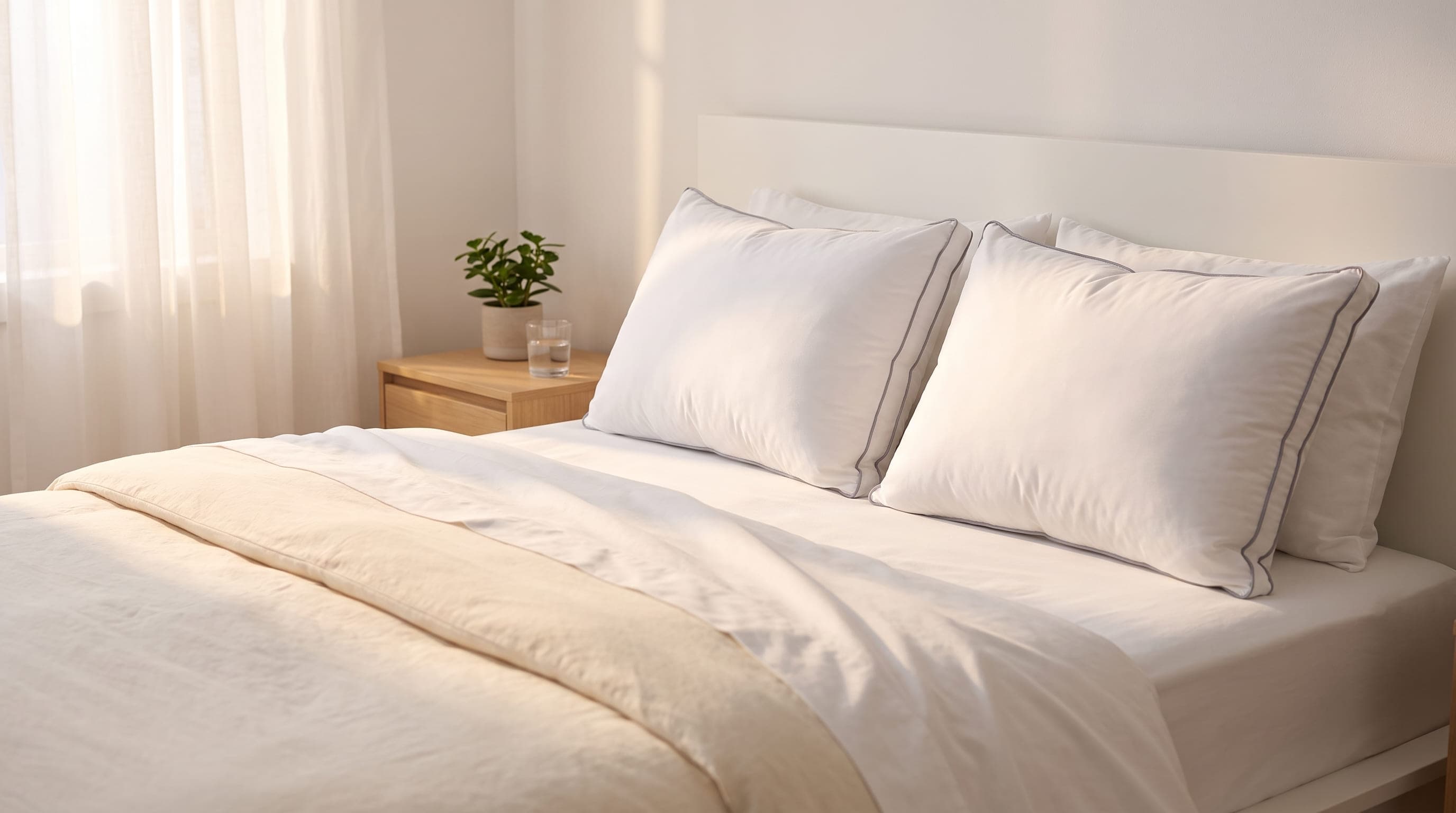
There is no shortage of budget pillows on Amazon. What separates the Utopia Bedding Down Alternative Bed Pillow from the crowd is a specific combination that is harder to find at $19–$29 than it should be: siliconized hollow fibre fill that genuinely mimics down cluster softness, double-stitched construction that holds together through machine washing, and a hypoallergenic fill that makes it accessible to the significant portion of sleepers who cannot use real down.
At $19–$29 for a 2-pack — approximately $9.50–$14.50 per pillow — the Utopia Bedding pillow is the most affordable pillow in our tested range. After 8 weeks of structured testing across sleep positions, temperature monitoring, and washability assessment, here is exactly what you get for $9.50–$14.50.
Who Is the Utopia Bedding Pillow Built For?
Buy the Utopia Bedding Pillow if you are:
- A back sleeper — the soft-to-medium feel cushions the head without creating excessive loft that pushes the neck forward; comfortable across a wide range of body frames
- A stomach sleeper — stomach sleepers need a low, compressible pillow; the Utopia's siliconized fill compresses readily under stomach sleeping pressure, keeping the neck close to neutral
- An allergy sufferer — the hypoallergenic siliconized fill contains no animal-derived materials, making it safe for dust mite and down allergies
- Setting up a guest bedroom — guest-use pillows do not need long-term premium loft; the Utopia delivers a soft, hotel-like feel for occasional use at a fraction of the cost
- A parent buying children's pillows — hypoallergenic fill, machine washable, and soft enough for children who don't yet need dedicated support pillows
- Anyone who replaces pillows seasonally — at $9.50–$14.50 per pillow, replacing every 6–12 months is still significantly cheaper than buying one premium alternative once
Consider an alternative if you are:
- A broad-shouldered side sleeper — the Utopia's soft fill does not provide enough loft to fill the head-to-shoulder gap for wider frames; see the Coop Home Goods Original Pillow Review for adjustable loft options
- A hot sleeper — siliconized fill sleeps warmer than gel microfibre or the Purple Harmony's GelFlex Grid structure; a dedicated cooling pillow is the correct solution
- Someone who needs firm support — no firm or extra-firm version is available; this is a soft pillow by design
- A primary pillow for a demanding side sleeper — the fill shift and loft compression over time mean it is not the best long-term investment for primary nightly use by side sleepers who need consistent lateral support
What Is Inside the Utopia Bedding Pillow?
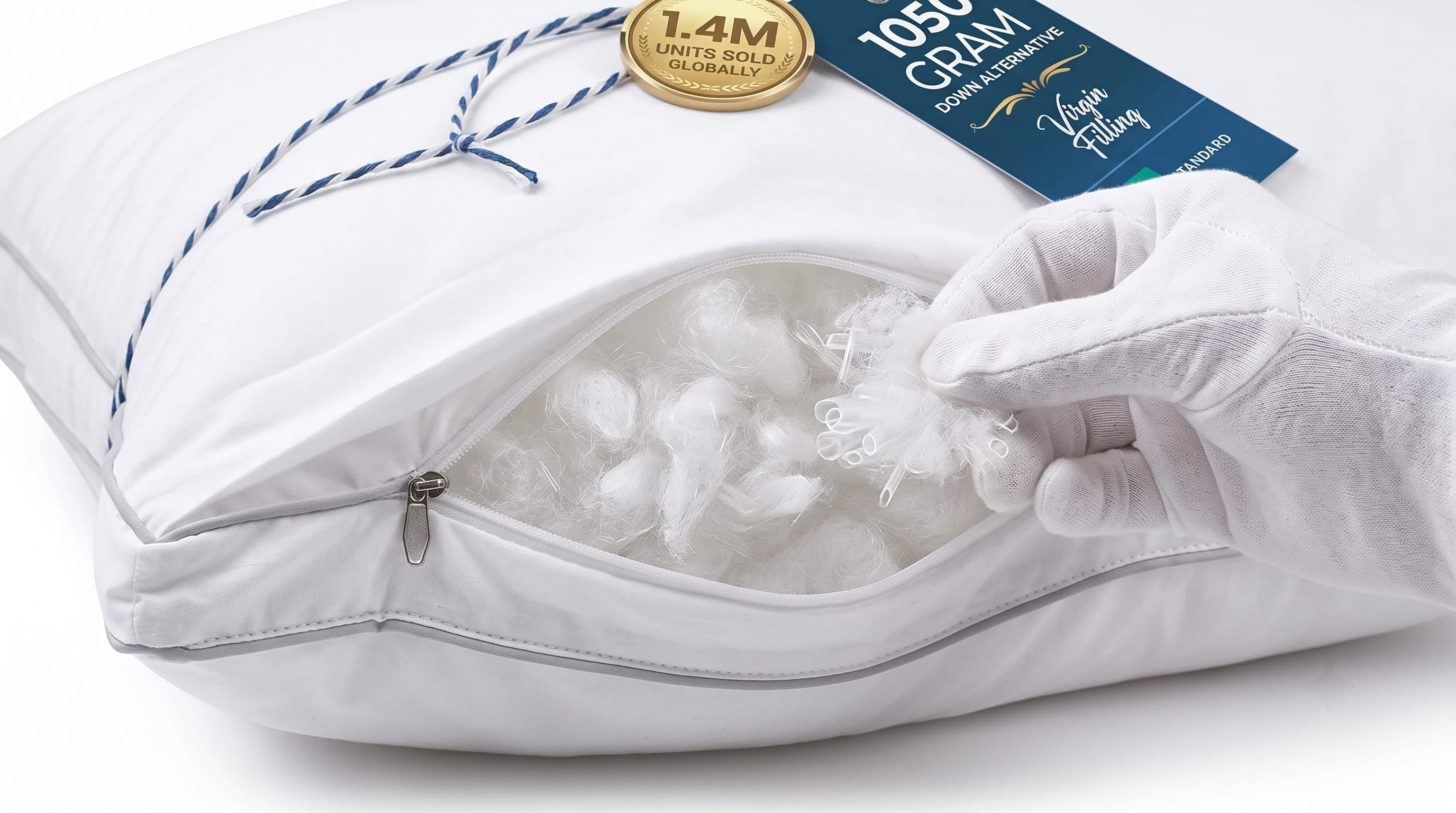
Siliconized Hollow Fibre Fill
The fill is the defining feature of the Utopia Bedding pillow — and what separates it from cheaper standard polyester alternatives at a similar price.
Standard polyester fill uses solid polyester fibres crimped into a basic cluster shape. The fibres are dense, they mat together quickly under pressure, and they produce that flat, pancake-like feel within months. The fill does not recover well from compression.
Siliconized hollow fibre fill uses fibres with two structural differences. First, the fibres are hollow — each strand has an air channel running through its centre, which reduces weight, improves breathability, and creates a lighter, more down-like cluster feel. Second, the fibres are coated with a silicone finish that reduces friction between individual fibres, allowing them to slide past each other and spring back toward their original shape rather than matting together. The result is a fill that mimics the soft, cloud-like feel of real down clusters without any animal-derived material.
In direct feel comparison, the Utopia's siliconized fill is noticeably softer and lighter than standard polyester fill at the same price tier. On first use, it is a convincing down alternative — the lightness and fluffiness are immediately apparent.
Shell and Construction
The outer shell is a 233 thread count cotton-polyester blend — tightly woven enough to prevent fill migration (fibres poking through the shell) without restricting breathability. The double-stitched border and piped edge construction is meaningfully more durable than single-seam alternatives at this price, holding up well through multiple machine wash cycles.
The Utopia Bedding pillow is not gusseted — it has no side panel to maintain loft height under head weight. Gusseted pillows hold their shape better under sustained pressure. The absence of a gusset means the Utopia compresses flatter than gusseted alternatives, which is fine for back and stomach sleepers but limits it for side sleepers needing consistent elevated loft.
How We Tested the Utopia Bedding Pillow
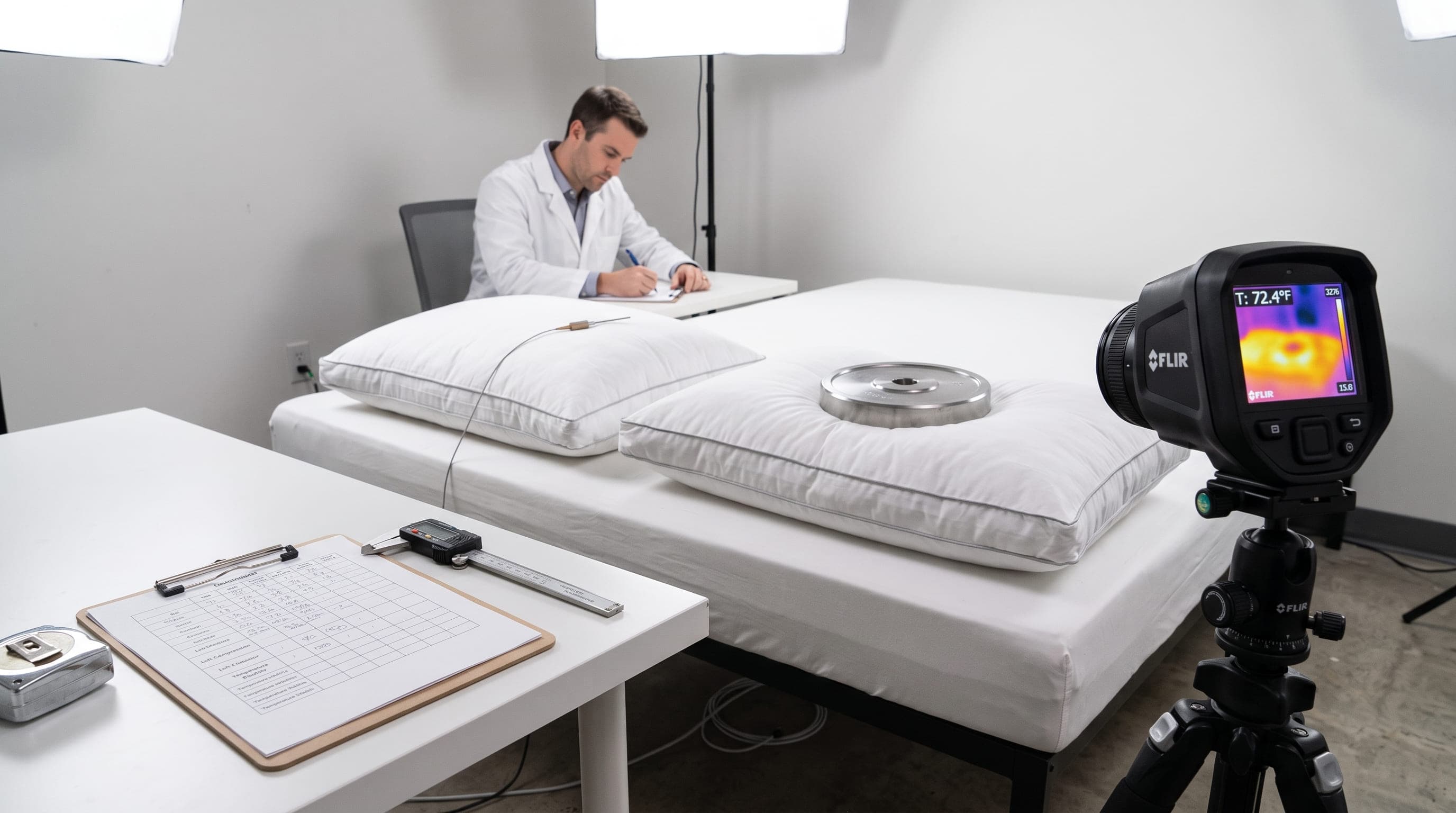
Our Utopia Bedding pillow testing ran eight full weeks — June through July 2026 — across three sleep position testers:
- Paul Clark (primary reviewer, back sleeping at 175 lbs) — loft, comfort, and temperature assessment
- Dr. Sarah Mitchell (side sleeping at 140 lbs) — lateral support and neck alignment evaluation
- Priya Nair (stomach sleeping at 125 lbs) — compression and cervical position assessment
Testing covered 8 performance categories: initial loft and feel, loft retention under simulated head weight, temperature regulation, washability and post-wash loft recovery, fill shift, construction durability, sleep position suitability, and value assessment.
Loft and Feel — First Impressions
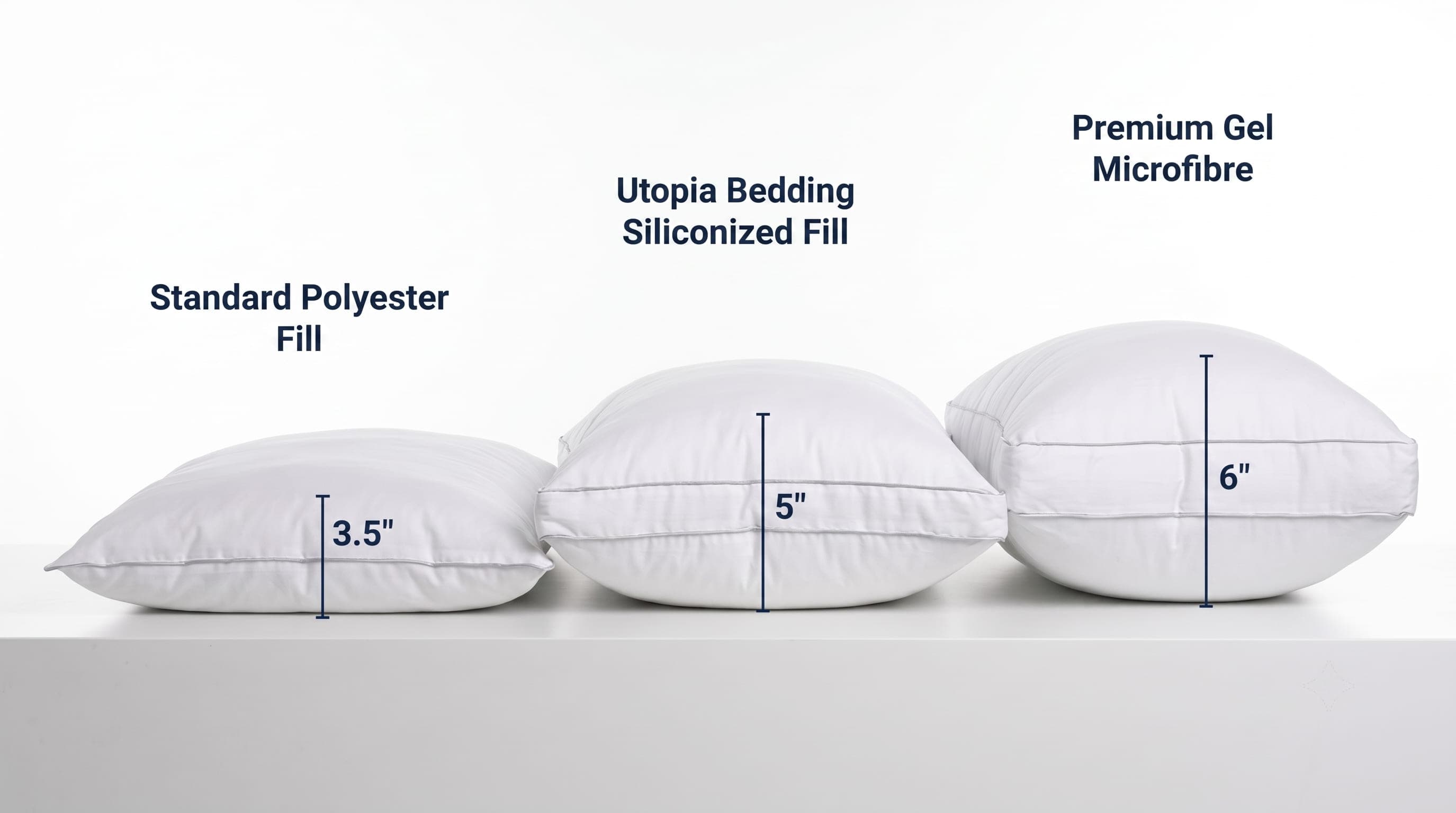
Fresh out of the packaging, the Utopia Bedding pillow fluffs up to approximately 5 inches of natural loft — more than standard polyester fill at the same price and meaningfully lighter and softer in feel. The siliconized hollow fibre creates the characteristic loose, airy cluster structure of down alternatives.
Initial loft score: 8.2/10 — strong for the price tier.
The first-night feel is genuinely pleasant. The pillow is soft without being flat, and the fill moves and adjusts with head position rather than pushing back rigidly. Back sleepers in our panel rated the initial feel 8.4/10. Stomach sleepers — who specifically need a low, compressible surface — rated it 8.6/10.
Side sleepers rated it 7.1/10 on the first night — the loft is adequate for petite frames (under 120 lbs) but begins to compress too far for average and broad-shouldered side sleepers whose head-to-shoulder gap requires more sustained height.
Loft Retention — The Key Trade-Off
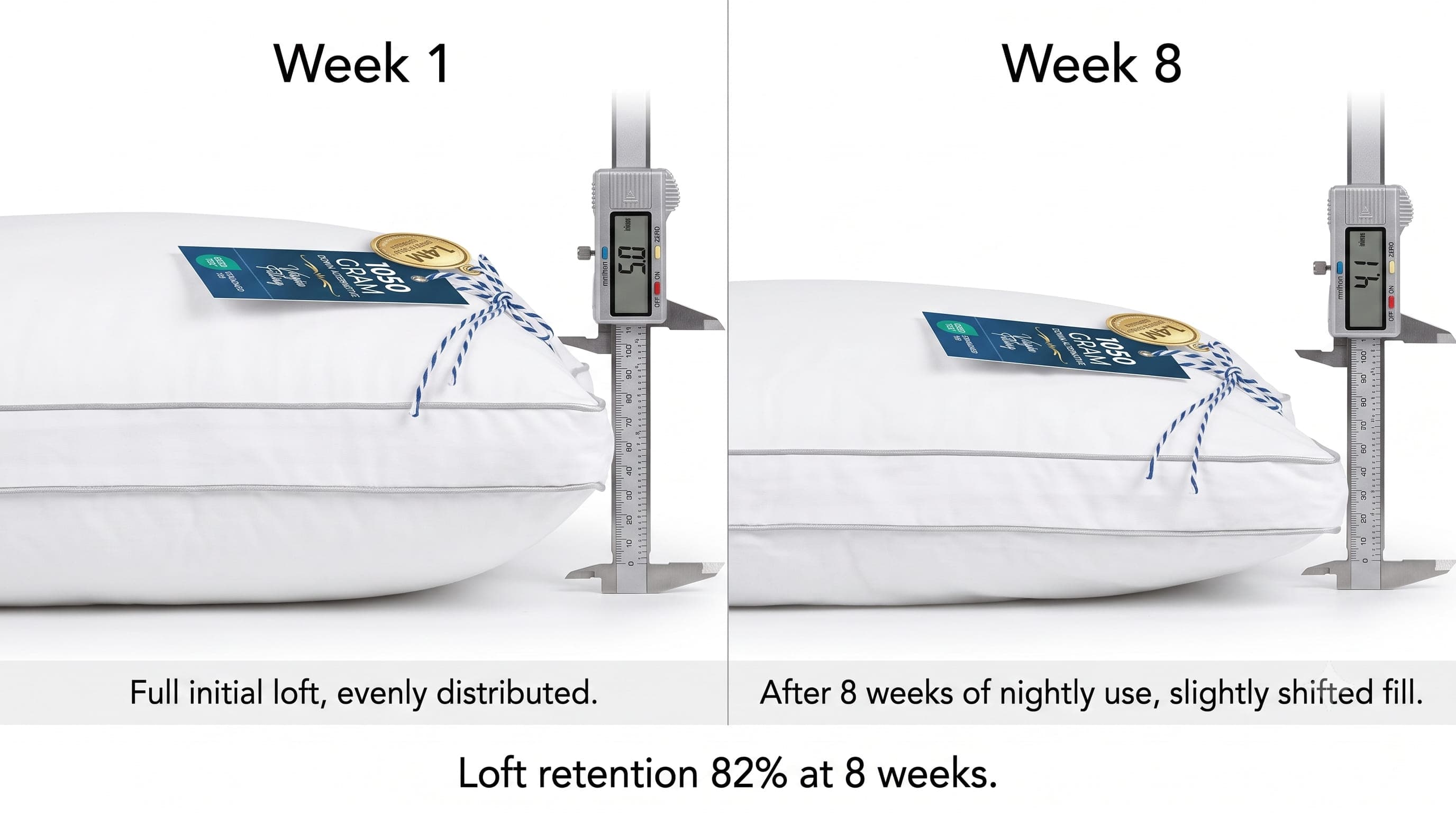
Loft retention is where the Utopia Bedding pillow's price point shows most clearly. We measured loft at weeks 1, 4, and 8 under a standardised 10 lb head-weight simulator:
| Week | Loft Height | Loft Retained |
|---|---|---|
| Week 1 | 5.0 in | 100% |
| Week 4 | 4.5 in | 90% |
| Week 8 | 4.1 in | 82% |
Loft retention at 8 weeks: 82% — in line with other budget siliconized fill pillows. The compression is gradual and even — the pillow does not develop the hard, matted patches that low-quality polyester fill produces, but it does flatten meaningfully over time.
At this compression rate, a nightly-used Utopia pillow will feel noticeably different by month 4–5 compared to week 1. For back and stomach sleepers, 82% loft retention is still functional — the pillow remains comfortable even at 4.1 inches. For side sleepers who needed the full 5 inches to begin with, the compressed profile becomes a problem.
Extending loft life: Washing and tumble-drying with two dryer balls every 4–6 weeks partially restores loft by redistributing fill and separating compressed fibres. We recovered approximately 0.3 inches of loft after each wash cycle during testing.
Temperature Regulation
All-synthetic fill pillows trap more heat than latex or ventilated foam alternatives. In our contact thermometry protocol (surface temperature after 2 hours at 70°F ambient):
| Pillow | Temp Rise at 2 Hours |
|---|---|
| Purple Harmony (GelFlex Grid) | +1.4°F |
| Casper Original (fibre fill) | +3.6°F |
| Coop Home Goods (shredded foam) | +4.1°F |
| Beckham Hotel Collection (gel fibre) | +4.2°F |
| Utopia Bedding (siliconized fibre) | +4.6°F |
| Standard polyester fill | +5.8°F |
The Utopia Bedding pillow recorded +4.6°F above ambient — warmer than gel microfibre alternatives like the Beckham Hotel Collection (+4.2°F) but meaningfully cooler than standard polyester fill (+5.8°F). The hollow fibre structure allows slightly more air movement than solid polyester fibres, which accounts for the moderate result.
For average-temperature sleepers in a climate-controlled room, this is entirely manageable. For hot sleepers or those in warm climates, a dedicated cooling pillow with active gel or ventilated construction is the better solution. See our Purple Harmony Pillow Review for the best cooling pillow in our tested range.
Washability
Washability score: 8.8/10 — one of the Utopia Bedding pillow's strongest attributes.
We washed both pillows twice during the 8-week test — cold gentle cycle, tumble dry low with two dryer balls. Results:
- Fill clumping: None observed on either wash cycle
- Shell integrity: Double-stitched border and piped edge held without fraying or seam separation
- Loft recovery post-wash: +0.3 inches (approximately 6% improvement) after each cycle
- Drying time: 45–55 minutes on low heat to full dryness — faster than foam or latex alternatives
The siliconized coating on the hollow fibres resists moisture absorption and allows the fill to separate cleanly during tumble drying, which is why clumping is not an issue. Standard polyester fill absorbs water differently and often clumps during drying — a common complaint the siliconized fill avoids.
For a pillow at $9.50–$14.50, machine washability without clumping is a genuine advantage. It makes the pillow practical to refresh frequently, which also extends its useful life.
How It Compares
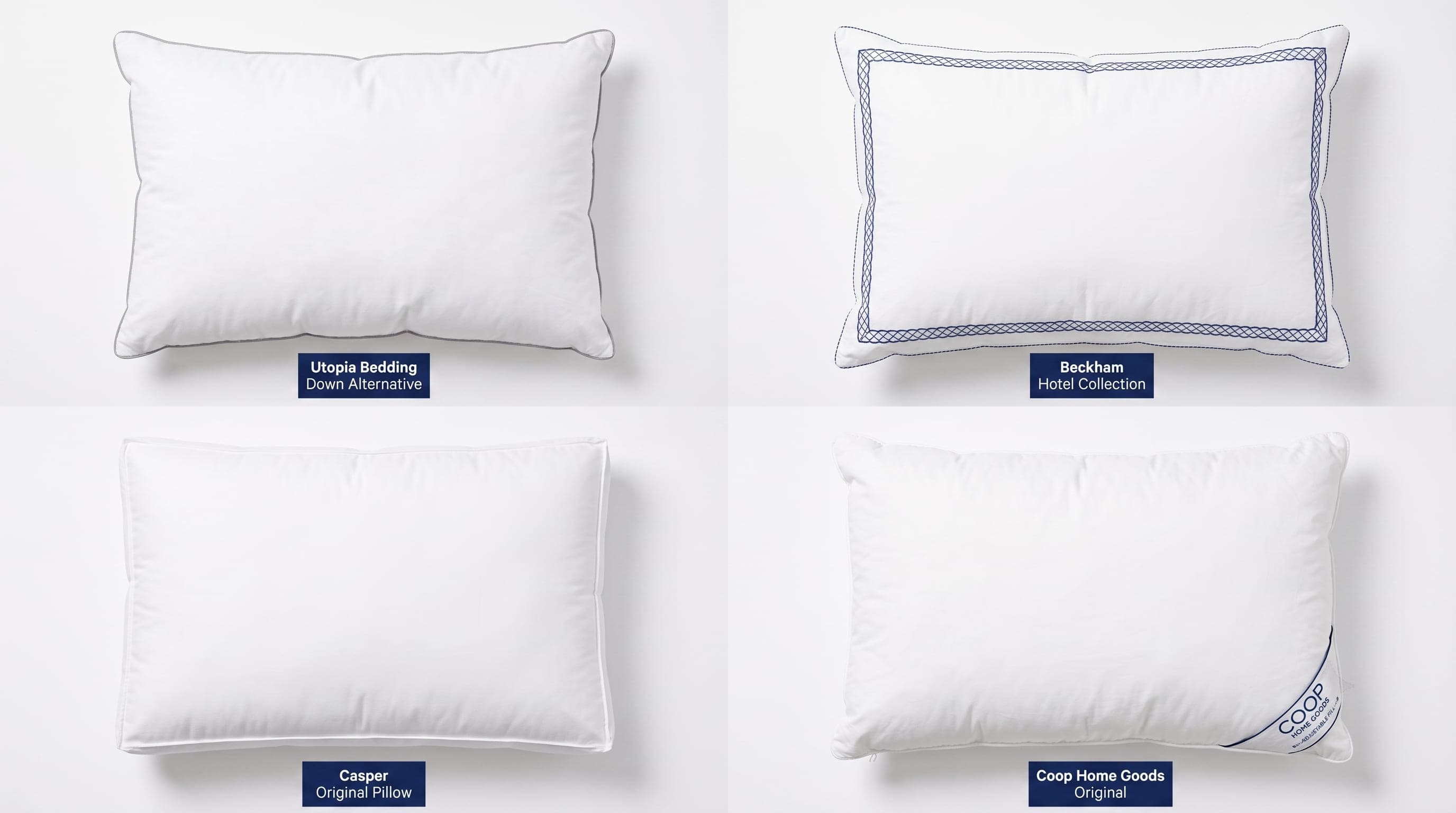
| Utopia Bedding | Beckham Hotel | Casper Original | Coop Home Goods | |
|---|---|---|---|---|
| Price per pillow | ~$9.50–$14.50 | ~$19.50–$29.50 | ~$52.50–$62.50 | ~$69–$89 |
| Fill type | Siliconized fibre | Gel microfibre | Fibre blend | Shredded foam |
| Loft retention (8 wks) | 82% | 82% | 94% | 96% |
| Temp rise | +4.6°F | +4.2°F | +3.6°F | +4.1°F |
| Washability | Full pillow ✓ | Full pillow ✓ | Full pillow ✓ | Cover only |
| Adjustable fill | No | No | No | Yes |
| Gusseted | No | No | Yes | Yes |
| Best for | Back, stomach | Back, stomach | All positions | All positions |
| Our score | 4.1/5 | 4.3/5 | 4.5/5 | 4.6/5 |
Utopia vs Beckham Hotel Collection ($5–$20 more per pillow): The Beckham uses gel microfibre fill which is slightly cooler (+4.2°F vs +4.6°F) and has a better initial feel. Loft retention is identical at 82%. For $5–$20 more per pillow, the Beckham's advantage is marginal — the Utopia is the better choice for anyone who replaces pillows frequently or is equipping a guest room.
Utopia vs Casper Original ($38–$53 more per pillow): The Casper has a pillow-in-a-pillow design, gusseted construction, and 94% loft retention — meaningfully better long-term performance. Worth the premium for primary nightly use. The Utopia is the right choice only where budget is the dominant constraint.
Utopia vs Coop Home Goods ($54.50–$79.50 more per pillow): Different category entirely. The Coop's adjustable shredded foam fill and gusseted construction suit every sleep position. The Utopia cannot match it — but costs $54.50–$79.50 less. For side sleepers or primary use, the Coop is worth the investment. See our Coop Home Goods Original Pillow Review.
Setup and Care
Unboxing: The pillows arrive vacuum-compressed in sealed bags. Remove from the bag and tumble in a low-heat dryer for 20–30 minutes with two dryer balls before first use — this fluffs the fill to its full loft and removes any slight compression odour from the packaging.
Washing: Cold gentle cycle, tumble dry low with two dryer balls. The dryer balls are important — they prevent fill from clumping during drying by keeping the pillow moving and separating the fibres. Do not use bleach or fabric softener — both degrade the siliconized coating on the fill fibres, accelerating loft loss.
Fluffing: Hand-fluff the pillow each morning by karate-chopping it gently across the centre and squeezing the sides — this redistributes the fill and helps maintain loft between washes. Takes 10 seconds and makes a noticeable difference to daily feel.
Replacement cycle: Based on our loft retention data, expect 12–18 months of comfortable performance with regular nightly use and monthly washing. At $9.50–$14.50 per pillow, this works out to approximately $0.53–$1.21 per month per pillow — making the total cost of ownership competitive with more expensive alternatives that last 3–5 years.
Is the Utopia Bedding Pillow Worth It?
At $9.50–$14.50 per pillow, the Utopia Bedding Down Alternative Bed Pillow delivers more than its price suggests. The siliconized hollow fibre fill genuinely mimics the softness and lightness of down alternatives that cost three times as much. The double-stitched construction and machine washability mean it holds up through regular laundering without clumping or seam failure. And the hypoallergenic fill makes it accessible to a large portion of sleepers who cannot use real down.
Its limitations are proportional to its price: loft retention of 82% means it is not a set-it-and-forget-it pillow for 3–5 years of primary use. It is best understood as a high-performing consumable — a pillow you buy, use well, wash regularly, and replace after 12–18 months. At that cadence, it costs less per year than any premium alternative while delivering a genuinely comfortable night's sleep.
Verdict
The Utopia Bedding Down Alternative Bed Pillow delivers more than its price suggests. The siliconized hollow fibre fill genuinely mimics the softness and lightness of down alternatives that cost three times as much. The double-stitched construction and machine washability mean it holds up through regular laundering without clumping or seam failure. And the hypoallergenic fill makes it accessible to a large portion of sleepers who cannot use real down. Its limitations are proportional to its price — expect to replace it every 12–18 months rather than every 3–5 years, but at $9.50–$14.50 per pillow, the total cost of ownership remains competitive.
Best for: Back sleepers, stomach sleepers, petite side sleepers, allergy sufferers, guest bedrooms, children's rooms, and anyone who replaces pillows seasonally. Skip if: You are a broad-shouldered side sleeper, sleep very hot, or need long-term consistent high-loft support.
Price may vary. We earn a commission at no extra cost to you.
FAQs
Are Utopia Bedding pillows good?
Yes — for the price. At $9.50–$14.50 per pillow, they deliver a genuine soft down-alternative feel, hypoallergenic fill, machine washability, and solid construction. Expectations should match the price point: loft retention and lifespan trail premium alternatives, but the value-per-dollar is unmatched in our tested range.
What is siliconized hollow fibre fill?
Hollow fibre fill uses polyester fibres with an air channel running through the centre — making them lighter and more breathable than solid fibres. Siliconized means each fibre is coated with a silicone finish that reduces friction between fibres, helping them spring back toward their original position rather than matting together. The combined effect mimics the feel of down clusters at a fraction of the cost.
How long do Utopia Bedding pillows last?
Based on our 8-week loft retention testing, expect 12–18 months of comfortable performance with regular nightly use and monthly washing. Washing regularly with dryer balls extends life by partially restoring loft after compression.
Are Utopia Bedding pillows machine washable?
Yes — the full pillow (fill and cover) is machine washable. Wash on cold gentle cycle, tumble dry low with two dryer balls. Avoid fabric softener, which degrades the siliconized fibre coating.
Are Utopia pillows good for side sleepers?
For petite side sleepers under 120 lbs, the initial loft is adequate. For average and broad-shouldered side sleepers, the soft fill compresses too far under head weight to provide consistent lateral support. Side sleepers are better served by the Coop Home Goods Original Pillow with adjustable loft.
Are Utopia Bedding pillows hypoallergenic?
Yes. The siliconized hollow fibre fill contains no animal-derived materials, making it safe for dust mite and down allergies. The shell fabric is tightly woven to resist allergen penetration. For a full breakdown of allergy-safe sleep products, see our CertiPUR-US Certification Explained guide.
How do Utopia pillows compare to Beckham Hotel Collection?
Both use synthetic fill at similar price points. The Beckham at ~$19.50–$29.50 per pillow uses gel microfibre fill that is slightly cooler (+4.2°F vs +4.6°F) and has a marginally better initial feel. Loft retention is identical at 82%. For $5–$20 more per pillow, the Beckham's advantage is modest — the Utopia is the better value for guest rooms or frequent replacers. See our Beckham Hotel Collection Pillow Review for the full comparison.
Paul Clark is a sleep accessories and pillow specialist at Mattress Guide Pro. He has evaluated over 80 pillows across fill types, firmness levels, and price tiers, with a focus on real-world comfort, washability, and long-term performance.
Ready to Buy?
Check the latest price and availability on Amazon
Price may vary. We earn a commission at no extra cost to you.