
On this page
- 1The Mattress Firmness Scale: 1–10 Explained
- 2Sleep Position and Firmness: What the Research Says
- 3Body Weight and Firmness: The Missing Variable
- 4How Mattress Type Affects Perceived Firmness
- 5Firm vs Soft: What Each Actually Does to Your Body
- 6Choosing Firmness as a Couple
- 7How to Use Your Sleep Trial to Confirm Firmness
- 8Mattresses From Our Reviews and Their Firmness Profiles
- 9Research and Sources
- 10Frequently Asked Questions
- 11Related Guides
Choosing a mattress firmness sounds simple: soft, medium, or firm. Then you start reading product pages and realize every brand uses those words differently.
One company's "medium" is another's "medium-firm." A mattress labeled "soft" by a manufacturer might feel like a board to a 120-lb sleeper and like quicksand to a 260-lb one. The advice you find online is "side sleepers need soft, back sleepers need medium-firm, stomach sleepers need firm." It's a useful starting point, but it skips the single biggest variable: your body weight.
This guide gives you a complete, practical framework for choosing mattress firmness. We'll cover the firmness scale and how sleep position and body weight interact to change what you feel. We'll also cover how couples handle different firmness preferences, and how to use your sleep trial wisely if you are unsure.
The Mattress Firmness Scale: 1–10 Explained
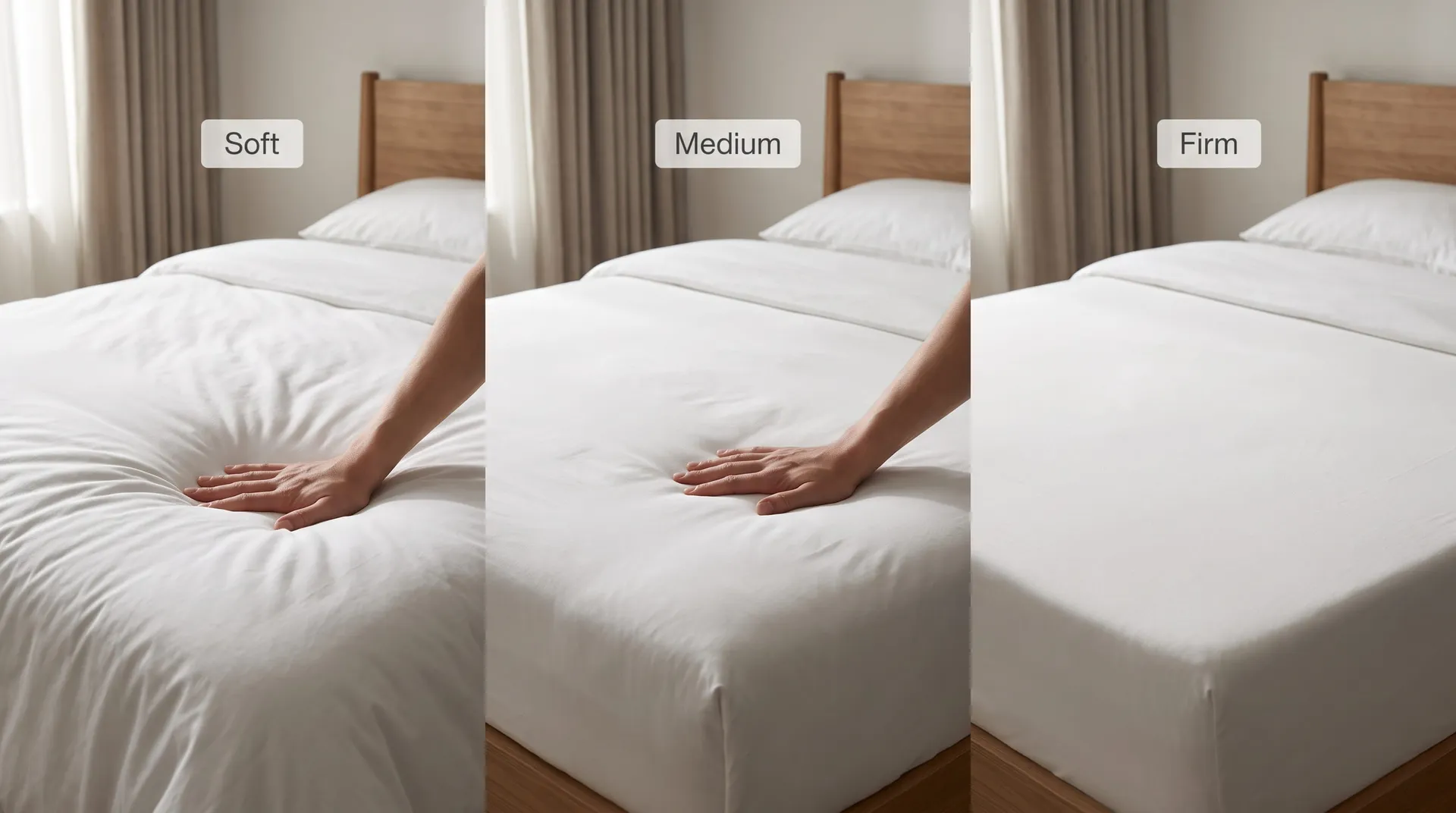
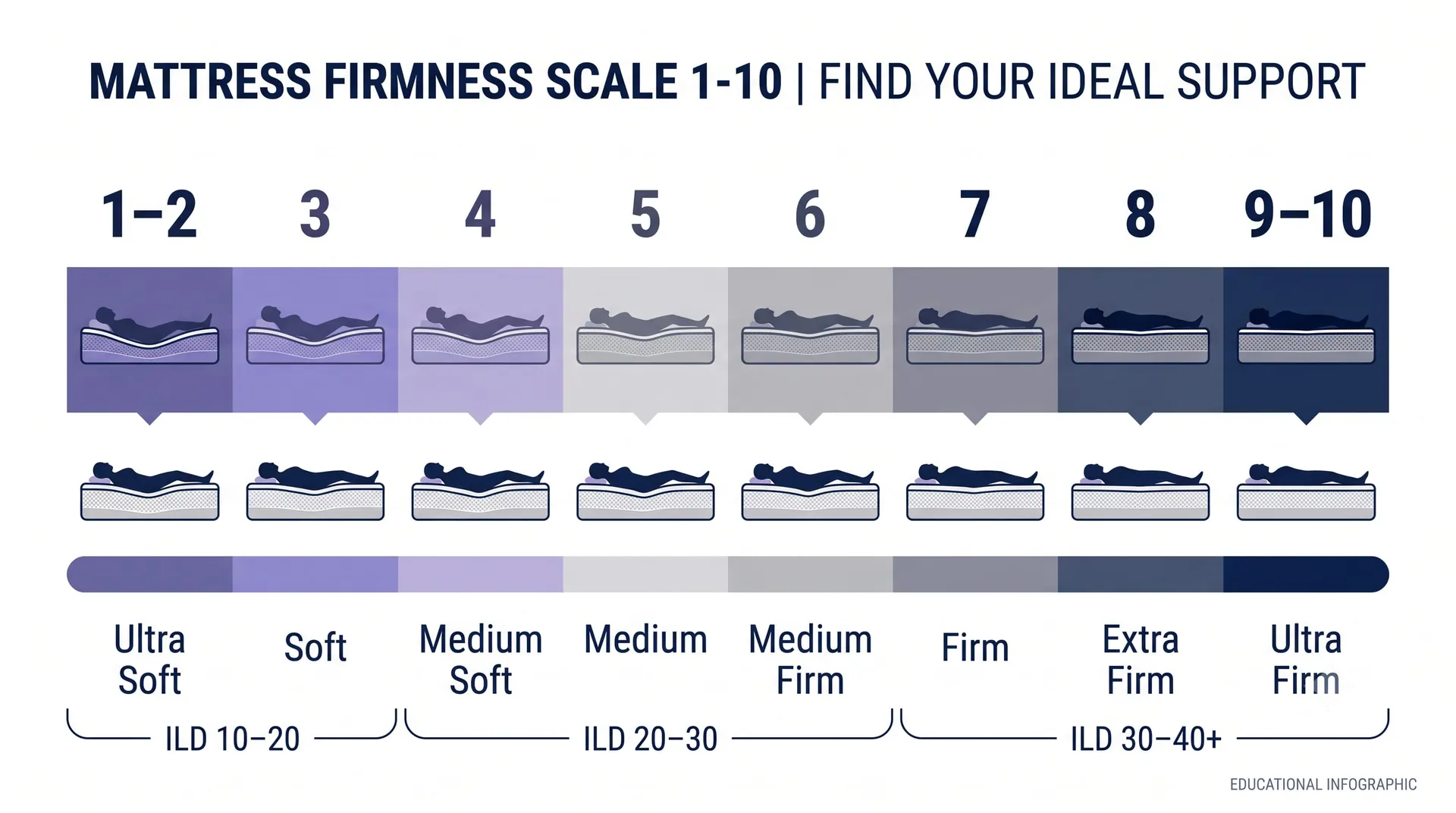
The mattress industry uses a 1–10 firmness scale to describe how a mattress feels underfoot — or more precisely, how much it resists your body weight. Here is how to read it:
| Scale | Label | What It Feels Like |
|---|---|---|
| 1–2 | Ultra Soft | Cloud-like sinkage; very rare, typically medical-use only |
| 3 | Soft | Deep contouring; significant body sinkage |
| 4 | Medium Soft | Gentle cradling; moderate sinkage at hips and shoulders |
| 5 | Medium | Balanced; some contouring with moderate pushback |
| 6 | Medium Firm | Supportive with light contouring; the most common "standard" feel |
| 7 | Firm | Minimal sinkage; strong support throughout |
| 8 | Extra Firm | Very little give; you sleep "on" the mattress, not "in" it |
| 9–10 | Ultra Firm | Rigid feel; typically used for specific medical or therapeutic needs |
Most mattresses sold commercially fall between 3 and 8 on this scale. The sweet spot for the widest range of sleepers is 5–7 (medium to medium-firm), which is why you see those labels everywhere.
Important caveat: The scale is not standardized across brands. A "6/10 medium-firm" at one manufacturer may feel like a "7/10 firm" at another. Always read third-party reviews and look for ILD (Indentation Load Deflection) ratings — the actual measurement of foam resistance — when they are available.
What Is ILD?
ILD (Indentation Load Deflection) is the objective measurement behind the subjective firmness label. It measures the pounds of force required to compress a foam layer by 25% of its thickness using a 50 square inch circular disc.
- Low ILD (10–20): Soft foam — deep contouring, significant sinkage
- Medium ILD (20–30): Medium foam — balanced support and pressure relief
- High ILD (30–40+): Firm foam — strong resistance, minimal sinkage
When a manufacturer provides ILD data for their foam layers, you can compare mattresses objectively rather than relying on brand-specific "medium" labels. Most premium brands publish this; budget brands rarely do.
Sleep Position and Firmness: What the Research Says
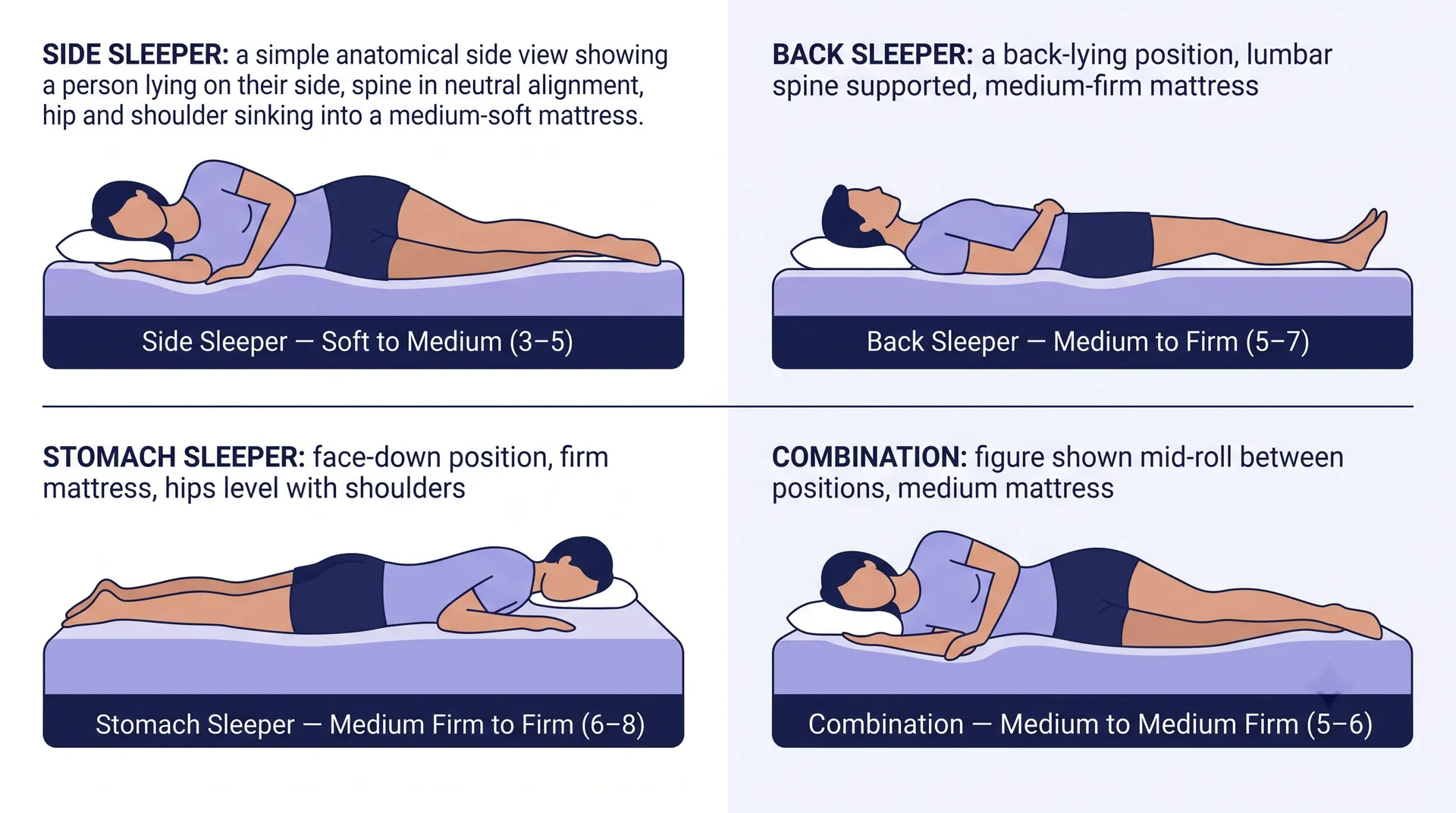
Sleep position determines where your body puts pressure on the mattress and which areas need cushioning versus support. It is the most commonly cited firmness factor — and for good reason.
Side Sleepers
Side sleeping concentrates your body weight at two contact points: the hip and the shoulder. These are the two most prominent bony areas on the side-lying body, and they create significantly higher pressure than the rest of the contact surface.
If a mattress is too firm for a side sleeper, the hip and shoulder cannot sink in enough. The spine is pushed into lateral flexion (side-bend) rather than kept in neutral alignment. The shoulder absorbs direct pressure that can cause discomfort, numbness, or the "dead arm" feeling you sometimes wake up with.
Recommended firmness for side sleepers: 3–5 (Soft to Medium)
The softer end of this range allows the hip and shoulder to sink in proportionally — enough to keep the spine in a straight, neutral line from the neck down through the lower back.
Note: heavier side sleepers (230+ lbs) should adjust upward — see the weight section below.
Back Sleepers
Back sleeping distributes weight more evenly than side sleeping. The contact surface is larger (head, shoulders, upper back, lumbar spine, hips, thighs, calves), so peak pressure at any single point is lower.
The critical concern for back sleepers is lumbar support. If a mattress is too soft, the hips sink further than the shoulders, creating a hammock-like curvature that hyperextends the lumbar spine. This is the most common cause of mattress-related lower back pain.
If a mattress is too firm, the lumbar spine has no support at all. The natural inward curve of the lower back (lumbar lordosis) is suspended in air above the mattress surface, leaving no support through the night.
Recommended firmness for back sleepers: 5–7 (Medium to Firm)
The right mattress for a back sleeper fills the lumbar curve rather than letting it collapse or float.
Stomach Sleepers
Stomach sleeping is the most demanding position from a spinal alignment standpoint. When lying face-down, the lumbar spine naturally hyperextends (arches downward) as the abdomen and pelvis sink into the mattress. On a soft mattress, this hyperextension is severe and sustained throughout the night — the primary mechanism behind chronic lower back pain in stomach sleepers.
A firm mattress minimizes pelvic sinkage, keeps the spine flatter, and reduces lumbar stress.
Recommended firmness for stomach sleepers: 6–8 (Medium Firm to Firm)
Stomach sleepers should generally go firmer than any other position, particularly as body weight increases.
Combination Sleepers
Combination sleepers — those who shift between two or more positions during the night — need a mattress that performs acceptably across multiple positions rather than perfectly in one.
Recommended firmness for combination sleepers: 5–6 (Medium to Medium Firm)
The medium to medium-firm range is the best compromise. It's firm enough to support back sleeping and cushioned enough for some pressure relief on your side, but not so soft that stomach-sleeping moments cause alignment problems.
Responsiveness matters for combination sleepers too. A mattress that responds quickly when you reposition (hybrid or latex construction) is more practical than a slow-contouring memory foam that holds your body shape after you move.
Body Weight and Firmness: The Missing Variable
Here is what most mattress guides skip: the same mattress feels different to people of different weights.
A mattress rated 6/10 medium-firm compresses more under 280 lbs than under 140 lbs. The foam layers respond to force — and a heavier body applies more force. This means a "medium-firm" mattress may feel genuinely firm to a lightweight sleeper and genuinely medium to a heavier sleeper on exactly the same product.
This is not a flaw — it is physics. But it means firmness recommendations must always be read with body weight in mind.
Weight-Adjusted Firmness Guide
| Body Weight | Side Sleeper | Back Sleeper | Stomach Sleeper |
|---|---|---|---|
| Under 130 lbs | 2–4 (Soft) | 4–5 (Med Soft–Med) | 5–6 (Med–Med Firm) |
| 130–180 lbs | 3–5 (Soft–Med) | 5–6 (Med–Med Firm) | 6–7 (Med Firm–Firm) |
| 180–230 lbs | 4–6 (Med Soft–Med Firm) | 6–7 (Med Firm–Firm) | 7–8 (Firm) |
| 230–300 lbs | 5–6 (Med–Med Firm) | 6–7 (Med Firm–Firm) | 7–8 (Firm) |
| 300+ lbs | 6–7 (Med Firm–Firm) | 7–8 (Firm) | 8 (Firm–Extra Firm) |
How to use this table: Find your weight row and sleep position column. The number range is your adjusted firmness target — not the standard recommendation for your position alone.
Example: A 260-lb side sleeper should not follow the standard "soft to medium (3–5)" side-sleeping advice. At that weight, a soft mattress will allow excessive hip sinkage and spinal misalignment. A medium-firm (5–6) is the appropriate target.
How Mattress Type Affects Perceived Firmness
The material a mattress is made from affects how its firmness feels in practice — even at the same ILD rating.
Memory Foam
Memory foam compresses slowly and conforms closely to body shape. This close contouring can make a memory foam mattress feel softer than its ILD rating suggests. The surface adapts to fill every curve, which reduces the feeling of resistance even on firmer versions.
Memory foam also retains heat, which can slightly alter the feel — foam softens in warmer temperatures, meaning a memory foam mattress may feel slightly softer in summer.
Practical implication: If choosing memory foam, consider going one step firmer than your target. A medium-firm memory foam often performs more like a medium in practice.
Latex
Latex foam has a faster, more buoyant response than memory foam — it pushes back rather than conforming. This makes latex feel firmer than an equivalent ILD memory foam, and it means latex mattresses provide more immediate support for position changes.
Practical implication: If choosing latex, the ILD rating is a closer match to actual felt firmness than with memory foam.
Innerspring / Hybrid
Coil-based mattresses (innerspring or hybrid) have a more surface-level feel — the coils provide immediate pushback rather than the slow-conforming character of foam. This makes them feel firmer and more responsive than foam mattresses at equivalent comfort layer depths.
The comfort layer on top of a hybrid mattress (foam, latex, or pillow-top) determines the surface feel; the coil system provides the underlying support. A hybrid can combine a softer surface feel with firm underlying support — an advantage for side sleepers who need pressure relief but still require structural support.
Practical implication: Hybrid mattresses tend to "feel" their stated firmness more accurately than pure foam alternatives.
Firm vs Soft: What Each Actually Does to Your Body
What a Soft Mattress Actually Does
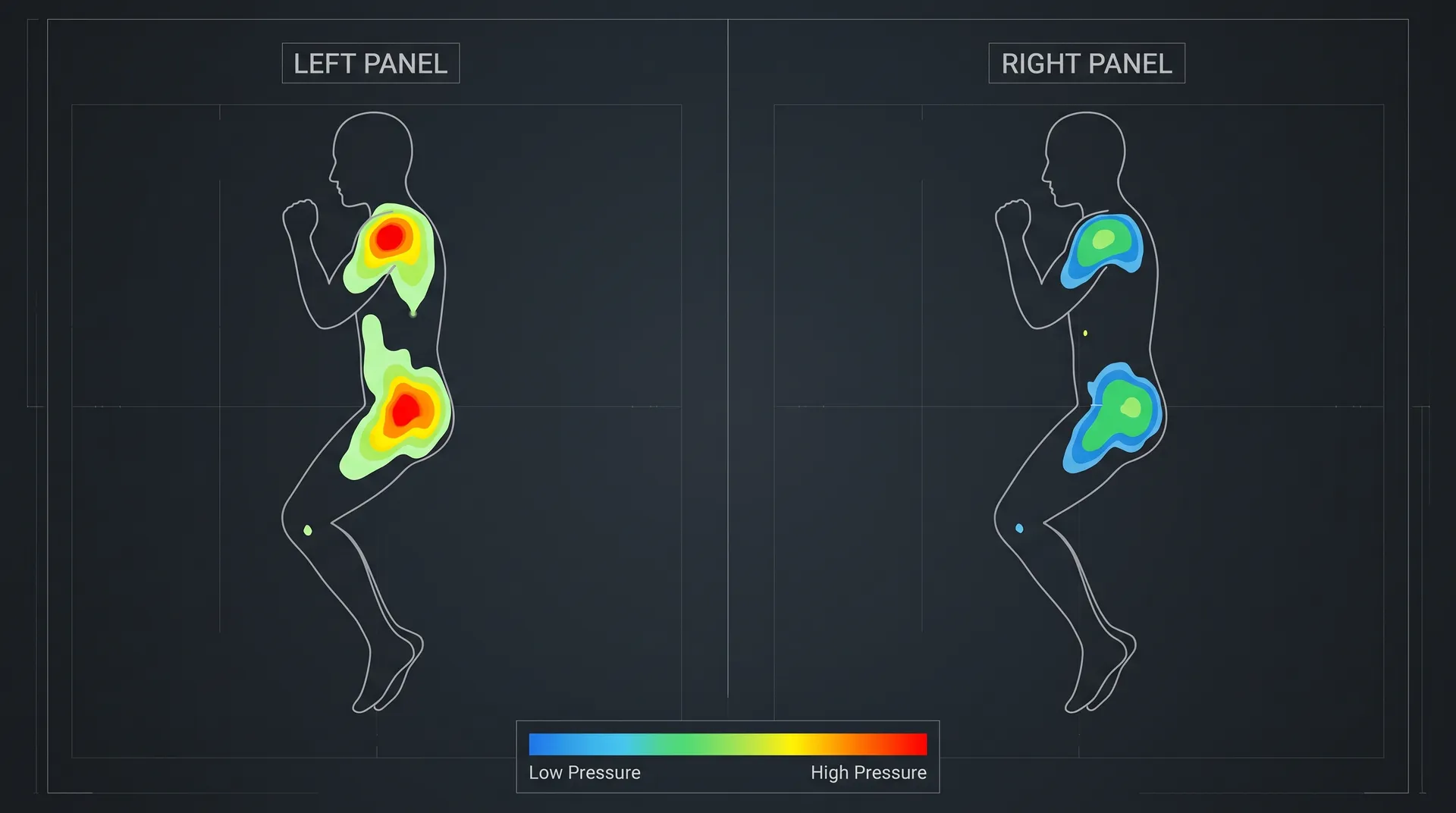
A soft mattress allows the heaviest parts of your body — typically the shoulders and hips — to sink deeper into the comfort layer. This distributes your body weight across a wider surface area, which reduces peak pressure at any single contact point.
Where a soft mattress genuinely helps:
- Side sleepers — the shoulder and hip need to sink in enough to keep the spine in a straight horizontal line. Without adequate sinkage, the spine bows and creates pressure points.
- Lighter-frame sleepers (under 130 lbs) — a lighter body does not compress a firm surface enough to relieve pressure naturally, so a softer surface is needed to achieve the same effect.
- Sleepers with shoulder or hip pressure sensitivity — conditions like arthritis or bursitis benefit from the reduced peak pressure a soft surface provides.
Where a soft mattress causes problems:
- Stomach sleepers — a soft surface lets the hips sink deeper than the chest, forcing the lower back into hyperextension.
- Heavier sleepers (over 230 lbs) — a soft comfort layer bottoms out under higher body weight, effectively becoming a firm surface anyway, but without the structural support underneath.
- Back sleepers with lumbar pain — excessive softness can allow the hips to sink too far, pulling the lumbar spine out of neutral alignment.
What a Firm Mattress Actually Does
A firm mattress resists sinkage, keeping the body's weight distributed across the surface rather than allowing deep contouring at any point. The body rests more "on top of" a firm mattress than "inside" it.
Where a firm mattress genuinely helps:
- Stomach sleepers — the hips stay level with the chest and shoulders, preventing the lumbar hyperextension that soft surfaces cause in this position.
- Heavier sleepers (over 230 lbs) — a firm support structure resists sinkage under higher sustained weight, preventing the "bottoming out" that undermines a soft mattress at higher body weight.
- Back sleepers who prefer minimal contouring — some back sleepers find a firmer surface keeps the lumbar curve supported without feeling like they are sinking into the mattress.
Where a firm mattress causes problems:
- Side sleepers — the shoulder and hip cannot sink in, creating concentrated pressure at those joints. This is the most common cause of the "numb arm" complaint from side sleepers on overly firm mattresses.
- Lighter-frame sleepers — insufficient body weight to compress a firm surface at all, meaning zero pressure relief regardless of sleep position.
- The persistent myth that firm is always better for back pain — research does not support this broadly. A widely cited randomised trial (Kovács et al., The Lancet, 2003) found medium-firm mattresses outperformed firm mattresses for chronic low back pain outcomes.
Choosing Firmness as a Couple
Couples sharing a mattress face the challenge of potentially different firmness needs — different sleep positions, different body weights, or simply different comfort preferences.
When You Have Similar Preferences
If both partners sleep in the same position or have similar body weights, a single mattress in the appropriate firmness range for both works well. Medium-firm (6/10) is the most statistically likely sweet spot for couples with overlapping but not identical preferences.
When You Have Different Preferences
If one partner is a side sleeper who needs soft and the other is a back sleeper who needs firm, the options are:
Option 1 — Compromise on Medium (5–6). Not perfect for either partner but acceptable for both. Works best when the difference in preference is not extreme.
Option 2 — Split King with dual firmness. Two Twin XL mattresses placed side by side allow each partner to choose their own firmness entirely. This is the only option that genuinely solves strongly incompatible preferences. It does require a split king bed frame and two sets of bedding.
Option 3 — Zoned support mattress. Some mattresses use different firmness zones (firmer in the center/hip zone, softer at the shoulder zone) to serve multiple positions simultaneously. These can reduce the compromise needed for couples with different position needs.
Option 4 — Dual-sided mattresses. A small number of manufacturers offer mattresses with different firmness on each side — flip the mattress to access the other firmness level. Less common but available from some specialty brands.
How to Use Your Sleep Trial to Confirm Firmness
Most quality mattresses now come with sleep trials of 100 nights or longer. Here is how to use that window intelligently:
Week 1–2: The adjustment period. Almost every new mattress feels different from your old one — sometimes dramatically so. Do not make any return or exchange decisions in the first two weeks. Your body needs time to adjust to a new sleep surface, and your perception of "too firm" or "too soft" often shifts significantly after the first week.
Week 3–6: The real assessment window. By week three, the initial adjustment is typically complete and you are sleeping on the mattress as it will actually feel long-term. Pay attention to:
- Morning back, hip, or shoulder pain that is new or worse than before
- Pressure point discomfort at hips or shoulders during the night
- Feeling of "bottoming out" (coil or base layer contact through the comfort layer)
- Feeling of being "on" the mattress rather than supported by it
Signs you need softer: Pressure point pain at the hip or shoulder (side sleepers), waking with numb arms or hands, feeling of sleeping "on top of" the mattress with no contouring.
Signs you need firmer: Lower back pain (back or stomach sleepers), feeling of hips sinking lower than shoulders, waking with the sensation of being "swallowed" by the mattress.
Week 7 onward: If you have concerns, contact the retailer before the sleep trial window closes. Most trials allow one exchange for a different firmness level within the trial period — this is exactly what they exist for.
Mattresses From Our Reviews and Their Firmness Profiles
Here is how the mattresses we have tested in our lab slot into the firmness spectrum:
| Mattress | Type | Firmness (1–10) | Best For | Buy |
|---|---|---|---|---|
| DreamCloud Classic | Hybrid | 6.5 — Medium Firm | Back sleepers, heavy combination sleepers | Amazon → |
| Leesa Original Hybrid 11" | Hybrid | 6.5 — Medium Firm | Back and stomach sleepers, hot sleepers, strong edge support | Amazon → |
| Glacier Original Hybrid | Zoned Hybrid | 6 — Medium | Back sleepers with lumbar-specific pain, combination sleepers | Amazon → |
| Purple Original | Foam (grid) | 5.5 — Medium | Side sleepers, hot sleepers, most positions | Amazon → |
| Nectar Classic | Memory Foam | 6 — Medium Firm | Back sleepers, 130–230 lbs | Amazon → |
| Sweetnight CoolNest | Hybrid | 5.5 — Medium | Side and back sleepers, hot sleepers | Amazon → |
| Vibe Quilted Hybrid | Hybrid | 6 — Medium Firm | Back sleepers, budget hybrid buyers | Amazon → |
| Naturepedic Serenade | Hybrid | 5 — Medium | Side sleepers, organic-focused buyers | Amazon → |
| Brooklyn Bedding Plank Firm Luxe | Hybrid | 8–9 — Firm to Extra Firm | Stomach sleepers, heavier frames, orthopedic firmness needs | Amazon → |
| Saatva Natural Latex Topper | Latex Topper | Adjustable | Adds softness layer over existing firm mattress | Amazon → |
The Saatva Natural Latex Topper deserves a special mention here. If your mattress is slightly too firm but otherwise performs well, a quality latex topper can shift the felt firmness down by 1–2 points without replacing the entire mattress.
Research and Sources
Our picks come from our own hands-on testing. The guidance on firmness, sleep position and health in this guide is checked against these sources:
- Kovacs et al., The Lancet (2003) — randomised, double-blind trial of 313 adults with chronic low back pain: after 90 days, people on medium-firm mattresses reported less pain in bed and less disability than those on firm mattresses.
- Radwan et al., Sleep Health (2015) — systematic review of 24 controlled trials: medium-firm and self-adjusted (custom-inflated) mattresses were best for sleep comfort, sleep quality and spinal alignment.
- Caggiari et al., Journal of Orthopaedics and Traumatology (2021) — review of 39 studies concluding that a medium-firm mattress promotes comfort, sleep quality and spinal alignment.
Frequently Asked Questions
What firmness is best for most people?
Medium-firm (6/10) is the most versatile firmness level and suits the widest range of sleepers. It provides enough resistance for back sleeping alignment while offering enough surface cushioning for side sleeping comfort at average body weights (130–200 lbs). If you have no strong preference or sleep in multiple positions, medium-firm is the safest starting point.
Can a mattress that is too firm cause back pain?
Yes. An overly firm mattress causes two types of back pain. For side sleepers, hip and shoulder pressure forces the spine into lateral misalignment. For back sleepers, the lumbar spine's natural curve is unsupported (suspended in air above the surface), putting chronic strain on the lumbar muscles and discs. If you wake with new or worsening lower back pain after switching mattresses, firmness (or lack of lumbar fill) is the most likely cause.
Does firmness change over time?
Yes. Most mattresses soften over time as foam layers compress and lose their original resilience. This process is gradual, typically 1–2 firmness points over 5–7 years. But it means a mattress that felt ideal at purchase may feel noticeably softer after a few years. Higher-density foam and latex materials resist this compression longer than low-density foam.
Is a firm mattress better for your back?
Not universally. A 2003 randomised trial in The Lancet (Kovács et al.) found that medium-firm mattresses produced significantly better outcomes for chronic lower back pain than firm mattresses. The research challenged the long-standing assumption that firmness equals spinal health. For most back pain sufferers, medium-firm (5–6) is a better target than firm (7–8) unless stomach sleeping demands it.
What firmness is best for side sleepers with hip pain?
Hip pain in side sleepers is almost always related to insufficient pressure relief. The hip bone (greater trochanter) is the primary contact point and needs to sink into the mattress rather than rest on top of it. A soft to medium firmness (3–5) with good pressure-relief properties (memory foam or latex comfort layer) is the appropriate choice. If you are a heavier side sleeper (230+ lbs), move up to medium (5) to prevent excessive overall sinkage while still allowing hip relief.
How do I know if my current mattress is too soft or too firm?
Too soft: you wake with lower back pain, feel like you're sinking into the mattress, or find it difficult to change positions at night. The mattress has visible body impressions even when unoccupied. Too firm: you wake with hip or shoulder soreness (especially as a side sleeper), feel pressure points during the night, or your lower back feels unsupported (floats above the surface as a back sleeper). In both cases, the sleep trial exchange window is the right next step if your mattress is relatively new.
What firmness should couples choose?
Medium-firm (6/10) is the most commonly satisfying compromise for couples with different preferences. Sometimes the gap in preference is large: one partner needs soft for side sleeping and the other needs firm for stomach sleeping. In that case, a Split King (two Twin XL mattresses) is the only solution that fully satisfies both needs without compromise. Heavier sleepers should also see our dedicated Best Mattress for Heavy People guide, since firmness needs shift meaningfully above 230 lbs.
What firmness is best for sciatica or nerve pain?
Sciatica typically responds best to a slightly softer target than general back pain: medium to medium-soft (4–6/10) rather than medium-firm. The hip needs real cushioning to relieve direct pressure on the sciatic nerve, not just spinal support. See our dedicated Best Mattress for Sciatica guide for a full firmness breakdown by sleep position and body weight.
Related Guides
More on learn the basics
- How to choose a mattress
- Size chart
- King vs queen
- How long a mattress lasts
- Cleaning a mattress
- Noisy mattress fixes
- Disposing of a mattress
- CertiPUR-US explained
- Hybrid vs memory foam
- Latex vs memory foam
- Nectar vs Purple
- Nectar vs DreamCloud